Komati Power Station decommissioned after serving for 60 years. The shutdown took place on 31 October 2022. The power plant will be converted into a renewable generation site powered with 150MW of solar, 70MW of wind and 150MW of storage batteries.
“I’m appealing that please don’t use South Africa as an example on how the just transition is being done. That has nothing to do with just transition. We only came to know about it when we couldn’t put food on our table.”
These stark words from Malaka George Mpe at last year’s 30th annual UN climate summit (COP30) in Brazil capture the harsh reality facing communities around South Africa’s decommissioned Komati Power Station.
What should have been a model for climate action has become a cautionary tale of what happens when communities are excluded from decisions that reshape their lives.
When the power station closed its doors in 2022 after 60 years of operation, nobody expected to wake up one day with an evaporated economic value chain. Everything came to an abrupt stop. For communities that had built their existence on the coal value chain, the closure wasn’t just about lost jobs; it was about lost futures.
“In the middle of all this confusion, we were not aware that this was going to come to us. No proper engagement was done to prepare the community for what was coming. We could have prepared people ahead of time. We were left in the dark,” Mpe said.
The Komati situation reveals a flaw in South Africa’s approach to the energy transition, critics say. While civil society organisations celebrated cutting emissions and shutting down power stations, communities bore the brunt of job losses, with no Plan B in place.
“Let’s talk about Komati,” said climate activist Errol Mlambo of EarthLife Africa. “We think about a coal power station which took about 60 years to be decommissioned in a community where there are people. We are having this conversation as if it was a surprise.
“When the decision was made, there was no succession plan in place because that’s how decision makers view communities … We are left behind and it seems deliberate because I cannot accept myself as part of civil society after 60 years and on the eve of decommissioning of a power station, people are without jobs.”
Mpumalalanga generates 50% of South Africa’s greenhouse gas emissions, with 11 power stations, among them the now-decommissioned Komati. All eyes were on the province to respond to climate change first.
“When we were looking at the just transition, we looked at climate change. We didn’t want to separate the two, because [the] just transition is embedded in climate change,” said Dudu Sibiya from the Mpumalanga provincial government. “At the same time, we were not looking at the community level.”
Only after the Komati closure did the government and organisations scramble to respond, activists say. The Presidential Climate Commission and other departments helped establish a community representative mechanism. This led to the Komati community connecting with Indalo Inclusive, a not-for-profit company that promotes economic activity.
This brought in a social employment fund through the Industrial Development Corporation, which absorbed about 30 young people into a one-year programme, providing monthly stipends.
But the intervention came too late to prevent the hardships and undesirable social behaviour that emerged when people did not know where their future lay. Historically, South Africa has been heavily reliant on the coal value chain that kept economies active. When mines and power stations close simultaneously, communities collapse.
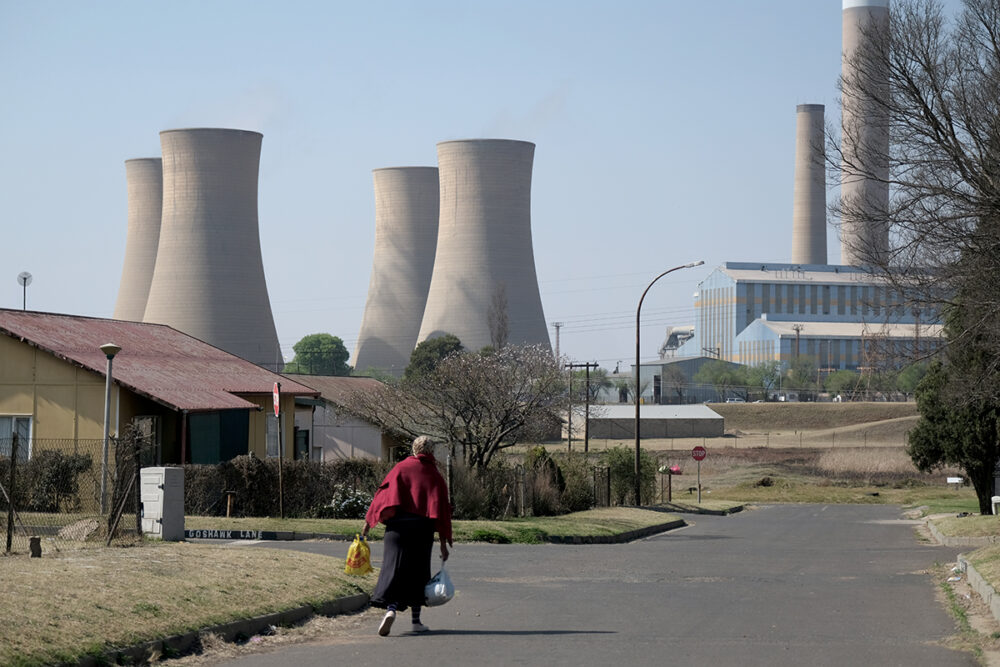 A woman walks in the streets of Komati, a few kilometres from Komati Power Station. While, the Komati Repowering and Repurposing project is aimed at supporting the local economy and
livelihoods, residents of Komati say they have been excluded from mining activities.
A woman walks in the streets of Komati, a few kilometres from Komati Power Station. While, the Komati Repowering and Repurposing project is aimed at supporting the local economy and
livelihoods, residents of Komati say they have been excluded from mining activities.
Learning through listening
When Shamila Reid and her team from Indalo Inclusive arrived in Komati in January 2025, they were hesitant.
“It felt messy. We wanted to know whether we would add value and what sort of need existed for the type of work we do,” Reid said. “When we got to Komati, the community told us to leave the venue. One thing that surprised me was that Komati community members knew very little about the energy transition.”
There was also significant misinformation about why the power station was closing. Indalo Inclusive’s approach was to conduct focus group discussions, set up based on gender and age, to understand people’s different realities.
The findings revealed the personal effects of the transition. Men felt emasculated after losing their jobs and no longer being providers for their families. Women felt technical skills were given to men while they were undermined and pushed into caregiving roles.
The elderly felt just transition opportunities were for young people and they lacked digital skills to access information. The youth felt excluded from decision-making and leadership roles.
Climate activist Karabo Mokgonyana, who also attended COP30, posed this challenge: “How can we move away from this narrative that communities are consistently recipients, the ones always at the receiving end of just transition?”
She called for a community and worker-led just transition, saying this was not happening in South Africa where communities waited for the government, private sector and organisations for implementation.
“There are conversations currently taking place in the community, realising past mistakes. Waiting until the last minute to resolve problems is a recipe for disaster. Lack of consultation is basically the greatest of them all,” Mlambo emphasised.
Mpe adds a crucial clarification: power stations weren’t being closed to address climate change. “Komati, while in the process of closing down, the concept of renewable energy transition came into play at the tail end of closing the power station.”
Since Eskom started switching off generators as early as 2017, just transition frameworks came far too late. “We wish we knew this 10 years ago. Things would be different today,” Mpe reflected.
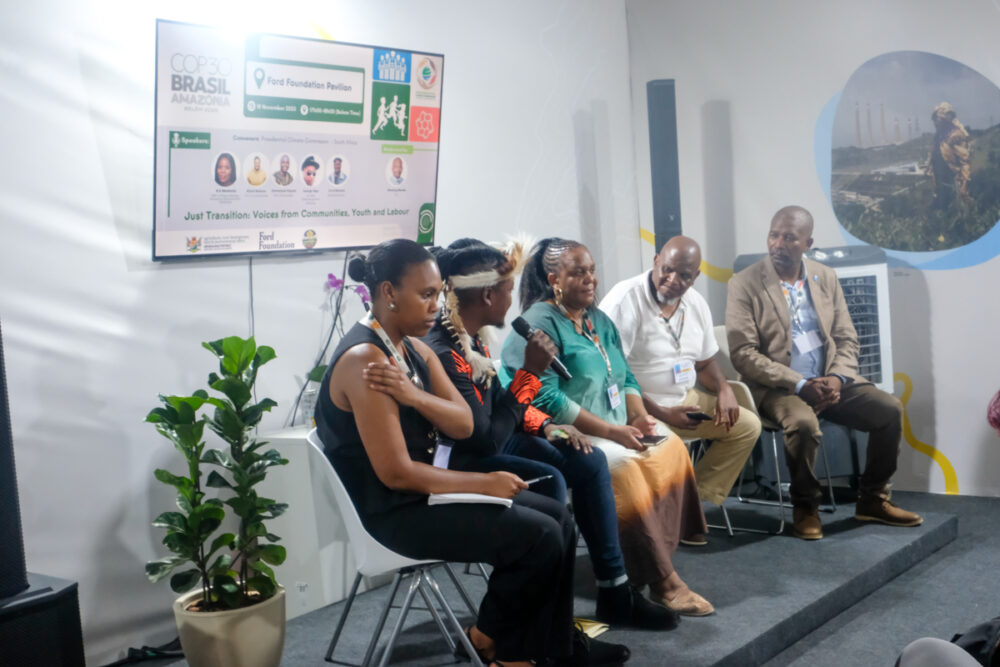 The Presidential Climate Commission convened a panel discussion at the Ford Foundation Pavilion in Bélem, Brazil on 18 November 2025. The panellists included representatives from the Mpumalanga provincial government, EarthLife Africa, Indalo Inclusive and the PCC. The lessons learnt from the decommissioning of the Komati Power Station was at the centre of the discussion.
The road ahead
As South Africa prepares to decommission more power stations, the Komati experience offers essential lessons. Social Labour Plans, supposedly designed to ease transitions, often don’t materialise. Procedural justice and leaving no one behind require more than good intentions; they demand genuine succession planning.
“If you think about the just transition in terms of getting net zero by 2050-2060, less is said about implementation. How do we prepare the workers for the future?” Mlambo asks.
Communities need skills development and learners need educational preparation.
South Africa attended the crucial COP30 talks, without ministerial representation after Environment, Forestry and Fisheries Minister Dion George was fired during the conference. Yet communities, youth and labour representatives ensured their voices were heard.
Their message is unambiguous: the just transition cannot be imposed from above. It requires prior education, meaningful consultation, co-creation with communities and understanding that behind every statistic about emissions and employment lies a human being asking where their next meal will come from.
As other coal-dependent regions worldwide contemplate similar transitions, Komati stands as a warning, an opportunity and a chance to learn from mistakes and put communities at the centre of climate action.