


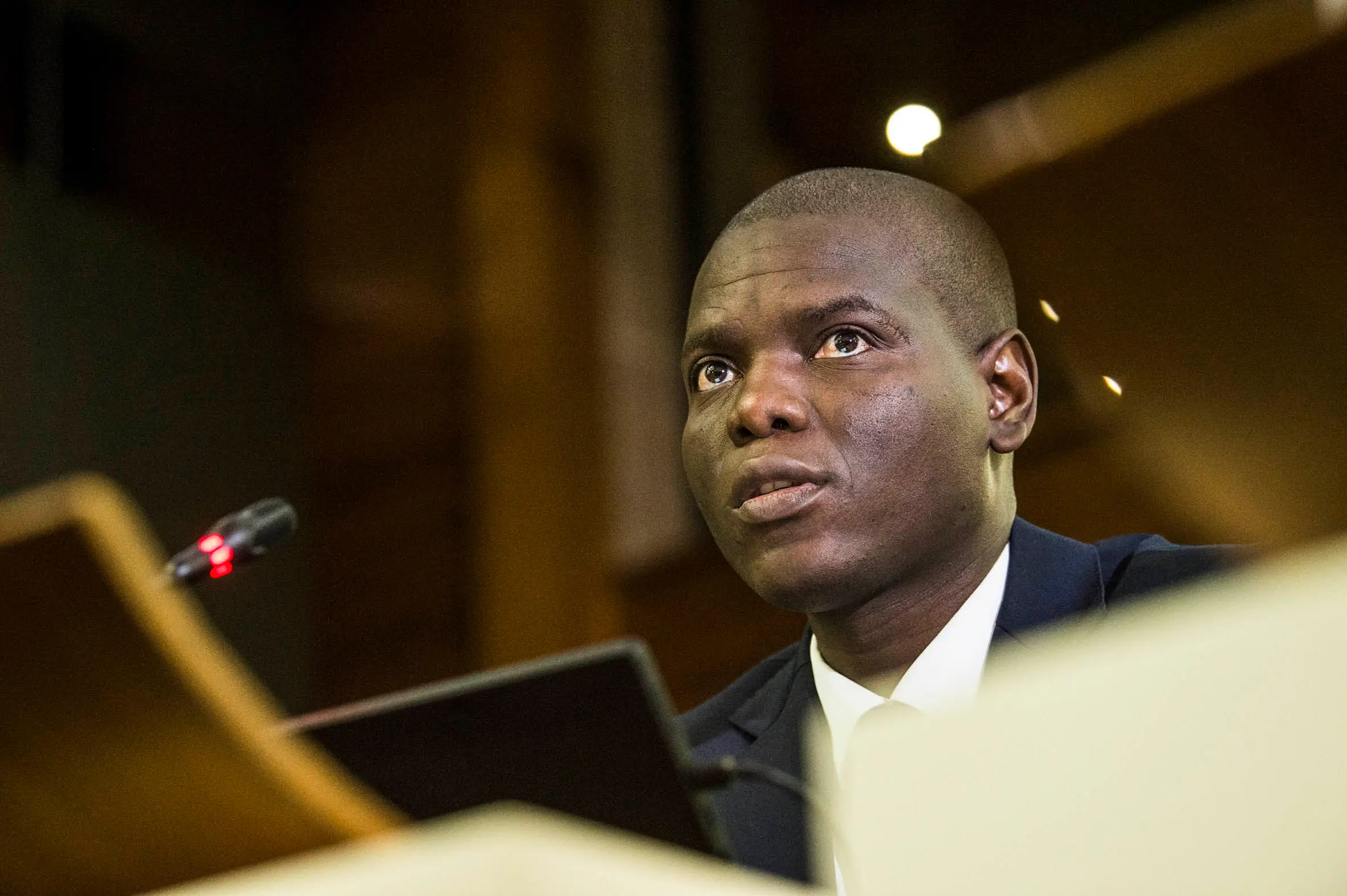
The Minister of International Relations and Cooperation, Ronald Lamola, was on Monday cross-examined on the 76th day of the Truth and Reconciliation Commission (TRC) Cases Inquiry in Johannesburg by Advocate Howard Varney, counsel for the Calata and other families, about his tenure as Minister of Justice and Constitutional Development between 2019 and 2024.
Varney began by commending Lamola’s tenure as Justice Minister, noting that significant progress had been made in advancing TRC-related cases during his administration. The Commission has also acknowledged that greater progress was achieved during Lamola’s tenure.
During his previous testimony last week, Lamola told the Commission that he had focused his efforts on ensuring that the National Prosecuting Authority (NPA) had the necessary resources to investigate and prosecute TRC-related matters.
He was referring to several key cases that resulted in landmark judgments, including those involving Ahmed Timol, the Cradock Four, Chief Albert Luthuli, Griffiths Mxenge, Neil Aggett and Hossen Haffajee.
Lamola conceded that when he assumed the Justice Ministry, he was briefed by the National Director of Public Prosecutions (NDPP) about the challenges confronting the NPA’s TRC unit.
The Commission, chaired by Justice Sisi Khampepe, was established following a letter sent to President Cyril Ramaphosa in early 2019 by the Foundation for Human Rights (FHR), which called for investigations into suspicions of political interference in the prosecution of TRC-related cases.
During his tenure, Lamola deployed his then-deputy minister, John Jeffery, to engage with the families of victims. Lamola said he also met and engaged directly with some families on an informal basis, including the families of the Cradock Four - Matthew Goniwe, Fort Calata, Sparrow Mkhonto and Sicelo Mhlauli. However, he could not recall the exact dates of these engagements, although he indicated that some may have taken place during the Covid-19 pandemic.
The inquiry also heard about a memorandum allegedly written by the NDPP and addressed to the Chief Justice, calling for the appointment of a retired judge to head a commission of inquiry into the factors contributing to delays in the prosecution of TRC-related cases. The proposed commission, however, never materialised.
Lamola said the government was facing significant budgetary constraints at the time, partly as a result of the economic consequences of State Capture and the Covid-19 pandemic.
He maintained that the NPA had a duty and responsibility to investigate and prosecute matters arising from the TRC process, adding that the prosecuting authority was empowered to deal with these cases.
Lamola also acknowledged that some families of the victims were unhappy with the decentralisation of TRC cases but said he believed the process was the best way forward. This became one of the contentious matters among the NPA, ministers and families, according to Lamola.
Initially, the cases were handled centrally at the NPA’s head office before being decentralised to various provinces and placed under the authority of Directors of Public Prosecutions (DPPs).
Responding to a question about complaints concerning the poor standard of investigations, Lamola said he could not recall ever complaining about the quality of the investigations.
“We supported the NPA to work with the Hawks (Directorate for Priority Crime Investigation),” he said.
The Ahmed Timol inquest became a central focus of the cross-examination. Lamola explained that the Justice Ministry took some time to respond following the landmark judgment in the case because it had anticipated that Joao Rodrigues would appeal the ruling.
Rodrigues died in 2021 before he could stand trial after failing in his attempts to secure a permanent stay of prosecution. His application was dismissed by the South Gauteng High Court in 2019 and subsequently by the Supreme Court of Appeal (SCA) in 2021.
The Commission prevented Lamola from commenting on the NDPP’s memorandum, which had been sent to the Minister in preparation for a question-and-answer session in Parliament, because the document had not been furnished to him.
According to Varney, the NPA’s memorandum acknowledged that there had been an unwillingness or internal obstruction to prosecuting some of the TRC-related cases.
“What would be the import of putting the questions arising from the memo that was not received by the witness. The evidence has not been placed before us,” Commission chairperson, Khampepe, said.
Advocate Varney did not have the memo either and appealed to the commission to locate the memorandum.