65-year-old Fikile Ntshangase was a leading member of the Mfolozi Community Environmental Justice Organisation (MCEJO) was murdered last Thursday. She was a vocal opponent of plans to extend Somkhele coal mine, one of South Africa’s largest open coal mines, situated on the border of iMfolozi-Hluhluwe Game Park in northern KwaZulu-Natal. (Photo: Oupa Nkosi)
Terrified women and children flee their homes every night as fears of being assassinated grip Somkhele in KwaZulu-Natal.
This terror follows last Thursday’s gunning down of Fikile Ntshangase, 63, who was shot six times and killed inside her home in Ophondweni Village while her 13-year-old grandson played outside with two of his friends, metres away from the gruesome death.
 Place of mourning: The home where environmental activist Fikile Ntshangase was killed last week while children played outside. (Oupa Nkosi/M&G)
There is also an alleged hit list, with the names of staunch anti-mining activists.
Ntshangase was the deputy chairperson of the Mfolozi Community Environmental Justice Organisation (Mcejo) and was described as a fierce opponent of the expansion of operations by Tendele Coal Mining — the owner of Somkhele mine in the area.
Jan du Preez, the chief executive of Petmin, which owns Tendele, has been accused of having “blood on his hands” after an ominous message he sent last month as motivation for 19 families to vacate their land and make way for the mine’s expansion.
Du Preez has denied the claims that he has blood on his hands.
Nineteen families, as well as Mcejo activists, stand between the expansion of Tendele, which has an annual revenue of $129.76-million (or about R2.1-billion) and a licence that covers more than 22 000 hectares.
Ominous messages
Du Preez’s message, which the Mail & Guardian has seen, warns of possible violence should the 19 families and Mcejo activists continue objecting to Tendele’s operations. “The key thing is that the [department of mineral resources] minister [Gwede Mantashe] and the [KwaZulu-Natal] premier [Sihle Zikalala] and everyone realises that they cannot allow the mine to die. Unheard of! Everyone, including the Zulu king, is working together to try and save the mine,” Du Preez wrote last month.
“It is obvious that 19 families and the Mcejo organisation [are] probably less than 100 members out of a community of 220 000. Obviously, we [Tendele] and the task team are inviting everyone to try and find a solution to save the mine and to avoid violence.”
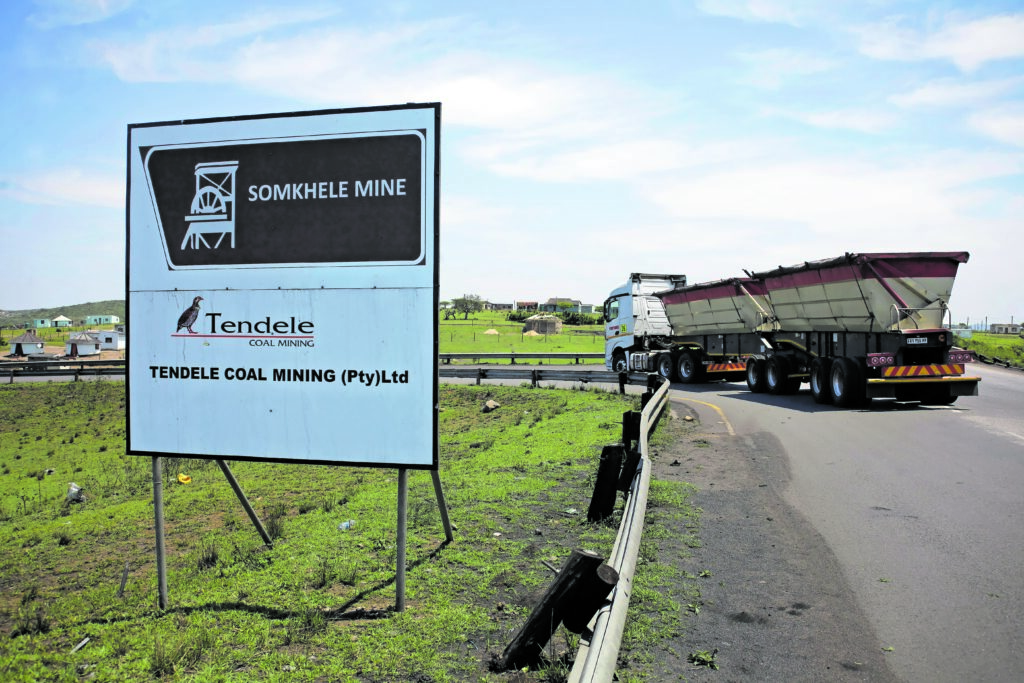 Fair compensation? Tendele Coal mine in Somkhele village in KwaZulu-Natal has been offering money to residents to encourage them to relocate to make way for the mine’s expansion. (Photo: Oupa Nkosi)
The recipients of the message asked to remain anonymous.
The aforementioned task team — consisting of Tendele and the national department of mineral resources as well as the royal council in KwaZulu-Natal — said in a joint statement sent to the M&G that its members were “saddened and concerned” about Ntshangase’s death, adding that they hoped “the perpetrators of this terrible crime will be brought to book”. The task team’s statement goes on to say that, through mediation, they hope to mine won’t close and that 1 600 jobs won’t be lost.
However, Ntshangase’s death was not the first act of violence. In April this year, 19 shots were fired at the home of Tholakele Mthethwa, another anti-mining activist, who was forced to take cover with her two-year-old granddaughter amid a hail of bullets raining down on them. No one was harmed. There have been no police leads regarding that attempted killing either.
In his response regarding the message warning of violence, Du Preez emphasised that he had been warning about it since September 2018.
“I was worried that if the mine closes, there will be violence. I have been warning about violence, in every letter to the community and our own employees,” Du Preez said.
“If the mine closes, 40 000 people will lose [either] a job, a contract, a training opportunity or food. I have been begging everyone involved to meet and mediate, as it is obvious that violence is a big risk.”
Du Preez added that the message he sent last month was not clandestine, and was in line with his open letters since September 2018. “There is zero proof as to the cause of the sad [and] senseless death. We are working with and assisting the police investigation. The mine and its people have not committed the crime,” he charged.
Hit-list fears
This spate of violence has elicited fears in the area, with the M&G being reliably informed about an alleged hit list targeting activists — spreading angst and panic throughout the serene and picturesque region, resplendent in its green rolling hills.
A petrified mother said she was aware that she and her son were on the kill list because of their vehement opposition to mining in the region.
The visibly shaken woman, who cried throughout her interview with the M&G, said the string of violent shootings in the area had forced her to rethink her obstinate opposition to the mining expansion.
“It is better for me to leave my home rather than die like Mrs Ntshangase. Had it not been for her death, as well as Mrs Mthethwa’s attempted murder, I would still be resolute and stay on my land.
“But now I fear for my life, which is in grave danger. Before nightfall, I have to leave with my children and grandchildren and seek refuge at neighbours’ homes because I know that I’m also on the hit list,” the woman said. “Mrs Ntshangase was killed while living with her grandchild. A hail of bullets flooded Mrs Mthethwa’s home with her two-year-old granddaughter in the house. None of us is safe.”
This was echoed by another family, whose members said they also had to seek protection elsewhere when night falls because, even though they didn’t know whether they would be next, the violence in the area against those opposed to mining necessitated precaution.
KwaZulu-Natal police spokesperson Colonel Thembeka Mbele only confirmed that Ntshangase “sustained multiple gunshot wounds” on October 22 and that a murder investigation was underway. Mbele did not respond to questions about how police would stem the violence and protect known anti-mining activists.
KwaZulu-Natal premier Sihle Zikalala said he was “deeply concerned” by Ntshangase’s death, and sent condolences to the family.
“We have instructed community safety MEC Bheki Ntuli to appoint investigators, who will leave no stone unturned in probing this murder. If, indeed, this was a planned hit, those who are responsible must be caught so that they can reveal their motive for this evil act, as well as who sent them, so that all the parties involved must face the music,” Zikalala said.
In response to questions from the M&G, the department of mineral resources and energy said that it condemned any act of violence: “We believe no investment is worth the loss of lives. We trust that the law enforcement agencies will investigate this matter and bring the perpetrators to book.”
Bribery allegations
At least four families, who are known to the M&G, allegedly received what they have termed as “bribes” of R100 000 each from representatives of Tendele in December 2018 to entice them and their neighbours to vacate their homes for mining purposes. However, none of the families had left the community.
“The plan was for the families to receive the money [R100 000] so that others could see that the mine was willing to pay big money for us to leave the area. The balance would be paid after the valuations were completed. But none of the families has left Ophondweni, even after they received their big payouts,” said a family representative who allegedly received the money.
Du Preez disputed that the money paid to the families was bribes, and said it was to assist with Christmas groceries and school uniforms, as part of signed relocation agreements.
“This [the allegation of bribery] is nonsense. We have signed agreements with 128 families. By December 2018, we only had a few agreements in Ophondweni, and a few desperate families needed some funds.”
He added that although the company had made loan agreements, stating that future payments would be received when all families had signed the relocation agreement, after a meeting with the department of mineral resources in January, the mine had decided to discontinue what it called “pre-payments” because “we have no idea whether there will be a relocation or not”.
The department said it is not aware of any allegations of bribery relating to this matter. “We urge all people with information of such allegations to report them to the law enforcement agencies,” it said in a statement to the M&G.
Relocation compensation
However, according to Tendele documents seen by the M&G, there is a host of financial plans breaking down how families the mine wants to be relocated would be compensated.
According to the documents, an independent valuation company estimated that families would be paid from R10 870 to more than R1.5-million.
The assessments encompassed values of the houses, rondavels and amaqhungwa (beehive-shaped huts) on a homestead to determine compensation.
An “upset allowance” would also be included for “psychological uncertainty of relocating to a new location”.
Customary rituals to move a homestead would be capped at R15 000 a homestead that would include a cow, a goat, a tent, groceries and other requirements. The value of a cow is capped at R9 000; a goat is R1 500.
The majority of the homesteads in the area have grave sites and Tendele said it was prepared to pay a cow, a goat and R5 000 for the relocation of the head of the household’s grave site and. Any other graves would be compensated at a rate of R4 000 plus a goat.
But one family rejected the grave relocation valuation, saying when they buried more than five elders on their homestead, each burial was accompanied by a goat and a cow. “They [Tendele] don’t count the groceries we bought for each funeral or the other costs.”
Du Preez said it was “nonsense” that the mine was compensating people less than R400 000 for them to relocate. “The lowest that any family will receive for legitimate houses is R400 000. I have declared this under oath in our application to ask the court to determine what is fair.
“All our agreements with people to be relocated have been negotiated with 100% locally based, locally born teams, and all negotiations are in isiZulu, and actual final agreements are in isiZulu and English,” Du Preez said, adding that the average payment was about R750 000.
Official assessment records from Tendele, which the M&G has seen, show that seven families could be offered less than the R400 000, with the lowest amount being R10 870. The other six sub-par amounts are: R26 000, R32 129, R44 645, R61 329 and R70 086.30.
Traumatised boys
Psychologists visited Ophondweni this week to assist Ntshangase’s 13-year-old grandson and his two friends, aged eight and 10, who had to endure the horrific experience of hearing screams and gunshots as the matriarch’s life was snuffed out.
The three boys were visibly shaken when the M&G visited this week, with a family elder saying the children sprinted towards the nearest neighbour (more than 100m away) when bullets blasted from inside the house.
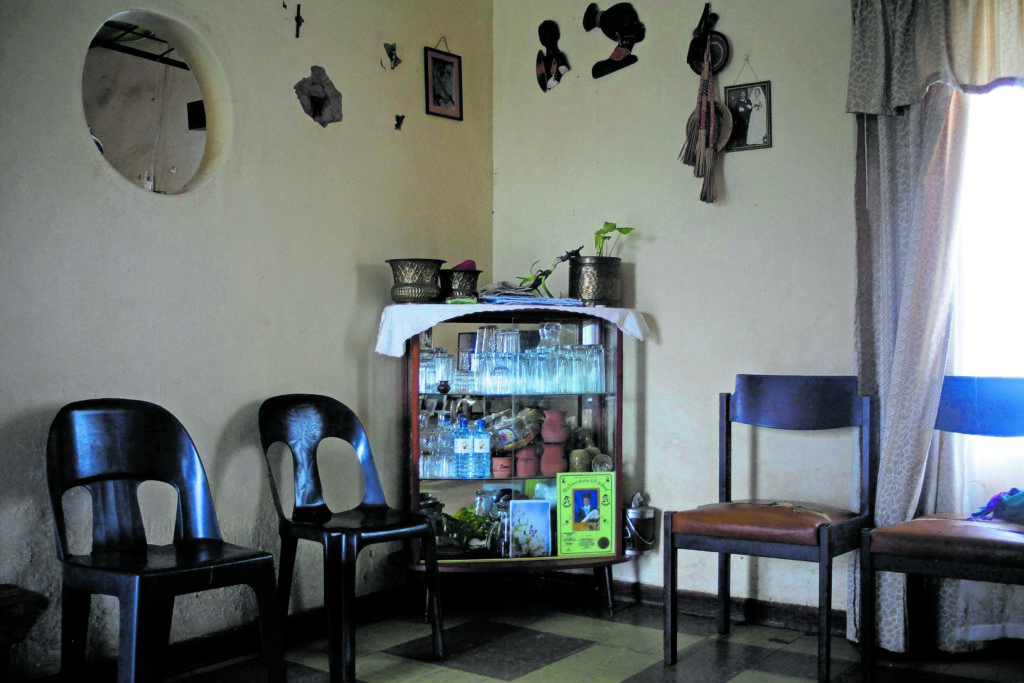 The house room where the 65-year-old Fikile Ntshangase was murdered in last Thursday. She was a vocal opponent of plans to extend Somkhele coal mine, one of South Africa’s largest open coal mines, situated on the border of iMfolozi-Hluhluwe Game Park in northern KwaZulu-Natal. (Photo: Oupa Nkosi)
“The psychologists took the three boys on a leisurely trip to town for them to clear their minds and become children again, and they will receive extensive counselling thereafter to deal with the trauma,” said an elder, who asked to remain anonymous.
A bullet pierced straight through Ntshangase’s body, with a gaping hole visible on the concrete floor she was seated on while peeling onions for supper. “This shows that those assassins shot her even after she had fallen to finish her off,” said the anonymous elder.
The killing of activists is increasing globally
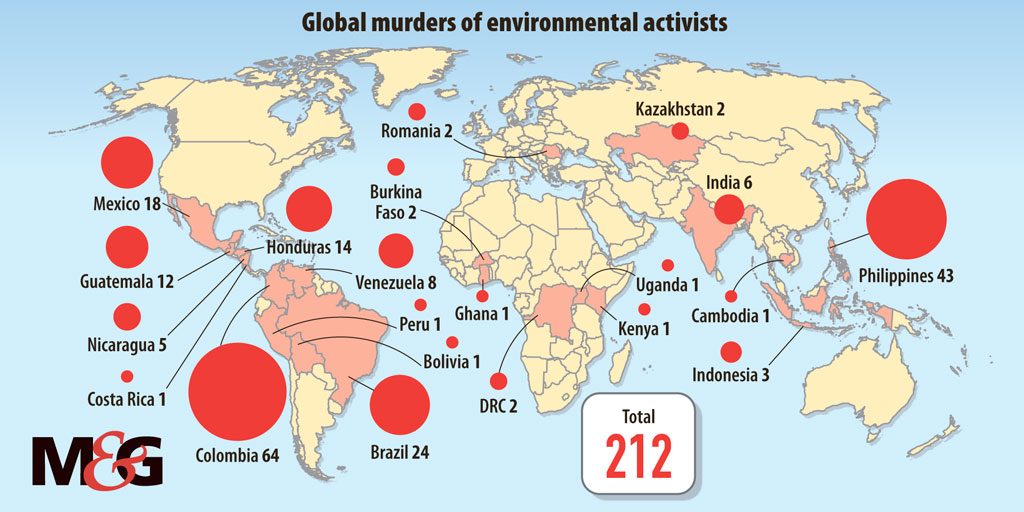
The brutality of killing activists for protecting their land and environment is not isolated to South Africa: in 2019, 212 defenders were killed around the world.
This figure is contained in a Global Witness report released in July. The nongovernmental organisation’s report highlighted mining as the deadliest sector for activists. Fifty were killed worldwide last year. In total, more than four activists were killed every week in 2019. These figures have spiked 30%, from 164 recorded in 2018.
The killing of Ntshangase has galvanised South African activists, who said they will not back down and would continue fighting against mining in their regions, despite the wanton violence and deaths meted out to defenders.
The assassination of Ntshangase on 22 October, also sparked an international outcry, including from the United States-based Human Rights Watch.
“Mining was the deadliest sector, with 50 defenders killed in 2019. Agribusiness continues to wreak destruction, with 34 defenders killed, and 85% of such attacks recorded in Asia,” the Global Witness report said. Half of the reported killings in 2019 took place in Colombia and the Philippines, with the former country showing its highest-ever recorded numbers.
Indigenous people, the report stated, are also disproportionately killed for their environmental activism, making up 40% of deaths worldwide. Back in South Africa, former chairperson of the Amadiba Crisis Committee (ACC), Sikhosiphi “Bazooka” Rhadebe, was also shot and killed in March 2016 for his organisation’s relentless fight to stop an Australian company from mining titanium from the Eastern Cape’s Wild Coast dunes.
Sibusiso Mqadi, the current ACC chairperson, told the Mail & Guardian last week that the committee was prepared to die for their land and to prevent mining operations. “As the ACC, we took a painful resolution that, at the end of the day, they will not kill us all.”
[/membership]