About 422 000 local jobs are tied to exports to economies with active or incoming carbon border adjustment mechanisms (Oupa Nkosi)
South Africa is stepping up its climate change programme ahead of the 26th session of the Conference of the Parties (COP26) in Glasgow, Scotland, in November.
Some of these actions will force industries to report accurately on their greenhouse gas emissions, and a carbon tax has introduced accountability to the big polluters.
The most notable progress last year was the submission of South Africa’s Low Emission Development Strategy to the United Nations Framework Convention on Climate Change, which is the country’s plan to reach net-zero emissions by 2050.
The Presidential Climate Change Coordination Commission is to finalise its plans this month, which will guide the country’s climate change programme from the highest office.
Improving reporting
The draft guidelines to regulate the methods industries used to report greenhouse gas emissions were released last month.
The United Nations’ Intergovernmental Panel on Climate Change developed a methodology to improve accuracy, transparency and accountability in greenhouse gas emissions. The national greenhouse gas emissions reporting regulations in South Africa were promulgated to ensure that reporting requirements became more legally binding. South Africa must reduce the effects of climate change under its commitment to the Paris Agreement, which seeks to keep global warming below 1.5°C.
“Disclosure of GHG [greenhouse gas] emission data in the public interest was reinforced by the environment minister in April 2020 when she ordered the disclosure of data from major GHG emitters in South Africa. Full access to this information, including how a company calculates its GHG emissions for reporting, will contribute towards transparency and accountability,” said Timothy Lloyd, of the Centre for Environmental Rights.
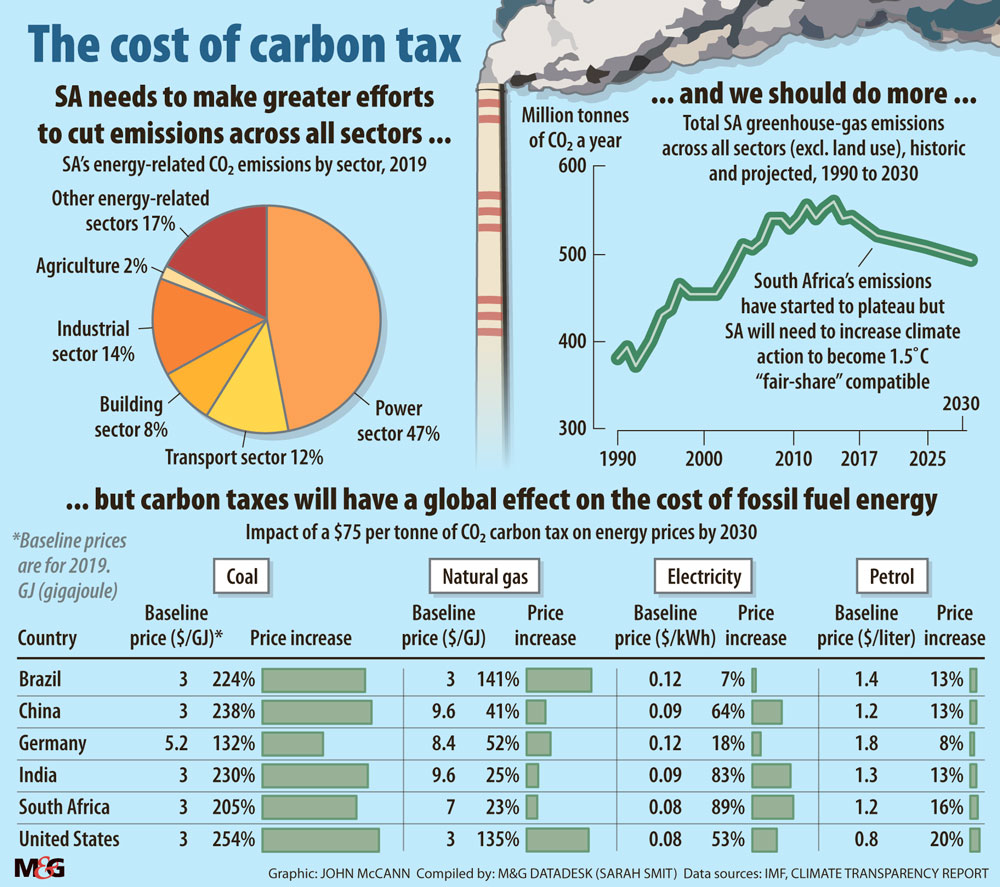 (John McCann/M&G)
In September last year, the national greenhouse gas emissions inventory draft report for 2017 was released. It showed that the country’s emission increased by 27.7% between 2000 and 2017. The energy sector is the largest contributor (79.1% in 2017) to emissions, responsible for 90.3% of the increase over the 17 years. This is a result of the country’s heavy reliance on fossil-fuelled electricity generation.
The Integrated Energy Resource Plan sets out to reduce the country’s reliance on coal to 43% in 2030 from the current 90%. Despite calls for all new planned coal investments to stop post-2020, South Africa will introduce 1 500 megawatts of new coal-fired power to the grid by 2030.
Carbon budgets and tax
The carbon budget aims to serve as the maximum level of emissions allowed where a higher tax rate applies to emissions above the sector’s budget. This, said the department of environment, forestry and fisheries, will ensure accountability by big polluters exceeding the allowable limits.
In 2021, the carbon tax rate will increase from R127 a ton of carbon dioxide equivalent to R134 a ton of CO2e. The department and the treasury are working on aligning and integrating the carbon tax and carbon budget instruments, promising those affected that there would be no double penalty. Once the legislation on carbon budgets passes, the 5% allowance will be phased out, according to audit firm KMPG. The allowance applies to companies participating in the voluntary carbon budget system.
The updated inventory is expected to help determine the carbon budgets, which affects the tax due from carbon emissions. According to the Carbon Tax Bill, liability is calculated as the tax base (total quantity of greenhouse gas emissions from combustion, fugitive and industrial processes proportionately reduced by the tax-free allowances) multiplied by the rate of the carbon tax.
Importantly, the new guidelines provide methods to determine emissions from individual activities, which is expected to improve transparency and accuracy. The department said the emissions information for individual activities is used to set baselines to determine limits or, more formally, carbon budgets to companies at a company level.
A carbon budget is an assigned amount of emissions allocated to a company over time (five years in South Africa) that must not be exceeded. Once it becomes law, the Climate Change Bill will pave the way for a carbon budgeting system.
“The same data is used to inform baselines for assessing the impact of mitigation measures identified for specific activities over the same commitment period of a carbon budget. That allows companies to compile an emissions mitigation plan that stipulates how it uses its mitigation measures to meet its carbon budget,” said the department’s spokesperson, Albie Modise. “The principle is that the carbon tax will enforce the carbon budget. The treasury is working on a penalty regime for cases where companies exceed carbon budgets.”
South Africa’s biggest polluters, Eskom and Sasol, have escaped accountability for minimum air quality violations through successful applications for exemptions on emissions. Eskom told parliament’s portfolio committee on minerals and energy last week that the restructuring of Eskom into three wholly-owned divisions will enable the introduction of lower carbon and renewable generation technologies.
Just transition
The power utility has established a Just Transition office to plan and implement a low emissions strategy that is inclusive and equitable. As six of Eskom’s coal-fired power stations reach their end of life, thousands of jobs will be lost in the sector before 2030. The Just Transition office is expected to ensure that the move to a low carbon economy does not leave miners and mining communities behind. Mandy Rambharos, who heads the Just Transition office, said the utility’s role is key to achieving the nationally determined contributions (NDC) target.
“… it’s important to bear in mind that the coal plants contributing to the emissions were built many, many years ago. As we shut down these plants and start to replace them with low carbon technologies, we will have a positive contribution to the NDC target and our contribution to the Paris Agreement,” she said.
Rambharos believes that despite the risks, the transition will present the economy with new opportunities. “I think it will attract a lot of investment. There is potential for jobs, but also along with that comes the potential for local manufacturing. So yes, there will be job losses, but there will also be potential for job creation, and I think that is what we need to capitalise on.”
Tunicia Phillips is an Adamela climate and economic justice reporting fellow funded by the Open Society Foundation for South Africa
[/membership]