The involvement of South African Social Security Agency chief executive Totsie Memela-Khambula in "fraudulent" contracts worth R45.5-million has highlighted her role in the alleged concealment of corruption in Sassa.
Totsie Memela-Khambula, the chief executive of the South African Social Security Agency (Sassa), promoted a senior manager despite the official being implicated in a R1.3-million procurement-related fraud and corruption investigation.
Themba Matlou, who manages Sassa offices in KwaZulu-Natal, Free State and Mpumalanga, was the regional executive manager in Gauteng when more than R1.3-million was allegedly illegally given in only two months to four companies.
The companies are MJ Communications, Mbeu Protection Services, Wapras Trading and Projects and Sonke Sibahle Projects.
This was for cleaning contracts from February to March 2020. Collusion and gross flouting of procurement policies and laws were uncovered in the Gauteng region.
In an internal investigative report by Sassa’s internal audit and risk management department, it was found that there was “deliberate splitting of orders” to “circumvent tender processes”.
The alleged circumvention, according to the report, was related to treasury regulations on supply-chain management processes, which requires all procurement exceeding R500 000 to be advertised.
“The inconsistencies in the procurement of service and allocation of work … confirm [the] existence of collusion between Sassa officials and some service providers and/or favouritism”, reads the report, which was marked as confidential and dated August 2020.
It recommended that Memela-Khambula, in her capacity as Sassa’s chief executive, should discipline or “apply consequence management” against Matlou, as the then regional executive for Gauteng, “for failure to play his oversight role”.
Despite these damning findings, Matlou was promoted to oversee KwaZulu-Natal, Free State and Mpumalanga.
Matlou was promoted in May last year while the forensic investigation, which was finalised in August, was ongoing. An insider close to the audit alleged that Matlou’s promotion preempted the negative findings against him.
Senior Sassa sources, who asked to remain anonymous, also claimed that Matlou’s promotion was consistent with Memela-Khambula’s alleged perpetuation of not taking corruption seriously.
The sources alluded to a recent Mail & Guardian story on how the chief executive was allegedly covering up a nepotistic and allegedly corrupt awarding of a R45.6-million cleaning tender in the Eastern Cape.
[related_posts_sc article_id=”415729″]
After the report, Sassa took to social media to deny the alleged cover-up, but did not elaborate on what actions Memela-Khambula had taken to deal with the alleged corruption.
Sassa did not respond to the M&G’s questions nine days prior to the article’s publication.
In the latest corruption allegations related to Matlou, an insider claimed Memela-Khambula was acting in the same manner as the Eastern Cape scandal.
“The chief executive was given this report and, not only did she not act on Matlou as per the directives of the internal investigation, she promoted Matlou and gave him more responsibilities,” said one insider.
Memela-Khambula signed the report and dated it on 26 August 2020.
Matlou said he was not aware of the report and bemoaned what he said was a “tendency of black people to destroy each other”.
Later, Matlou responded in a text message, saying: “My brother Koko, I am puzzled by these allegations because I was never involved in any process of appointing any service provider in Gauteng. I have requested the head office to respond accordingly on this matter and they are busy with it.”
He added: “Even the report, I saw it [for the] first time after its completion but it does not even implicate me on any appointment of service providers because I was never involved in whatever process. I wonder who is trying to tarnish my credibility so much.”
Sassa disburses social grants to about 18-million people, mainly for people who collect monies on behalf of children. On 25 May, Social Development Minister Lindiwe Zulu, during her budget vote in parliament, said R195.5-billion would be used in the 2021-22 financial year for the payment of grants.
She said Sassa would be allocated R7.4-billion “to efficiently and effectively manage, administer and pay social assistance”.
Three years ago, the previous Sassa chief executive, Pearl Bhengu, was in business with Skhumbuzo Mazibuko, the daughter of the former social development minister, Bathabile Dlamini.
The latest report on alleged irregularities painted a picture of a leaderless Sassa in Gauteng, including that the agency’s regional management had “no regard for prescripts governing procurement”, according to the internal forensic investigation.
“Leadership, senior management and officials failed to develop, implement and monitor effective systems and processes of internal control, including corrective action.”
Sassa spokesperson Paseka Letsatsi said the forensic report had not yet been finalised.
“The internal audit report is under discussion by Sassa governance structures and, as such, its contents are [a] work in progress. Themba Matlou responded to all the questions posed to him although he was not interviewed per se. He hasn’t indicated an intention therefore to take the report on review, given its status,” Letsatsi said.
He added that Sassa did not have cluster managers but had given regional executives more responsibilities to provide “oversight in more than one region while we go through business process reengineering to determine the capacity required by the organisation”.
MJ Communications, Mbeu Protection Services, Wapras Trading and Projects and Sonke Sibahle Projects were also found not only to have participated in alleged collusive actions through their rotation of various Sassa offices in Gauteng, but also allegedly violated labour laws.
The report recommended that Sassa should consider “blacklisting the service providers, who will be found to have abused their employees and report the said service providers to the department of labour and employment”.
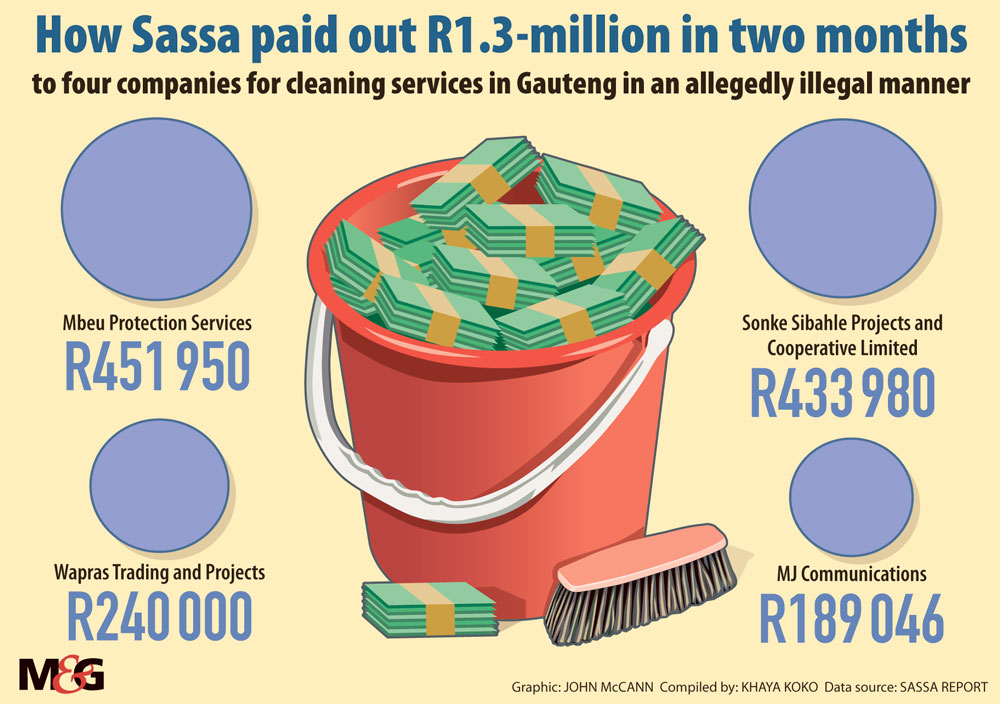 (John McCann/M&G)
One of the company’s received a R204 930 payment on 13 March last year to supply personal protective equipment to Sassa Gauteng at the beginning of the Covid-19 pandemic, despite being contracted for cleaning services.
Mbavhalelo Mavhunga, owner of Mbeu Protection Services, said it was not true that workers had not received their full pay, adding that the first time she heard about the Sassa report was when she was contacted by the M&G.
Her views were echoed by Wapras Trading and Projects’ Lufuno Mukomafhedzi, who also said he had not received complaints of nonpayment and had not been interviewed for the internal report. “I found those workers there [at Sassa Gauteng] and I didn’t see the need to hire other people,” Mukomafhedzi said.
Pandelani Ndou of MJ Communi-cations said: “I’m not aware of the internal report, and everyone that I [worked with] was paid in full.”
Ntombenhle Dubazana of Sonke Sibahle Projects said her company had initially failed to pay all workers, but has finally settled all nonpayments.
She also said Sassa had not contacted her when the report was being compiled.
Post office branch closures may affect grant payments
The closure of 130 branches of the South African Post Office, which carries debt of about R5-billion, will be “catastrophic” to the disbursement of social grants.
Democratic Alliance MP Bridget Masango was reacting to the Post Office chief executive, Nomkhitha Mona, telling parliament that 80 more branches would be closed.
Masango said: “The closure of branches could be potentially catastrophic to the distribution of social grants. [The post office] was ultimately awarded the contract to distribute grants exactly because of its wide footprint through the country and its ability to reach millions of poor South Africans in the most rural of communities.”
Last week, the Mail & Guardian reported that the Post Office had failed to pay about R842-million towards its workers’ pension funds.
[related_posts_sc article_id=”416208″]
Its spokesperson, Johan Kruger, confirmed that the Post Office’s liabilities exceeded its assets and was “technically insolvent”. This echoed auditor general Tsakani Maluleke’s report in April that the Post Office was R5-billion in debt, and that it was “commercially insolvent”.
[/membership]