Living his dream: Wynne Dryden coaches his son Rephan. (David Harrison/M&G)
The uneven field in Forest Drive, Epping Forest in the Western Cape is covered with scattered waste and dry patches of grass on which a few horses graze. This field has multiple purposes: it is a battlefield for local gangs — the Terrible Josters and The Horribles — and a battlefield of another kind when children play soccer games.
For 40-year-old Wynne Dryden, the field holds memories of both his lost soccer dream and his past gangster life. It is also a symbol of his dream for the children of Epping Forest; specifically, those with a talent for football that needs nurturing.
“What I did not get, I want for the children here,” a determined Dryden vows.
From the time he was five years old, Dryden has played soccer, following in the footsteps of his father and uncle, who both were keen football players for local clubs in Cape Town. At age five, he played for the u-9s and stayed in that team for five years until he could proceed to the next age group.
Dryden grew up with his grandparents in Matroosfontein, because his dad “left early and returned late” from work. His mother stayed in Mitchells Plain, where he visited her frequently. Both areas are known for the notorious gangs active on their streets. But despite his exposure to gangster life, Dryden tried to turn the other way — devoting his life to soccer.
He was, however, not able to stay on track.
By the time Dryden turned 16, several football clubs were already paying attention to his talent and well-known Cape Town club, Hellenic FC, wanted him to play for them. But his father refused to provide his permission and signature.
It was after many years of not talking to each other that his father, in retrospect, told Dryden that he had made the wrong decision that day, although he insisted he was driven by the fear of the teenager getting physically hurt by older players.
“If you get an injury you are out of the game. But you have to take that chance,” Dryden says today.
Soon after his father’s refusal to sign him to a bigger club, Dryden stopped playing soccer altogether. In a U-turn that would change his life forever, he sought a new identity, away from soccer, in a local gang.
“I fell into the gangster life. I made the wrong decision,” he admits.
In 2008, aged 26 and having spent almost a decade of his life being a foot soldier, Dryden was shot by a rival gang. Thirty shots were fired, killing his friend and wounding Dryden. A month after the shooting, he was discharged from the hospital as a quadriplegic.
The incident would, in Dryden’s view, lead to another watershed moment — one that took the life of his eldest son.
While he was in hospital after the shooting, Dryden’s wife, eldest son and another child of only four months old were coming back from church when the older boy was fatally struck at a pedestrian crossing by a car that ignored a red light.
Dryden blamed himself for the incident.
“It took me three years to recover from my son’s death,” he says. But Dryden then also realised the life he had chosen was not the life he wanted for his children.
“Enough was enough: I decided I was done with it [gangster life]. They tell you they are with you, but when you are in these circumstances no one can help you. They don’t know your heart or your thoughts. They say they are your brother or friend. That is a lie. From then, I withdrew myself from them.”
Today Dryden dedicates his life to children, by teaching them soccer and doing all he can to support those who could have a chance to play for big clubs.
“If there is a child who gets the opportunity, I will make sure he gets it,” he says, looking out at the field where he now spends most of his time.
Surrounded by tiny, government-funded houses, the open field is a beacon for the more than 200 children who come to play soccer and netball matches there.
As well as coaching u-13s at the Matroosfontein Football Club, Dryden also teaches life skills to the children, many of whom are from the families of gangsters. But he has to make do with very limited facilities.
“We are short [of] many things,” he says. “Circumstances here are very bad; things are backward
“We don’t have sports for our children. We don’t even have enough food. There is no food for our children,” he continues. “That is what is happening here; there are no job opportunities when they get older.”
The only opportunity for many of the children to get money is by acting as drug carriers or being sent by adults to go and buy them drugs.
“Our kids start to become gangster’tjies, or they skarrel soe [collect items from rubbish bins for recycling],” Dryden reflects sadly.
But he is determined to maintain a positive attitude and do what he can to make a difference.
When he is not busy coaching football, Dryden manages a small, informal cleaning business.
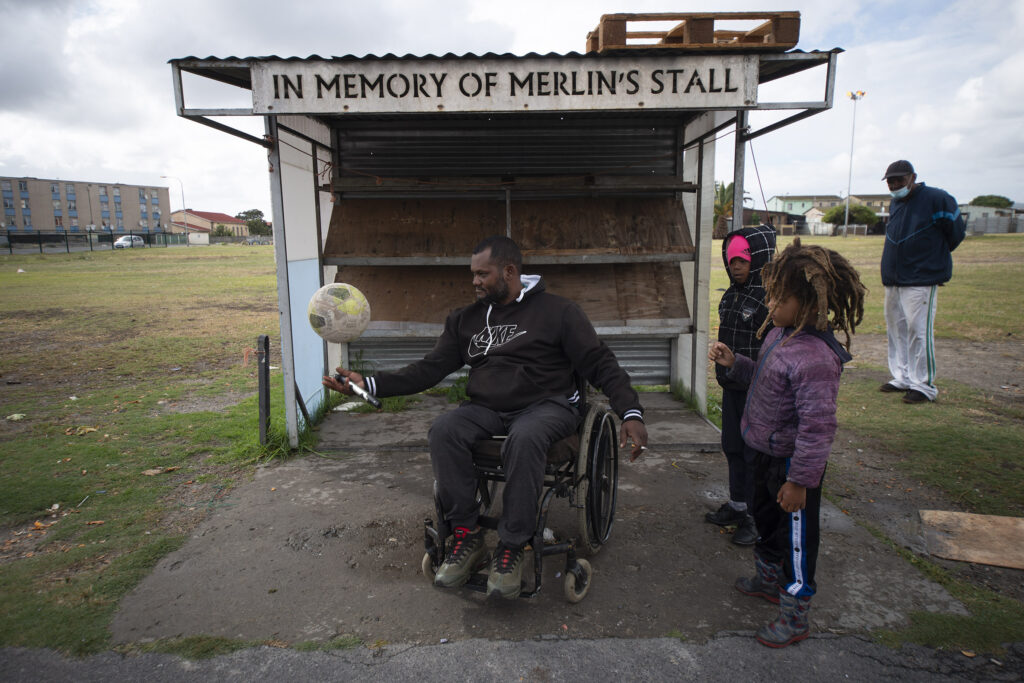 Wynne Dryden coaches about 200 other football-crazy kids every Sunday on a field in Epping Forest where he lives. (David Harrison/M&G)
“Ek kyk oek maar: we don’t have a lot of places we clean, but those that we get, we share with each other so that perhaps someone can put bread on the table tonight,” he says.
Dryden, who uses a wheelchair, moves from one company to the next, asking to clean their yards or remove rubble. For additional income, he and his team collect pieces of wood to package into firewood for sale.
His wife works as well, “but we have children oek, so I cannot let only her work, a man must do his bit. I don’t let the [wheel]chair get me down. As time passes, we will get more companies to clean. We just need to be patient,” he says.
But Dryden’s passion remains children and football. When he has some food to spare, he hands some of it out to the children, being aware that many of them come to the field with empty stomachs.
Sundays are tournament days.
On Sunday 14 November, when Bafana Bafana played against Ghana, needing only a draw to advance to a 2022 World Cup qualification play-off, Dryden’s senior team, the Hunters FC, lost in their final match to another local football club in Delft. Wynne gives a little laugh and says it was like dealing with a double loss last Sunday.
However, there are few things that can overshadow the joy his soccer teams bring him. Adding to this, Dryden’s 13-year-old son Rephan is following in his footsteps: “My klong is a soccer freak. He plays for the Matroosfontein FC,” he says.
The club hopes to let him play u-16 soon, but his dad is hesitant because, at the moment, he gets to coach him.
In his next breath, perhaps remembering his own youth, Dryden adds: “Maybe I’m also too overprotective and holding him back. If he has the ability to play where people might notice him, then I will send him.”
[/membership]