Hundreds of South African members of the non-governmental organisation Treatment Action Campaign (TAC) protest outside the Life Esidimeni arbitration public hearing on January 22, 2018 in Johannesburg, South Africa.
At least 143 mentally ill patients died after South African authorities moved them in 2016 from hospital to unlicensed health facilities that were compared to "concentration camps", a government investigation revealed on January 17, 2018. Many of the deaths were due to pneumonia, dehydration and diarrhoea, as the patients were hurriedly shifted to 27 "poorly-prepared" facilities in an apparent cost-cutting measure that showed evidence of neglect. / AFP PHOTO / GIANLUIGI GUERCIA (Photo credit should read GIANLUIGI GUERCIA/AFP via Getty Images)
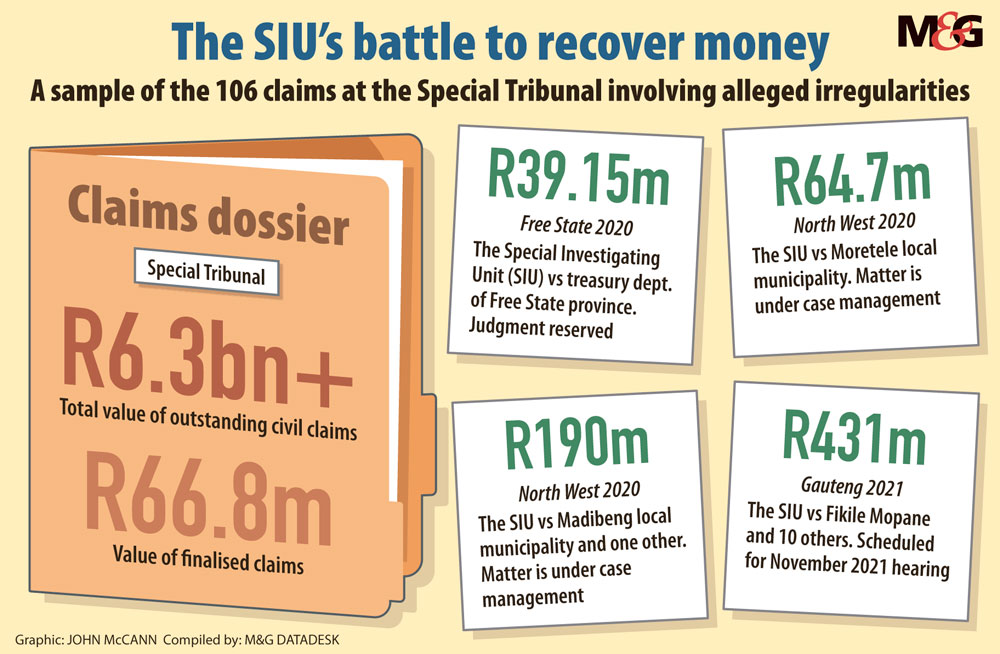
In its bid to retrieve money siphoned off through alleged procurement corruption, the Special Investigating Unit (SIU) has failed to finalise about R6.3-billion worth of civil cases dating back to 2019.
Only R66.8-million of the more than R6.3-billion of civil claims that are before the Special Tribunal have been finalised.
According to official records analysed by the Mail & Guardian, 52 of the 106 matters that are before the Special Tribunal are still under case management — in other words, the timelines for the trial’s expected duration for retrieving stolen money have yet to be finalised, or that documents have yet to be filed. Case management processes at times include the implicated parties, SIU lawyers and the sitting judge.
The M&G’s information is current as of 19 November.
Ten of the more than 100 matters have been at a standstill since 2019.
These include the irregular and corrupt appointment of NGOs in Gauteng to take care of the province’s mentally ill patients after the closure of the Life Esidimeni centres in 2016.
More than 140 people died and an inquest is underway to determine criminal culpability for what a 2018 report by former deputy chief justice Dikgang Moseneke found to be negligent deaths.
The 2019 cases before the tribunal amount to more than R271.7-million, with the irregular awarding of contracts for the care of the Life Esidimeni worth more than R5.7-million.
It is unclear from the SIU how the R6.3-billion in cases before the tribunal correlates with the figures in the unit’s 2020-21 annual report, which was released last week and stated that the SIU had recovered R1.8-billion in cash or assets, and had R818.6-million in potential cash or assets to be retrieved.
When the SIU’s spokesperson, Kaizer Kganyago, was asked about these figures he said the figures in the annual report were as at the end of March, and that “obviously the numbers have changed by now”.
Kganyago rejected claims of a slow conclusion of their civil cases, asserting that the matters the SIU brings before the tribunal are finalised expeditiously.
“There is no concern at the SIU [about the slow finalisation of matters] as the cases are finalised quickly at the tribunal as opposed to the ones at the high court.
“The SIU does not have any challenges that we are experiencing in finalising matters at the tribunal,” he said.
The biggest amount before the tribunal, according to its data, is the nearly R4.2-billion the SIU wants to retrieve from Chinese rolling stock manufacturer, CRRC E-Loco Supply, which is accused of gaining the money through “proceeds of unlawful activity, and fall to be forfeited to the state”.
This is for the contentious Transnet tender to procure 1 064 locomotives in 2014, which cost about R54-billion and which the state believes was inflated by more than R16-billion.
The SIU said in a statement that it approached the tribunal after an investigation it had conducted, alongside the South African Reserve Bank and the South African Revenue Service.
This investigation, the SIU said, had raised suspicions that “CRRC paid kickbacks disguised as business development services agreements (BDSAs) to entities linked to allegations of state capture and/or allegations of maladministration and irregularities, allegedly to influence the direction of tenders at Transnet”.
“No evidence exists to suggest that the payments envisaged in the BDSAs were for service rendered and the said payments are linked to the award of contracts and payments made by Transnet.”
Another matter before the Special Tribunal is the R172-million contract that flamboyant businessman Hamilton Ndlovu received from the National Health Laboratory Service to supply it with personal protective equipment (PPE) as part of the Covid-19 response last year.
 (John McCann/M&G)
Ndlovu gained notoriety when he posted a picture of a fleet of swanky brand-new vehicles he had bought with what the SIU contends was money received from the irregular awarding of the contract.
On Wednesday, legal arguments began in the SIU’s case to review the R431-million contracts disbursed by the Gauteng education department for the decontamination and sanitising of the province’s schools, also to prevent the spread of Covid-19.
Special Tribunal spokesperson Selby Makgotho said the case management process was important for “the speedy and expeditious disposition of the matter”.
Makgotho said the SIU approached the Special Tribunal in its own name, or that of a government agency or institution “for a just and equitable remedy recovery of the money”, but that these matters can be appealed.
“We are currently sitting with two appeal applications: the former chief financial officer of the Gauteng department of health, Kabelo Mantsu Lehloenya, is seeking leave to appeal the ruling which dismissed her bid to join Gauteng Premier David Makhura to the [R42.8-million] proceedings where the PPE financial irregularities are claimed from her.”
The second appeal relates to Petrus Mazibuko, the former senior manager for coal operations at Eskom. The Special Tribunal ordered that he forfeit R11-million to the state.
Makgotho said the two appeals will be heard in due course.
“It is our firm belief that the Special Tribunal has made a huge contribution, within a short space of time, in the fight against malfeasance, corruption, maladministration and any forms of financial irregularities by being able to adjudicate on civil matters brought by the SIU. Before the Special Tribunal, the SIU would queue in the high courts like other litigants and the matters would take a long time, even years, before being concluded.”
[/membership]