Residents of Marite village in Bushbuckridge, Mpumalanga, are up in arms over the refusal by their chief, Mathupa Mokoena, to allow them to bury their relatives in small family burial sites in their yards, and have asked the South African Human Rights Commission (HRC) to intervene.
Mokoena, who is the president of the Congress of Traditional Leaders of South Africa and a leader of the Mathibela Tribal Authority, recently summoned several residents to the tribal court for burying relatives in their yards.
Bushbuckridge is a semi-rural area and many families set aside a portion of their residential land to be used as a burial site.
This practice has been taking place throughout Southern Africa for centuries because of the belief that when a person is buried adjacent to their ancestors or other family members it is easy for them to connect and communicate well spiritually, according to a study in 2016 by University of KwaZulu-Natal researchers Judy Parker and Frederick Noel Zaal. In South Africa, this practice is still common.
In 2011, Mokoena said he would no longer allow the practice because it hampered development. In a series of recent incidents, he has reportedly ordered the detention of three women and demanded that their families pay fines.
Resident Morries Sibambo said his mother, Stutu Mashigo, had been summoned a few weeks ago to the tribal court because his sister had been buried in the family’s yard.
“When the trial began the presiding officer asked where the person was buried, and when they discovered that she was buried at the family gravesite situated in our yard, they ordered [my mother] not to leave until we paid a R23 000 fine,” he recounted.
“Just imagine, an old woman being kept at the tribal court for many hours without food. As a family, we were worried because my mother is not even healthy and she is 79 years old,” said Sibambo.
“We buried our grandfather some years ago, but Mokoena’s predecessors did not give us a problem. And recently we were obliged to lay to rest our sister and a child next to their ancestor’s grave. We are afraid to go to the tribal council to seek permission because we know they will not permit us.”
In August, Mokoena allegedly ordered the detention of two women who were accused of burying relatives at home.
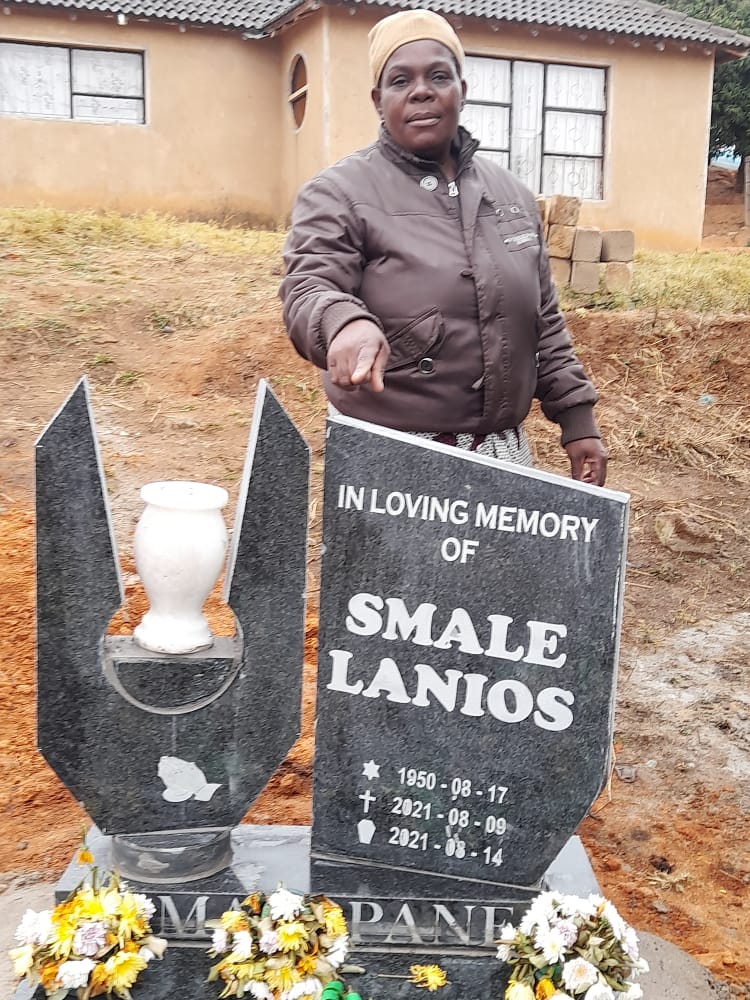 Rites: Thandi Malapani stands next to one of the graves in the family’s burial site in Marite.
The Malapani family, who live in Marite, reportedly asked for permission to bury their father at the family gravesite that contains 14 graves, but the chief did not respond to the letter and did not communicate with them.
The family proceeded with the funeral and burial, but a few days later they apparently received a call from the tribal council that the chief wanted to talk to them.
Family member Thandi Malapani said: “As we were still grieving the passing on of our relative, we sent two female relatives to represent us, and when they got there, they were told that we had disobeyed the tribal council [and] they were going to keep them there until we paid a R20 000 fine. They were kept there in the morning and released at about 5pm.
“The reason he released them is the fact that we phoned my aunt, who is a prominent leader of the ANC, asking for help, she then phoned him and asked him to release them.
“Our father informed us that when he passed on we must bury him next to his parents and other family elders. The place already has many graves and we never had a problem with other traditional leaders, who led us in the past.”
One of the detained women, Thelma Mokoena, said she was kept at the tribal court for more than five hours.
Asked why she had not opened a kidnapping case against the chief, she responded: “I don’t want to talk too much about this. What I can tell you is that I have already forgiven them.”
A few days ago, employees at the Mathibela tribal council allegedly tried to stop a funeral at a home in Marite but were chased away by angry villagers.
When contacted for comment, Mokoena denied that he detained people at the tribal council but conceded that he did not want graves in a residential area.
“Nobody was detained; we just ordered the families to come and pay the fine. We have sat down with the community and agreed that the dead must be buried at the cemetery, not in the yard. Having graves at the people’s homes is a problem because it interrupts development. Those who want to continue to do so will have to pay a fine.”
“Currently we have a situation where the construction of a huge shopping complex has been stopped because there is a family that refuses to remove their graves at the site where the construction was supposed to take place.”
After trying in vain to convince Mokoena to allow home burials, the people of the area wrote a letter to the HRC for help. In the letter the residents said they believed “that our rights are being infringed by chief [Mathupa] Lameck Mokoena, who refused that we bury our loved ones at the family burial sites”.
“Most of us have burial sites situated in our yards and we have been burying our beloved departed family members there. As Africans, we have our reasons why we have family burial sites and it is our right to have [them].
“We are requesting you to assist us or give us a piece of advice on how we can handle the situation professionally, instead of demonstrating and or using any violence,” the letter reads.
The HRC’s Mpumalanga manager, Eric Mokonyama, confirmed receiving the letter and said the commission would investigate the matter.
“Burials are conducted in terms of municipal by-laws, which should be available in all municipalities in the country. The commission, unfortunately, does not know all the by-laws at this stage. Rights (if any) would be in line with the by-laws, the laws in the country and the Constitution,” Mokonyama said.
“Burials should be conducted in terms of the laws of the country. No one has the right to take the law into their hands in conducting burials.”
The HRC’s legal researcher, Tshegofatso Molapo, said the inquiry had been forwarded to the commission’s land and housing unit for further assessment.
In South Africa, burial issues are regulated by municipal by-laws, and in every municipality there are different laws relating to burials. The by-laws should be aligned to the Constitution.
Land occupiers in rural and farming areas have been protected by section 6(2)(dA) of the Extension of Security of Tenure Act 62 of 1997, which allows them to assert a right of familial burial against landowners or leaders, provided certain conditions are met.
‘‘An occupier is allowed to bury a deceased member of his or her family who, at the time of that person’s death, was residing on the land on which the occupier is residing,” the Act says.
“The family members of an occupier contemplated in section 8(4) of this Act shall on his or her death have a right to bury that occupier on the land on which he or she was residing at the time of his or her death in accordance with their religion or cultural belief, subject to the conditions that may be imposed by the owner or person in charge.’’
Isaac Mthethwa, a cultural expert from the Oral History Association of South Africa, said there were no laws forbidding residents from burying relatives in their yards.
He said under normal circumstances, a grieving family that wants to bury their dead should apply for permission from the local tribal authority and will pay a fee ranging from R500 to R1 500.
“This is the procedure and I don’t remember a case in which a tribal authority refused to grant such permission. In the cases where residents were fined R20 000 is something else and I don’t think residents should take this seriously because it is just a mere threat.
“However, I think people should have family gravesites a bit far from their homes,” Mthethwa said.
Gakwi Mashego, who won the 2016 Voice of Heritage Award for his outstanding cultural work, lambasted Mokoena for demonising home burials, saying the land belongs to the people, not traditional leaders, and they must be treated with dignity and respect.
“I don’t understand how he can detain people and demand such a huge amount from the grieving families. As black people, there is nothing wrong when we have graves in our yard,” Mashego said.
Asked if people had the right to have graves at their homes, Lindiwe Msibi, spokesperson for the Mpumalanga department of co-operative governance and traditional affairs, said: “They do it if they believe that it is necessary and they are required to negotiate with the traditional leader before the burial. There is no provision or legislation in the law regarding burying the dead in the yard.
“Considering the population growth and the high demand for residential areas it is crucial that we optimally use the available space. That is why traditional councils allocated space for graveyards.”
Asked whether a traditional leader was allowed to detain people and demand a R20 000 fine, Msibi said each traditional council had its policy regarding burials rights, which was not determined by the department.
This article was made possible through the support of the German federal foreign office and the Institut für Auslandsbeziehungen (IFA) Zivik funding programme. The views expressed do not necessarily represent those of the German federal foreign office or the IFA
[/membership]