Farmers are battling outbreaks that are ravaging the Northern Cape, Eastern Cape, Western Cape. (Photo by Wikus de Wet/AFP)
The current endemic brown locust outbreak, which is razing through large tracts of agricultural land, is one of the worst in a decade, and has the country’s locust-fighting teams overwhelmed, from Pofadder to Somerset East.
A month ago, a sheep farmer, who asked to remain anonymous because he is not authorised to speak to the media, was helping to battle as many as 250 roosting brown locust hopper bands a week in the Northern Cape.
But the farmer hopes the worst is over for the Hanover district in the Karoo, after good rains unleashed the voracious insects late last year.
“We pretty much still had hoppers and we managed to contain them more or less, but I’m not saying that none of them escaped … We started getting them under control and then they started flying already,” the farmer said. “They’re definitely east of us now with big swarms in Molteno, Noupoort, Middelburg and Cradock. Last week, we saw a big swarm in Graaff-Reinet.
“It’s the first time in many years that we’ve had rain before December and so the locust swarms are a lot earlier than they normally are, which is in February, March and April. Last year, they started breeding out in October and November when the rains came.”
The farmer is worried about the devastation being wrought by the endemic brown locusts, which cause regular outbreaks in the semi-arid Nama Karoo. “Because we already dealt with a locust outbreak last year, we were prepared,” he said. “There’s been such widespread rain here, and I have an idea that most of the farmers to the west of us — who’ve had this terrible drought, in places like Sutherland, Van Wyk’s Vlei and Carnavon — weren’t prepared.”
Eastern Cape spread
Megan Maritz, the natural resources and water affairs assistant at Agri Eastern Cape, said the outbreak from the flying swarms has spread from the upper western region of the province, including Aberdeen, Willowmore, Graaff-Reinet and Middelburg, and moved east, affecting Steynsburg, Venterstad and Burgersdorp, reaching as far as Molteno.
For farmers, the main concerns are their grazing fields and crops that are being destroyed by the swarms, she said. “There has not been an exact figure put to the damage as yet, but many hectares of grazing veld and crops are being demolished. All of the above-mentioned areas (and more) have had some sort of destruction in some way or another.”
The department of agriculture, land reform and rural development has appointed district locust teams, who are spraying reported swarms within respective areas, and has supplied insecticides and spraying equipment. “The prognosis is unknown. There are many contributing factors — locusts’ activity normally decreases in the cooler, winter months of the year,” Maritz said.
Circle of life
A female brown locust lays an average of 380 drought-resistant eggs in her lifetime, which hatch with the onset of good summer rains. “They become hoppers, grow up, become fliers, mate and lay eggs,” said Ikalafeng Kgakatsi, the director for climate change and disaster management at the Northern Cape department of agriculture, environmental affairs, land reform and rural development.
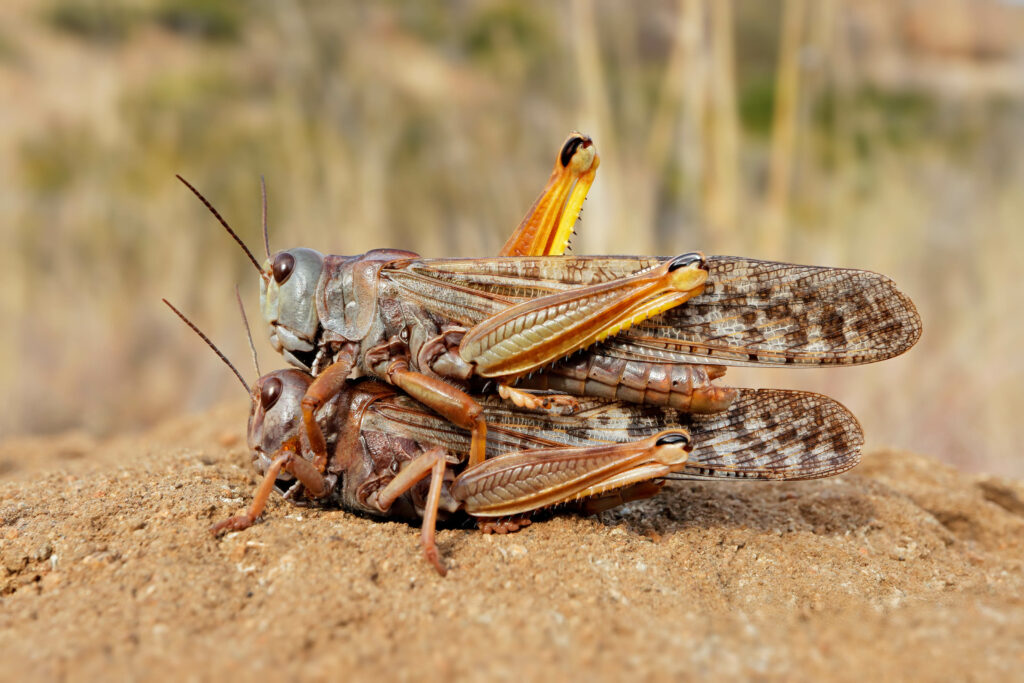 A pair of brown locusts (Locustana pardalina) mating.
“It’s a circle until the cold weather comes — that’s the only time we can have a break. With the rain and the high temperatures, they’ll keep on surviving. Those eggs can stay dormant in the soil for years, waiting for the right weather conditions to hatch. We are thinking that they laid a lot of eggs last year and that is why we are currently having this huge outbreak, in addition to the flying swarms that have come in from Namibia,” he said.
Dr Roger Price, research team manager at the Agricultural Research Council’s plant health and protection unit, said he was impressed by “some beautiful swarms 30km long” on social media recently, which showed the locusts “escaping” from the Karoo. “The large-scale outbreak of the brown locust is impossible to stop and we can only sit back and admire the power of the locust as a wonder of the insect world,” he said.
‘Wonder of nature’
“A big outbreak like this is a wonder of nature and it’s unstoppable because this is over a massive area from Pofadder to Somerset East …. They’re escaping, flying east, and are getting out of the Karoo slowly but surely … It’s quite a serious outbreak as far as agriculture goes,” Price said.
In October, Price published a scientific review paper on the brown locust in the journal Agronomy, which describes its very high outbreak frequency in the Karoo and the incredible numbers of locust targets (hopper bands and swarms) that are controlled almost every year by locust officers from the department of agriculture. The paper details regular outbreaks for the past 100 years, with big outbreaks, such as the current one, occurring about once a decade, he said.
The country’s locust-fighting teams are being “overwhelmed” by the sheer scale of the current onslaught. “Our guys are trying extremely hard, working all night, and are very enthusiastic and very dedicated, but they just don’t have the tools to deal with this size outbreak,” Price said.
“If it was a small outbreak — a normal outbreak in the Karoo; yes, they can handle it, but not when you’ve got swarms 30km long. They’re out of their depth … During the big outbreaks on the go at the moment, they simply get overwhelmed and end up chasing thousands of locust targets around the Karoo in their spray bakkies.”
In his paper, Price described how regular and often intense outbreaks of the brown locust in the semi-arid Nama Karoo region pose a direct pest threat to the sheep-grazing rangeland, crops planted under irrigation and, particularly, to the main maize and wheat cereal cultivation areas of the country within range of swarms escaping from the eastern Karoo.
“The brown locust, therefore, is a formidable pest problem and has been the target of chemical control campaigns waged by the department of agriculture since 1906,” Price said.
Locust management needs radical overhaul
Price advocates a radical rethink of the locust management system that entails a modernised and technology-equipped, integrated brown locust management strategy, combining ground and aerial tactics that will have the flexibility and the capacity to deal effectively with outbreaks.
“We are just very backward and we need to drag ourselves into the 21st century,” he told the Mail & Guardian.
Because of the seasonal nature and unpredictable location of brown locust outbreaks, operational management has relied for decades on the “commando system” — an army of temporarily employed locust officers and spray-machine operators tracking down and controlling individual hopper bands or roosting swarm targets. These are usually farmers with previous experience with locust-control campaigns, who are reappointed during outbreaks.
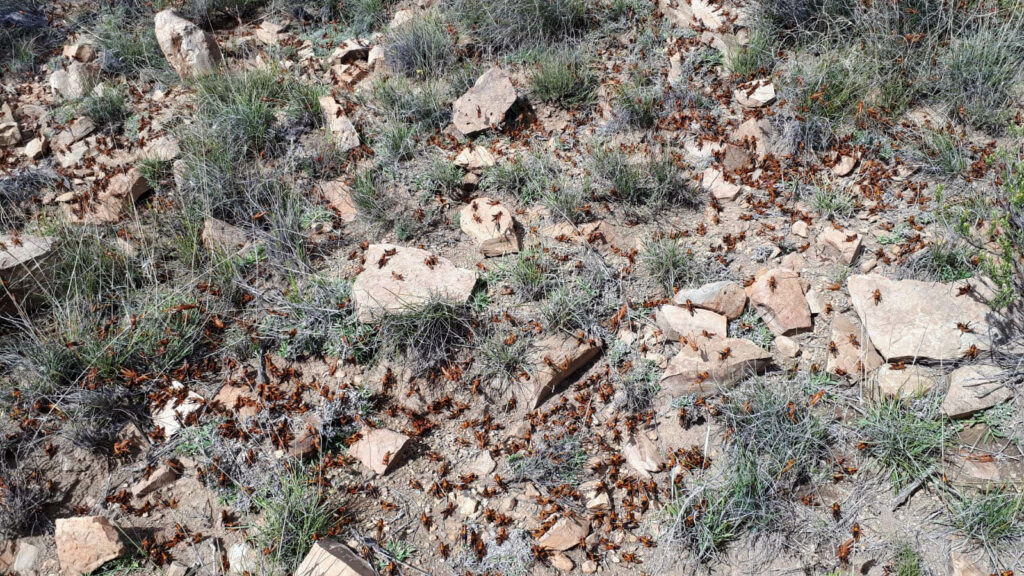 It is difficult to control a locust outbreak once it has reached the swarming stage.
“Locust-control operations have evidently failed, as they have been unable to stop the regular plague cycles from developing. The typical large-scale incipient upsurges over a wide area of the Karoo are impossible to prevent and, once the populations develop into gregaria phase eruptions [when they live in swarms, are able to migrate over large areas and may even darken the sky], then the only option is to undertake a large-scale and expensive chemical control campaign,” the paper notes.
“However, chemical control operations are rarely able to subdue the large-scale eruptions on their own and such extensive control campaigns are usually assisted by the onset of unfavourable dry or cold climatic conditions that restrict further locust breeding and suppress the eruptions.”
Few resident farmers left to report outbreaks
The tracking down and spraying of thousands of individual hopper bands and roosting swarms has long been considered as an inefficient use of manpower and resources, with the traditional commando system becoming more difficult to sustain because of the spiralling costs of transport and insecticides, and the costs of hiring the large temporary labour force.
“The ongoing depopulation of farms in the more remote and arid areas of the Karoo means that there is a very low density of resident farmers left to report the locusts,” the paper states.
Outbreaks on the large-sized farms in the remote central Karoo and upper Northern Cape areas often go undetected and the local control capacity can be “suddenly overwhelmed” by swarm escapes.
[/membership]