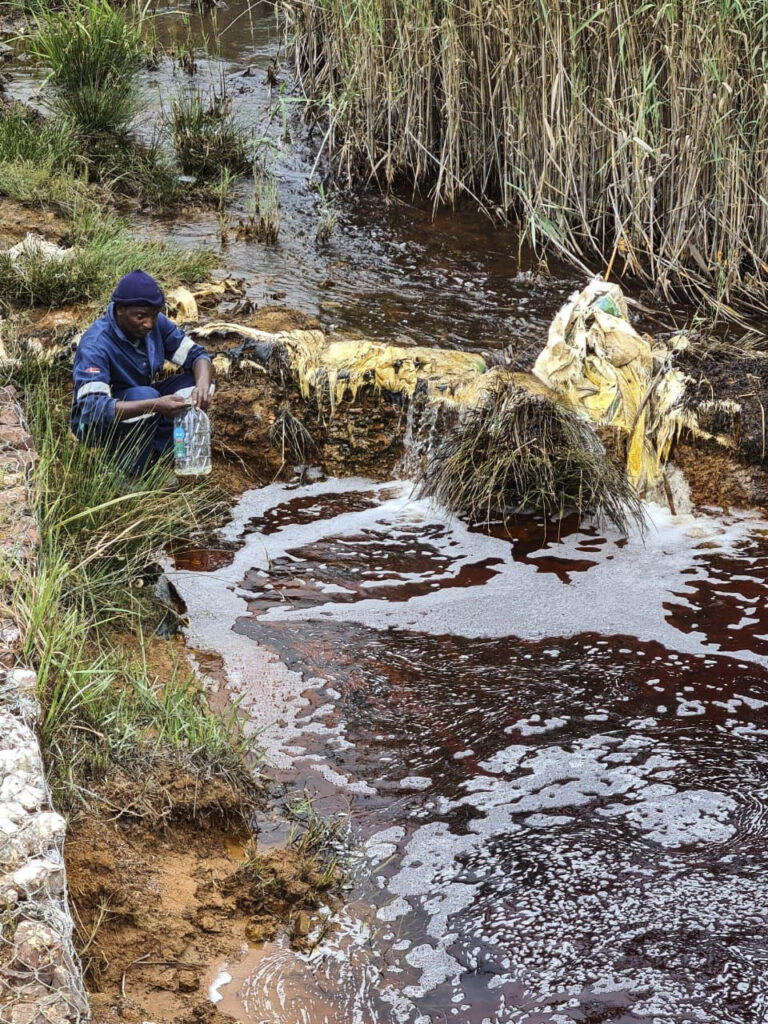
Aquatic disaster: The toxic water flowed from Khwezela Colliery near eMalahleni into the Kromdraaispruit to the Saalbookspruit, into the Wilge River
The toxic spill of millions of litres of acidic mine water from an old, disused coal mine shaft in Mpumalanga that wiped out tonnes of fish was a “severe and catastrophic event” for the Wilge River system and its aquatic life.
This is contained in the findings of a fish kill assessment report by aquatic scientist Jackie Dabrowski, which while focused on fish, described how “there would have been major associated impacts to macro-invertebrates and semi-aquatic species”.
In February, the Mail & Guardian reported on the acid mine drainage (AMD) contamination from Thungela Resources’ Khwezela Colliery’s Kromdraai site, outside eMalahleni, after an old shaft at the colliery collapsed on 14 February.
AMD refers to the spillage of toxic, polluted water from mining areas, which carries metals, radionuclides (atoms that emit radiation) and salts in hazardous concentrations.
The spill started in the Kromdraaispruit, flowed into the Saalboomspruit, then into the Wilge River, which leads into the Olifants River and reached the inlet of the Loskop Dam.
In her report, Dabrowski described how, on 16 February, large numbers of dead and dying fish of multiple species were first reported along with various water colour changes (orange and blue) and with the fish die-offs continuing until at least 21 February.
On 17 February, the department of water and sanitation slapped the mine with a directive for “failure to take all reasonable measures to contain and minimise the effects of the incident”.
Dabrowski said that on receipt of this directive, mine personnel from Thungela began working with stakeholders and several emergency response actions were taken.
The Bronkhorstspruit Catchment Forum and Oppenheimer Generations Research and Conservation asked Dabrowski’s firm, Confluent Environmental, to provide independent aquatic specialist inputs into the fish kill.
The Mpumalanga Tourism and Parks Agency reported 23 indigenous and three exotic species of fish killed. Three tonnes of dead fish were collected from Loskop Dam and buried.
 The Olifants River. (Elsabe Bosch)
“The fish affected vary in their sensitivity to pollution, and even the most resilient species were killed,” Dabrowski noted. “It is impossible to accurately determine the number of fish killed in this event given the large area and remote terrain of much of the affected system.”
Johan Steyl, of the Onderstepoort veterinary campus, conducted a histopathological assessment of several fish specimens, determining the primary cause of the mortalities was water acidification.
Dabrowski said: “All specimens had severe, diffuse bronchial epithelial necrosis, which is typical of exposure to water with a low pH (<4.0). This means that gill cell membranes were severely damaged resulting in death of the fish due to hypoxia [suffocation].
“The low pH of the water would have increased the bioavailability of various metals in a form that is toxic to fish. Damage to the gill epithelium by exposure to toxic concentrations of metals and the low pH is comparable to a chemical burn.”
In another report, Paul Oberholster, the director of the Centre for Environmental Management at the University of the Free State, said: “It’s an undeniable fact that the recent Kromdraai AMD spill will have a detrimental effect on the aquatic ecosystem of the Wilge River for many years to come.
“At pH levels greater than 4.0, precipitation of metal commonly known as ‘yellow boy’ can smother biota, whereas at lower pH values (<4) the dissolved metal ions can penetrate organisms’ membranes and cause toxicity,” he said.
‘Challenging … impossible’
Dabrowski described how the Wilge River was highlighted as one of the cleanest rivers in the “badly impacted” upper Olifants River catchment, improving water quality in the Olifants River at the confluence under normal circumstances.
“This event, as well as the ongoing pollution of the Bronkhorstspruit river by sewage, agricultural sources and water hyacinth, severely compromises the Wilge River, making the recommended ecological category of C [moderately modified] difficult to sustain.”
Rehabilitation of the watercourses affected by the spill is a “challenging, if not impossible task to actively undertake”, she noted. “The metals precipitated out of the water column will enrich the sediments of the rivers and Loskop Dam. In their soluble form, these metals may also be absorbed and adsorbed by algae in river systems, thus entering the food chain.
“Although not as toxic as the bioaccumulation of heavy metals such as mercury or arsenic, chronic exposure to these elements are known to impact on fish health … Precipitated metals will be distributed throughout the system, which is very difficult to access through remote tracts of land and steep gorges.”
Acid mine drainage has been discharging into a wetland on the Kromdraaispruit from the Kromdraai colliery for more than 20 years, and the wetland is believed to improve water quality through the accumulation of iron and manganese, Dabrowski said. But the volumes observed during the acid mine drainage spill “vastly overwhelmed” the capacity of the wetland to do so.
“To improve water quality, a permanent caustic soda (sodium hydroxide) dosing plant on the Kromdraaispruit is operated by the mine to raise the pH. Significant volumes of caustic soda were trucked in and dosed directly into the Kromdraaispruit to raise the pH of the water.”
In conjunction with regulating authorities, water was released from the Bronkhorstspruit and Witbank dams on 23 February to dilute the acid mine drainage and improve water quality in the Wilge and Olifants rivers.
“Dead fish were cleared from several locations, including Loskop Dam, to reduce the number of carcasses and potential scavenging by wildlife. This can be a serious secondary impact as it can result in outbreaks of potentially lethal botulism and is a possible link to the prevalence of pansteatitis in fish and crocodiles in Loskop Dam.
“Unfortunately, most of the affected river sections are inaccessible, with the result that hundreds, if not thousands, of fish carcasses would have been decomposing in and along the river.”
The significant discharge of acid mine drainage from the shaft at the Kromdraai mine had abated and “most water quality parameters had normalised”.
Soybean and lucerne farmer Marius Milner is worried about the health of his soil. “I’m a little bit angry. The mine is not corresponding with us. They just told us ‘you can carry on irrigating’, but they’re not telling us what was in the water, what is the state of the water and how long will it take to re-establish the water to the same state it used to be.
“We bought expensive irrigation land and probably our soil will never be as good as it used to be. Who is going to compensate us for the fertiliser and rehabilitation of the soil? … I’ll probably never catch a freshwater fish in this river again. Everything is dead.”
Thungela spokesperson Mpumi Sithole said that water quality has returned to levels preceding the spill “and has remained stable for weeks”.
“We continue to work closely with the department of water and sanitation on the rehabilitation plan. Initial indications are that the rehabilitation of the Wilge and Olifants river system will take around five years. We are fully committed to ensuring we restore the aquatic system and do what is right as citizens of the Mpumalanga community.”
She said the company had put in place resources to cater for Kromdraai’s rehabilitation. “This includes financial resources for the resumption of the treatment of mine affected water from Kromdraai at the eMalahleni water treatment plant.”
According to Dabrowski, the best approach to rehabilitation will be to ensure that the Kromdraai colliery itself is rehabilitated and a permanent solution to the “evidently significant groundwater problem” is found and implemented.
“Only this way can we be certain that the incident won’t recur. The continued seepage of AMD into the Kromdraaispruit with an instream treatment plant is not sustainable as a long-term rehabilitation solution.”
She said the departments of mineral resources, water, and environment must fully enforce the complete implementation of the mine’s closure and rehabilitation plan.
 The Loskop Dam
Poor mine closure
Environmentally sustainable mine closure in South Africa has a poor record because of the on-selling of mines to less well-resourced companies to close, illegal mining, complex and unwieldy systems and poor capacity and competence in the regulating government departments.
“This manifests in a legacy of high environmental risk, particularly when it comes to AMD, which is difficult to quantify and predict, complex to manage, and costly to treat. This situation is certainly not unique to Kromdraai, but this event has highlighted these problems in a very public way with devastating consequences for the receiving environment,” said Dabrowski.
If not decisively addressed with effective actions, the situation of decanting AMD from closed mines will increase in frequency across the Highveld in coming decades.
“This will require major financial commitments from the mining sector, which must be enforced through legislation … Stricter controls must be implemented, rehabilitation plans must be enforced, and polluters must pay for their transgressions.”
[/membership]