Determined: Thoko Mkhwanazi-Xaluva (above centre) arrives at Hillbrow police station to lay charges against Pastor Paseka Motsoeneng, of the Incredible Happening Ministries, who asked his followers to fund his legal fees as he prepared to battle the Cultural, Religious and Linguistics (CRL) Rights Commission in court. (Vathiswa Ruselo/Sowetan/Gallo Images)
In 2015, the then head of the Cultural, Religious and Linguistics (CRL) Rights Commission, Thoko Mkhwanazi-Xaluva, had to hire bodyguards when she gained powerful enemies during her quest to fulfil her constitutional mandate.
But these were not any ordinary enemies. Mkhwanazi-Xaluva had done the unthinkable: a woman was making demands on spiritual leaders in a male-dominated environment and she was investigating church leaders who operated without any repercussions and accountability to the law.
Among them were leaders of charismatic churches that used unorthodox methods of praise and worship — such as pastors spraying congregants with Doom insecticide and making them drink paraffin.
The commission had embarked on a mission to investigate the commercialisation of churches. This task meant opening the books of churches whose financials were clutched closely to the chests of their leaders. Many were reluctant to cooperate.
“[They thought] If I set up my own church, with my own money, there’s a gap there because there is no legislation that says you can’t set up your own church. Unfortunately it isn’t there up until today, in spite of the recommendations that were made to parliament way back in 2018, that never happened,” said Mkhwanazi-Xaluva.
She said that what she witnessed was very little training for the majority of pastors and prophets who have standalone churches, which meant there would be no accountability for their work.
She wanted parliament to pass legislation that would force religious leaders to adhere to regulations when starting their own churches.
“At the time, there was a lot of violation in terms of ‘culture is religion’, if you look at how religious leaders were behaving at the time — and I suppose it hasn’t changed much — but also how traditional healers were behaving themselves.
“There was a huge challenge in the country.
“You see what happens when people are benefiting from the system and you disrupt the system. Of course, they will be aggressive; if you think that they are not going to be aggressive it’s naivety … you should expect that there will be a serious fightback [and] there was a serious fightback at a very critical level.”
The fightback came in the form of death threats from church leaders. Much of Mkhwanazi-Xaluva’s routine had to change; even her family had to take precautionary measures.
“I think where I was a bit naive was the level of the pushback. You know, most of the time you think you’re dealing with religious people. You think they can only fight back through prayer, through whatever other means [in] that religious space. But it wasn’t like [that]. For the first time in my life, I felt that my life was at risk. I needed to have bodyguards, which is something I never thought I would have. I needed to decide where I [could] go and where I couldn’t go. My family had to take precautionary measures because we were told by the police that this is a high-risk situation I put myself in.”
Mkhwanazi-Xaluva’s hopes that religious organisations would be legislated was a pipe dream; the pushback also came from politicians. She admits she underestimated that the commission could end up with a political dynamic.
In 2019, the Democratic Alliance sounded the alarm on social media about the ANC deployment committee’s influence over the selection of commissioners in chapter nine institutions.
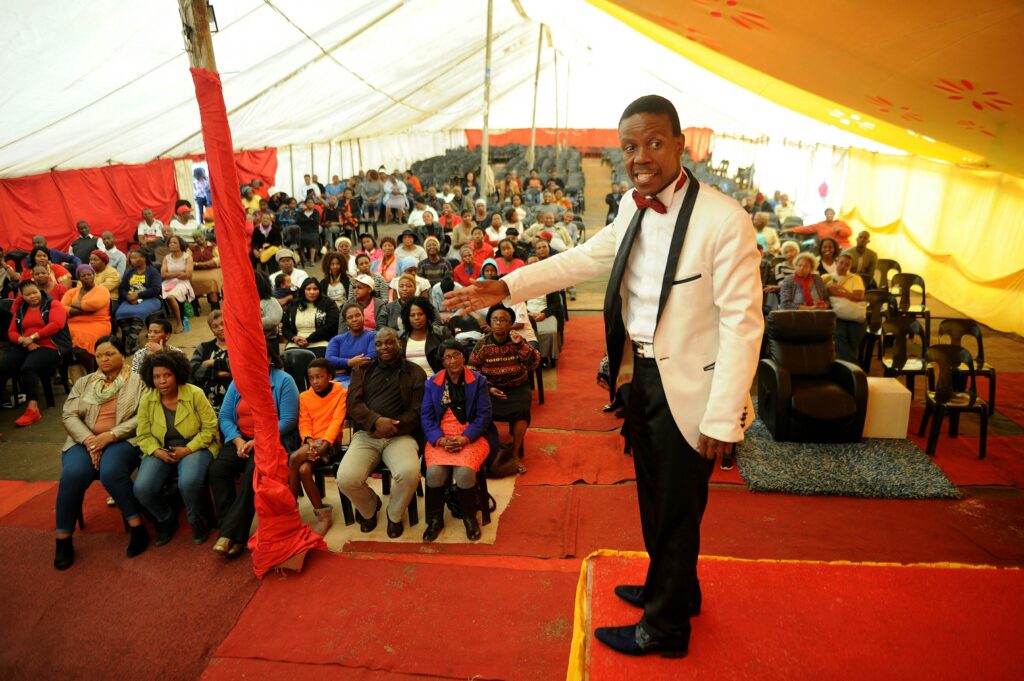 KATLEHONG, SOUTH AFRICA JULY 12: Prophet Paseka ‘Mboro’ Motsoeneng of the Incredible Happenings Ministries during a service on July 12, 2017 in Katlehong, South Africa. Controversial and self-proclaimed prophet Mboro Motsoeneng asked his followers to fund his legal fees as he prepares to battle with the cultural and religious rights commission in court. (Photo by Gallo Images / Sowetan / Veli Nhlapo)
“I used to think there is nothing political about this commission; there are known chapter nine institutions that could be political. But I was shocked to see that the decision for the chairperson [not to come back] at that time in 2019 was a decision taken while I was still at the CRL Commission, but taken at a very political level. So maybe I underestimated the politics behind the work,” said Mkhwanazi-Xaluva.
“So for me, you correctly say that I’m more than disappointed that nothing has happened in terms of taking the proposed legislation forward that every religious leader must belong to an umbrella organisation that is going to monitor them.”
She says religious institutions need to be monitored because many poor South Africans pour a lot of their finances into it. This includes traditional healers. Her investigation found that people would pay thousands of rands for a prayer.
In 2017, the commission handed over a report to the parliamentary cooperative governance and traditional affairs portfolio committee, which found that religious freedom had been interpreted, enacted and exercised in ways that could not pass the “reasonable person” or “objective observer” test.
Mkhwanazi-Xaluva’s report found that the imperative about exploitation and therefore financial matters led the commission to infer that there were financial issues in religious organisations that were illegal.
She also found that some churches should be investigated by the National Prosecuting Authority, as well as the home affairs and social development departments.
She told parliament that some church leaders gave the impression that they were above the law and that no process would affect them.
Her damning 65-page document was never discussed nor acted upon by parliament.
“It really breaks my heart because I sacrificed a lot, personally, to do the work. I persevered even when there were threats. I persevered even when that system refused to give me bodyguards. I had to get bodyguards from the commission. For the rest, I was on my own,” Mkhwanazi-Xaluva said.
“I feel it was a lost opportunity. I still hope this report will surface somewhere in the cooperative governance and traditional affairs portfolio committee in parliament. I’m hoping the recommendations will be taken very seriously.”
But her time in the commission was not lost. Her achievement included public awareness campaigns on initiation and an accurate report on the death of young men as a result of initiation.
“I think what we achieved with the commercialisation of religion was to outline how much this thing is costing poor people. It was the first time that anyone could make the religious leaders come to account,” Mkhwanazi-Xaluva said.
“No one [previously] had the audacity to summon them to say: come, I’m issuing a summons, if you don’t come I will lay a criminal charge … So you could ask them nicely and they refuse to come. But once you issue a summons to say: I want your financial [records], I want your qualifications, I want to know whom you report to, that gave us a clear framework as a nation to say: if you are feeding people grass and snakes and whatever else you want to feed them, what are your actual qualifications for you to be able to do all of these things?
“I think people who don’t normally ask those questions are people that go to those churches. Mostly it’s the sexual violations that were taking place in those churches — I think we broke that silence.”
One such case of sexual violation that has been under the media spotlight is that of controversial televangelist Timothy Omotoso, who faces 63 charges including racketeering, rape, sexual assault and human trafficking. Omotoso is accused of trafficking more than 30 girls and women from the three branches of his church, Jesus Dominion International, to a house in uMhlanga, KwaZulu-Natal, where he allegedly sexually abused them.
“I’m always proud when I see that Omotoso is still in jail; his case is still continuing. It might not have had that much attention. He could have still been doing whatever he was doing there but it’s not happening anymore because then people realise these are not honest people, these are not people who can’t be touched, that if you touch them you are going to die,” Mkhwanazi-Xaluva said.
“I’m still alive and I’m still here and I’m living proof that these people are all talk and no show at the end of the day.”Professor Luka Mosoma was appointed as the new head of the CRL Rights Commission in 2019.
[/membership]