Of the 4 983 households affected by the floods only 1 197 have been assessed and the majority are still living in mass-relief shelters. Photos: Delwyn Verasamy/M&G
When water started to engulf subsistence fisher Kevin Pearce’s home at Greens Farm during the April floods in Port St Johns, his biggest fear was that it would destroy his deep freezer.
As the water rose, Pearce and his brother Markie improvised a platform out of a table and a cupboard and managed to lift the freezer — essential for storing the fish they sell to earn a living — to above the eventual flood level of about 1.5m.
The coastal town, which falls under the OR Tambo district municipality, was ravaged by the floods that hit parts of the Eastern Cape and KwaZulu-Natal on 13 April, with the worst of the flooding affecting the central business district, Mthumbane and Greens Farm.
Much of Greens Farm, a former banana plantation, part of which was occupied illegally by people who built homes on the hillside because there was little low-cost housing in the town, was under water for several days.
 A canal in Port St Johns overflowed during the April floods.
Several houses further up the hillside were washed away while others were damaged but are still standing.
At the time, the OR Tambo municipality said that about 400 households, housing about 1 000 people, were affected by the flooding.
Several areas were evacuated by members of the South African National Defence Force based in the area, while food parcels, blankets and other emergency relief measures were distributed by municipal authorities to displaced people.
“It was heavy,” Pearce recalled. “We woke up at about 5.30am and the water was already starting to come onto the verandah. We were busy with buckets trying to push the water back but it didn’t work.
“Luckily we managed to get the freezer on top of some cupboards, right by the roof, so the water never got to it. The mattresses and everything else got ruined but at least we saved the freezer. This way we can still work,” he said.
Pearce and his brother sell fish to local restaurants, residents and tourists for R50 a kilogramme, with each earning between R2 000 and R3 000 a month, depending on the demand for their catch.
Their family, which has lived at Greens Farm for as long as either can remember, has produced several generations of subsistence fishers and motor mechanics.
“We couldn’t work for the whole week because of the floods. Nobody could get in or out of here. The disaster management people did bring us some food parcels but that was it. Since then, nobody has even come here,” he said.
 Downpour: Kevin Pearce managed to save his deep freezer from the flood waters.
Pearce said the flooding had been worsened by an unfinished culvert, installed by the municipality, which has still not been completed a month and a half later.
“This half job here was part of the problem. There was no way for the water to drain away so it just flooded all the houses here.
“The job still hasn’t been finished, so when there’s heavy rains again, we are going to have a problem,” Pearce said.
Other residents complained of a lack of response from the Ports St Johns local municipality to the flooding, which blocked the R61 to Mthatha for several days and left Mtumbane, above Second Beach, cut off by landslides.
Lodges and other businesses along the banks of the Mzimvubu River, which borders the tourism and fishing town, were submerged when the town’s drainage system was overwhelmed.
Most were back on their feet when the Mail & Guardian visited the town, but some of its most vulnerable residents are still reeling.
Phumla Malgas and her four children were trapped by flood waters for several days in the mud house she built on the hillside at Greens Farm 12 years ago.
The area was cut off by the flooding.
The house was badly damaged — the walls crumbled under the force of the water that tore through the house — and is still both a health hazard and a potential death trap, but Malgas does not have an option but to continue living there.
“The water came down the hill and right through the house,” she said. “The walls were breaking and the water was inside the house. We couldn’t get out because the water was full in front of us.
“We couldn’t get out for four days. Nobody came to help us,” she said. “Other people got blankets and food parcels. We got nothing.”
Malgas moved to Greens Farm from Caguba location, where her parents live, to try to find work in town. She is surviving off childcare grants and occasional work.
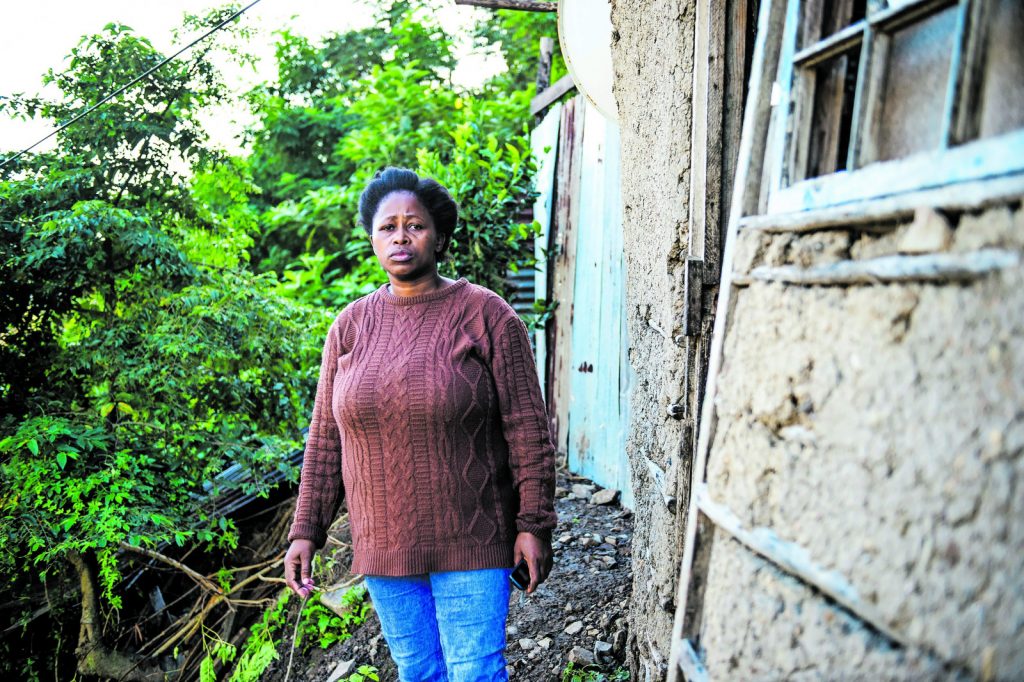 The water damaged houses including that of Phumla Malgas
“I came here to try and make a better life for my kids and to be closer to schools where they will get a better education. I failed,” she said.
Malgas said she had given up waiting for an RDP house from the municipality, for which she had applied more than a decade ago.
She said that she has no choice but to stay where she is, despite the daily danger and the threat of more floods during the rainy season later in the year.
“I did apply for an RDP house.
I have asked for jobs at the municipality but nobody has helped me. I vote. I voted last time. There are RDP houses, but they are given to certain people,” she said.
The seven families living at Isinuka Falls, a hot spring just outside Port St Johns that is frequented by tourists and pilgrims making use of its healing waters and mud, spent more than a week cut off by flood waters.
Thandi Hlela, a mother of nine who earns a living selling water at Isinuka, said she and other residents had to wait for the water to subside with no assistance from the authorities.
“Nobody did anything for us here. We had to wait for the water to go down so that we could go and buy food. It was very difficult for us to survive here,” Hlela said.
Nkosingiphile Seleman, who was born in Isinuka, said they had been given blankets after the floods by disaster management officials but that they had otherwise had to fend for themselves.
“Everything here was wet. Our houses and blankets and food were full of water. We couldn’t get out of here for two weeks and nobody came to help us,” he said.
 (John McCann/M&G)
Port Saint Johns mayor Nomvuzo Mlombile-Cingo undertook to respond to detailed questions from M&G but had failed to do so at the time of writing.
Mlombile-Cingo said in a TV interview in April that roads and bridges had been washed away, with more than 130 roads damaged.
A total of 420 people had been left homeless, while the homes of more than 1 000 people had been damaged. Schooling had been interrupted at several schools, while a six-year-old learner had drowned in the flooding, she said.
Provincial and national government officials visited the town after the floods to assess damage to property and infrastructure, while the South African Social Security Agency and NGOs assisted with relief efforts.
Mlombile-Cingo said the municipality had “tried our best” to prevent the flooding by cleaning drains but the heavy rainfall, combined with high tides at the entrance to the Mzimvubu River, had seen a repeat of the damage the town experienced in 2019 during the last floods.
[/membership]