Impofu Dam. (File photo)
On Friday, Rose-Anne Moodaley was doing what she always did: ensuring that there was enough drinking water to last the weekend for the 31 residents of the Malabar Home for the Aged in Gqeberha in case the supply was cut again.
“We’ve got water tanks … and we depend on our wonderful local councillor and our community who help us with borehole and spring water,” said the home’s administrator. “We hear of Day Zero looming and it’s scary, but in the northern and western areas of Port Elizabeth, we’ve long been without water.”
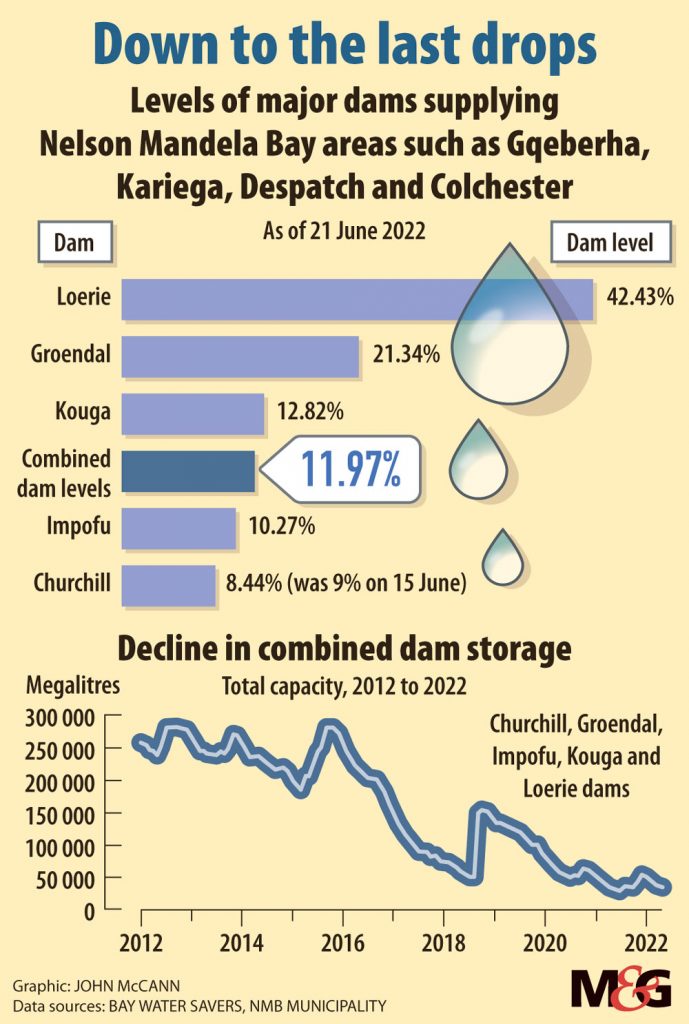
Day Zero appears imminent in drought-hit Nelson Mandela Bay metro, where taps could run dry within days, affecting 40% of the metro’s residents, largely in its western half. The Churchill Dam has about six days of water remaining, while the Impofu Dam has been decommissioned. Total dam storage is at 11.97%, while the water demand is 290 million litres a day, outstripping the targeted 230 million litres a day.
The neighbouring Kouga local municipality is in trouble too. With the level of Churchill Dam at 9%, the municipality implemented water-shedding on 13 June for Jeffreys Bay, Humansdorp and the Greater St Francis Area. Every day the water supply in these towns is switched off from 10am to 4pm.
“We have been trying to delay the need for water-shedding but the situation is critical, and we cannot avoid it any longer,” said Hattingh Bornman, the deputy mayor of Kouga
The municipality has urged residents to use no more than 25 litres of water per person a day. It can supply between 40% to 50% of the current water usage from its boreholes and fountains while more than R51-million has been allocated to help it secure extra water.
“This will be used to implement various short-term projects … should no more water be available from the Churchill Dam,” Bornman said, adding that the municipality had seen a reduction in water consumption over the past week. “The water-shedding is not a long-term solution and we are working hard to get additional water sources online.”
‘Failed state’
Anthony Turton, an affiliate professor in the Centre for Environmental Management at the University of the Free State, says South Africa is not dealing with a failing state and is now in the midst of a “failed state reality”.
He defined state failure as the inability of a government department to accurately interpret signals emerging from its operational environment, and then to implement a mitigation strategy that is well thought-out and adequately resourced.
“The fact is that the Nelson Mandela Bay water crisis has been known since the Cape Town Day Zero crisis, and nothing was done about it,” Turton said. “The fact is that the current dam levels in the area are marginally better today than they were a year ago, so this has not suddenly crept up on the decision-maker and shouted, ‘Boo!’.”
“The fact is that the canal transferring water from the Orange River Project to the city storage dams has been in dire need of repair, and nothing has been done about it other than to divert the money elsewhere,” he added.
“The fact is that a month ago, in the face of the most serious crisis the city has had in a few decades, the municipal leadership rejected assistance from the state, indicating that they had no real grasp of the implications of the circumstances in which they find themselves. Their focus was on preserving local power and financial privilege of the elite rather than resourcing a turnaround strategy.”
All of these are classic elements of a failed state, Turton said. “Everyone is numbed by the myth that the water crisis is looming but not yet upon them. Personally, I cannot see how the local economy can survive, even if a miracle happens and massive rainfall occurs in the next week. Investors need confidence in the government and here we have a failed state scenario for the whole world to see.”
National plan on Day Zeros
The water failures in the Nelson Mandela Bay metro underline the need for a national plan on Day Zeros, said the Water Community Action Network (WaterCAN), an initiative of the nonprofit civil action organisation, Outa. It warned that Day Zeros “is and will be the water challenge of the next decade” for South Africa.
The metro is not the first local city or town to get close to Day Zero and “neither will it be the last”, WaterCAN said: “South Africa is a water scarce country and the onslaught of climate shocks on top of failing infrastructure and local government means that water quality and safe supply needs to be addressed with urgency.”
With the early warning of a Day Zero, the metro should have put effort into reducing leaks, which amount to an estimated 80 million litres of water a day. “Why do you wait until you’re in the eye of the storm before you do anything?” asked Ferrial Adam, the manager of WaterCAN.
The water and sanitation department restricted extraction amounts but instead of reducing water use early in the disaster, the metro continued to over-extract water by three times the required amount. “They didn’t listen,” Adam said. “Why did the national department not arrest the municipal manager because this is a crime against the people?”
The metro, too, failed to use R183-million from the drought relief grant, which had to be returned to the treasury.
Adam said the water crisis worsens inequalities. “You’re going to have internal wars because of water — the borehole bourgeois who are going to be able to afford to drop a borehole in their backyards and the poorer communities who are dependent on water tankers — I call them the water tanker mafia. If you think that that’s the state of our water, it’s terrifying.”
Out of water
The water crisis in Nelson Mandela Bay and the water rationing that has been introduced by eThekwini municipality for the next year is “symptomatic of serious governance collapse”, said Benoit Le Roy, the South African Water Chamber’s chief executive. “These things take decades to manifest themselves and then everybody says what happened? Well, the government has not done its job for three decades and I say that with no reservation.”
Luvuyo Bangazi, spokesperson for the multi-sectoral joint operations crisis committee, said it planned to have cleared the backlog of more than 3 000 leaks by the end of the week. About 700 new leaks are reported weekly. “That’s a lot of millions of litres that can go back in the system. It’s a low hanging fruit that we’re attacking with everything we’ve got …
“We have a process where the two barges are being relocated — one from Impofu and one from Churchill — a contractor was appointed on Friday. Once those barges are relocated … we’re going to resume [abstraction] but unfortunately we have a shortfall right now.”
[/membership]