Will the South African Communist Party and the labour federation ever leave the ANC or are rumblings just hot air? Photo Delwyn Verasamy
ANC chairperson Gwede Mantashe, with credentials that include extensive trade union work, was the strategic choice to help quell workers’ resentment towards the party at Cosatu’s 14th congress last week.
But the ANC had seriously underestimated the wrath of the workers, or overestimated Mantashe’s standing in the trade union federation.
The frustration of the workers on the first day of the congress was palpable. Never before had an ANC delegation — much less one of the founders of the National Union of Mineworkers (NUM), the largest affiliate of Cosatu — been subjected to such humiliation.
The signs were there. Just a few months earlier, ANC president Cyril Ramaphosa, another party leader with a background in public sector unions, had to be swept away in a police Nyala by his security team during one of Cosatu’s key annual events, its Workers’ Day rally.
Mantashe, after being chased away on the first day of the congress, was again seated in the front row on Tuesday, waiting his turn to deliver a message of support from the ANC. That was not to be. Mantashe was booed and forced to abandon the speech. The party’s patriarch left the congress with his tail between his legs.
Also on Tuesday, South African Communist Party leader Solly Mapaila fired warning shots at the ANC, suggesting a possible exodus from the alliance if workers gave the green light to the SACP to contest the 2024 elections. Political analysts have suggested that this could signal the end of the tripartite alliance.
 The ANC’s relationship with its alliance partners has been controversial. Photo’ Delwyn Verasamy
Cosatu and the SACP have long called for a reconfiguration of the marriage, and ANC president after president has promised this, but nothing has come to fruition.
In its current form, the alliance partners have little say on the policy direction taken by the ANC.
Some SACP members have questioned why ANC branches are not discussing this matter during policy discussions and talks about contestation.
Mapaila said the ANC has moved the goal post on many occasions, leading to the realisation that the radical transformation agenda has taken a backseat.
He has previously said that the left edges of the alliance, who pushed for a working class programme and campaigned for the ANC under this programme, have been pacified.
But now “the ANC must understand the ground has shifted. When we are talking about changing the balance of power inside and outside of the movement, this is what we are talking about. The grounds have shifted, the working class cannot afford any more to be pacified.”
One wonders if this threat holds water.
The ANC’s relationship with its alliance partners has been controversial. It was the alliance that was instrumental in former president Thabo Mbeki’s demise. And after initially supporting Jacob Zuma, the alliance called him out for enabling state capture, going as far as banning him from its programmes.
The SACP has also contested local government elections.
Political analyst Ntsikelelo Breakfast argues that part of the problem is the three organisations are pulling in different ideological directions.
He said that although Mantashe and Ramaphosa have been at the receiving end of workers’ anger, it is not directed at particular individuals in the ANC but at the party’s national executive committee.
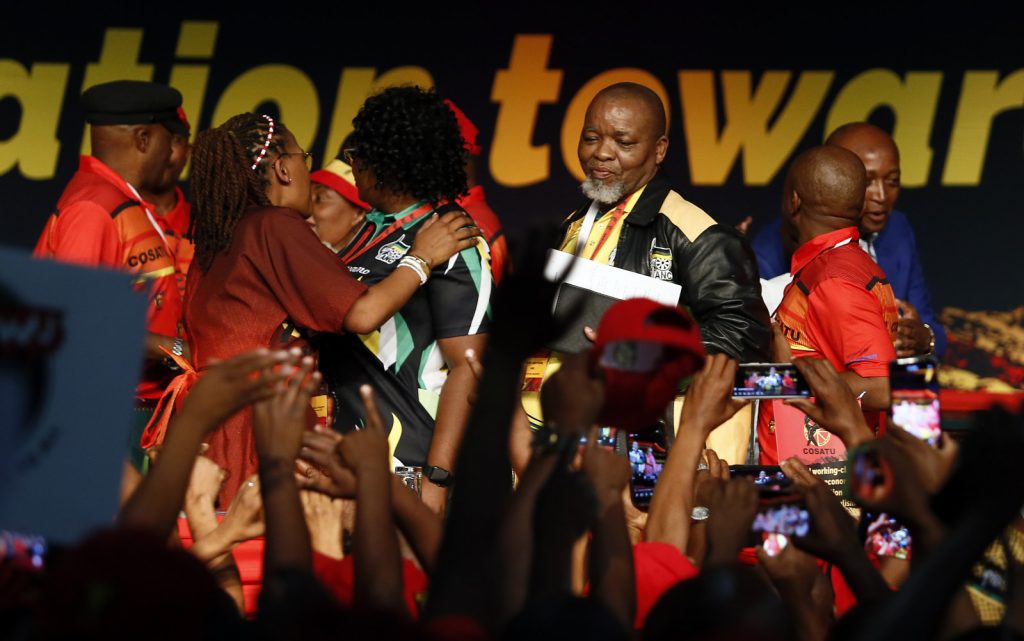 Has the ANC overestimated Mantashe’s standing in the trade union federation?
And although Cosatu members are clear about their feelings towards the ANC, their leaders do not share the same sentiments.
“There will always be differences in the alliance,” said Breakfast, “but if the SACP breaks away after the ANC has been dealt a blow electorally, I would see that as tantamount to opportunism.
“The alliance came to be because the organisations agreed on the national democratic revolution … The question now is when are we going to see the second transition of the revolution that will lead to the liberation of the working class?
“Comrades are not honest, because the SACP and Cosatu have had access to political proximity and by so doing, having access to economic resources, living a good life out of that access. Now they want to jump ship because the ANC is weakened. Why?”
Political analyst Mcebisi Ndletyana added that part of the problem the tripartite alliance faces is that Ramaphosa made promises that suggested he is amenable to their concerns and demands, but nothing to reflect that was ever implemented.
Mbeki never made any promises to the alliance partners, Ndlentyane said, adding: “My sense is that they would say, we knew where we stood with Mbeki but Ramaphosa takes them along for the ride making all sorts of promises, hence their disappointment would be as much as it was against Mbeki, if not more so. It’s like a jilted lover.”
Delegates who attended last week’s Cosatu congress said it was unlikely that the SACP and Cosatu would endorse Ramaphosa for a second term.
Members rejected Cosatu president Zingiswa Losi’s message in her opening address. She subtly criticised the ANC for failing to rid itself of corruption but said the party was the only one capable of advancing workers’ rights. Losi said the alliance had many problems but remained the most progressive and relevant political formation to champion the cause of the working class.
Her address was delivered before Mantashe was scheduled to speak.
Although Cosatu and the SACP do not have voting powers in the ANC’s conference in December, Ndletyana believes that not endorsing Ramaposa would be a massive blow to him.
“That would be a validation of an already existing sentiment throughout society that he is not living up to his own promises. It would add to the narrative that he is turning out to be a disappointment,” he said.
[/membership]