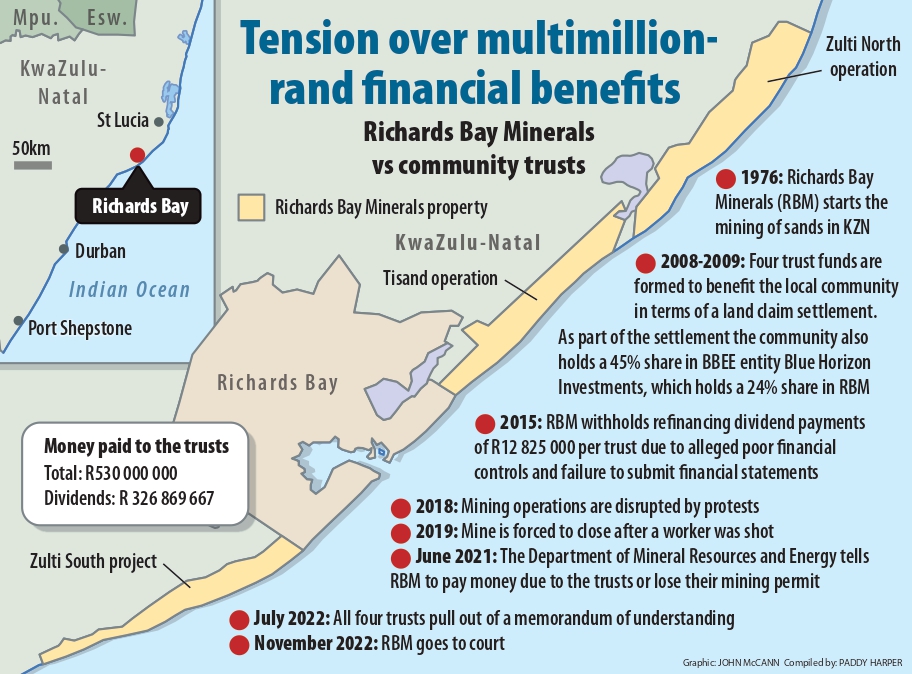
Richards Bay Minerals wants the high court to remove amakhosi and their families as trustees and beneficiaries of four trusts to which it has thus far paid R500 million in dividends to stop “abuse” of the funding, intended for community development purposes.
RBM has also halted any further payments to the trusts until the court rules, as it believes that as much as 80% of the money has been spent on salaries, expenses and payments to unauthorised third parties.
This is after amakhosi from the Dube, Mkhwanazi, Sokhulu and Mbonambi traditional authorities pulled out of a process to reform the trusts — set up in 2009 as part of a land claim paid to the communities and a share in an empowerment deal for 24% of the company — to which they had agreed when paid out R77 million last August.
The Rio Tinto subsidiary, which mines and refines ilmenite, zircon and rutile in the area north of Richards Bay, has approached the court as it fears that further payouts to the trusts would perpetuate the “historic pattern of abuse of trust funds and gross lack of governance” to “the greatest disadvantage of the intended beneficiaries of the public benefit trusts”.
In papers filed in Pietermaritzburg, RBM managing director Werner Duvenhage said if the court did not order the trusts to be reformed, “there is a reasonable prospect that the trust income flowing through the dividends paid…will not be utilised to promote and protect the interests of the host communities who are the intended beneficiaries of those dividends”.
RBM has asked the court to amend the beneficiary provisions by removing amakhosi and their families as trustees and beneficiaries; to modernise the trust provisions to improve controls and accountability and to introduce provisions relating to social investment policies of the trusts.
In his founding affidavit, Duvenhage said that the provisions of the trusts brought about consequences that the founders did not contemplate or foresee as they had facilitated an “abuse of power” by amakhosi who were appointed as trustees.
He said that from 2011, concerns had arisen over the administration and financial controls at the trusts, and RBM had “continually engaged” with them to try and modernise their provisions and improve their governance.
Further payouts were held in trust by RBM’s lawyers because of the concerns, with negotiations continuing with the amakhosi, until August 2021, when the department of minerals and energy intervened.
RBM was ordered to pay the trust or lose its mining licence and complied, signing a memorandum of understanding with the trusts agreeing to a reform process while releasing R77 million to the four trusts.
Duvenhage said despite the agreement, the amakhosi had failed to continue with the process and pulled out completely earlier this year.
“None of them appear to have embarked in good faith upon the negotiations referred to in the August memorandum of understanding (MOU). Instead, the lack of progress to achieve the objects of the August MOU has brought about the continued abuse of trust property for the benefit of on-beneficiaries, the amakhosi and their immediate families and to the prejudice of the host communities as the intended beneficiaries,” he said.
 RBM managing director Werner Duvenhage
“In the circumstances, the applicants have no other choice but to approach this court for an appropriate set of orders directed at the variation of the trust instruments.”
Duvenhage said the trustees had “failed or neglected to fulfil their fiduciary duties” and asked the court to alter the trust documents “to ensure conformity in respect of the operation of the trust instruments and in an effort to negate further transgressions by the trusts in the near future”.
He said the trusts had failed to provide complete financial records, while each had only filed a single quarterly report — which did not have the required detail on spending — since 2009.
Duvenhage said that in the case of the Mbonambi Community Development Trust, of R19 million paid by RBM on 24 August last year, R18.5 million was spent the next day.
“Importantly, none of the payments made appear to be in respect of public benefit activities and there is no recordal of a trustees’ meeting held prior to the money being spent by the trust. In the absence of a trustees’ meeting where it was to be resolved as to how the money would be spent, there is no evidence that the trustees’ authorised these payments,” he said.
Duvenhage said the trust paid R1 million to its chairperson for travel expenses without any further detail; a further R3.8 million to its accountants and R7.3 million for a toilet block at a local school
Other alleged abuses by the trusts included the illegal payment of R5.8 million to the inkosi.
Duvenhage said RBM was aware of an investigation by the Directorate for Priority Crime Investigation (the Hawks) into alleged corruption in the Phalane Trust, a land trust run by the Mkhwanazi traditional authority, and payments made to it.
The trusts had failed to register as public benefit organisations and had generated significant tax liabilities because of this, he said.
RBM also believed that the trustees were paying amakhosi more than the 10% of dividends they were entitled to and were failing to distribute the 57% they were meant to for the benefit of the community.
Other issues included payments in breach of the trust deeds; higher spending on expenses (80%) than on the public beneficiaries (20%); a lack of minutes of trustee meeting and a lack of supporting documents to validate expenses and other payments.
RBM has also asked the court for step in rights, which would allow it to audit the trusts and “remedy” any irregularities in their finances or failure by the trustees to adhere to the trust terms.
 (John McCann/M&G)
Duvenhage told the Mail & Guardian that the matter was expected to be heard in 12 to 18 months.
He said the company had taken steps to improve its security in case the application sparked a violent backlash. Two staff members and two community members have been murdered in the Mbonambi area in shootings related to conflict over the chieftainship and contracts with RBM.
Protests and road closures over the disputes have impacted RBM’s operations badly in recent years, with the company being forced to declare force majeure from June 2021 until March this year.
Duvenhage said the company had gone to court as a last resort and was only interested in ensuring that the money it paid out benefitted the communities, and not just individuals who were abusing the trusts.
No criminal complaint had been laid, he added.
“Our prime intention is to improve the governance of the trusts in a manner that ensures that benefits flow to our host community members. Any criminal process following our application will be a decision made by the relevant authorities and we will not speculate on this,” Duvenhage said.
[/membership]