Happy days: Cyril Ramaphosa takes pictures of the crowd after being retaining the ANC presidency. (Photo by MARCO LONGARI / AFP)
Cyril Ramaphosa has won a second term as president of the ANC, taking 56.6% of the vote against Zweli Mkhize. Increasing his margin since 2017, Ramaphosa will be satisfied with the 13-point margin of victory.
Ramaphosa strengthened his hand in the governing party’s top seven, winning five of the positions including all of the crucial organisational positions: president, secretary general, chairperson and treasurer general.
The ANC will also take solace in the fact that three women found their way to the top seats for the first time.
Ramaphosa had entered the week sitting on roughly 63% of the branch nominations, but fears of rebellions in the North West, Limpopo and Gauteng provincial executive committees had narrowed the gap in our projections. Most branches stuck by their original nominations, splitting all provincial voting blocs and keeping the majority of the vote with Ramaphosa.
Paul Mashatile won the deputy presidency with a five-vote majority over Ramaphosa’s allies, Oscar Mabuyane and Ronald Lamola, who inexplicably split their vote and could have cost the campaign another seat among the top seven.
A clearer decision by the Ramaphosa slate for deputy president may have influenced voting patterns and perhaps decreased the number of spoiled ballots and abstentions (15). It could be argued that the Mabuyane/Lamola split vote may have cost the renewal camp this position.
Ramaphosa’s enforcer, Gwede Mantashe, won the chairperson position, which will come as a huge relief because this vote was also split with David Masondo. Ramaphosa’s forces will now feel justified by their decision to stick by Mantashe (48%) as opposed to Stan Mathabatha (47%), when backing the latter would have probably secured a larger portion of Limpopo and made the whole thing a lot easier for the president.
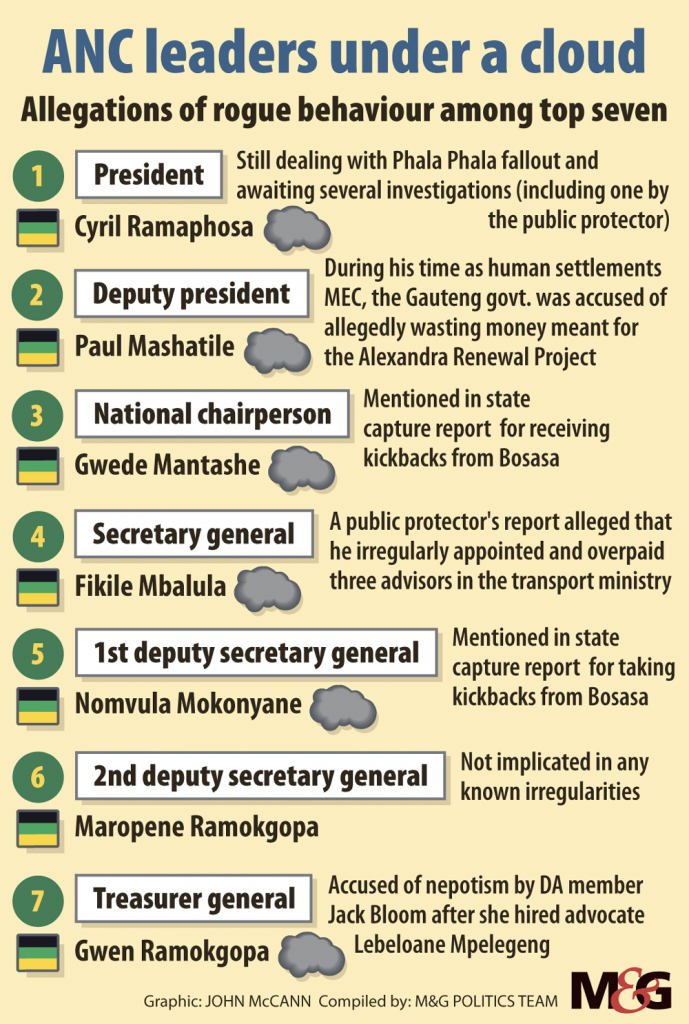 (John McCann/M&G)
The split vote could also have cost Ramaphosa’s allies the secretary general position, but Fikile Mbalula narrowly held off the so-called radical economic transformation (RET) candidate, Phumulo Masualle, by about 100 votes after Mdumiseni Ntuli ate into the renewal vote.
The RET’s big win was Nomvula Mokonyane, who took the position of first deputy secretary general by 50 votes over a rather compromised candidate, Tina Joemat-Pettersson, who was nominated from the floor for the Ramaphosa slate on Friday.
The second deputy secretary general position was won by 42-year-old Maropene Ramokgopa, young by ANC leadership standards, who is a close ally of the president, and his international relations adviser.
The treasurer general race was a mess. Mzwandile Masina pulled out of the race last night to consolidate the RET vote behind Pule Mabe. But his withdrawal came too late to have Masina’s name removed from the ballot paper, and 281 delegates still voted for Masina.
Mabe lost to another Ramaphosa ally, Gwen Ramokgopa, by 157 votes. So, Masina’s vote cost the RET a third spot on the top seven — although the same can be said of Benjani Chauke, who still pulled 590 votes, splitting the Ramaphosa ballot.
Strategically, it was a messy election from both sides, but Ramaphosa’s side always had the numbers. His power in the ANC has now increased, and that should translate somewhat into his approach in government — although the conciliatory leadership style that he has long possessed is unlikely to change radically.
The largest chunk of his opposition remains confined to KwaZulu-Natal, which, despite being the ANC’s largest province, cut lonely (albeit loud) figures at this conference and again left empty-handed.
Mike Law is a senior researcher at the Paternoster Group: African Political Insight.
[/membership]