Water hyacinth, native to South America, is described as the world’s worst aquatic weed. It thrives in nutrient-enriched waters like Hartbeespoort Dam, forming dense impenetrable mats that affect boating, fishing and water sport activities, harms aquatic biodiversity. (Delwyn Verasamy/M&G)
In less than two months, invasive water hyacinth has made an aggressive comeback on the polluted Hartbeespoort Dam, spreading its coverage from 5% to about 50%.
But Julie Coetzee, of the Centre for Biological Control (CBC) at Rhodes University, is confident that the tiny water hyacinth hoppers (Megamelus scutellaris) the teams rear and deploy can again successfully tackle the infestation of the world’s worst aquatic weed.
Last year, the release of 350 000 of these biocontrol agents whittled down the cover of the fast-growing floating plant to less than 5%. “They are little soldiers doing their work with no need for thanks,” she said.
On Saturday, 82 passengers and crew of a cruise barge on Hartbeespoort Dam were safely brought to shore in a rescue operation. The Alba was disabled when the propellers became entangled in discarded fishing nets and natural debris before “being surrounded and trapped by 1.2m to 1.4m high hyacinth that surrounded the barge in natural drift while they were repairing the motors”, according to the National Sea Rescue Institute.
Hartbeespoort Dam is a “dynamic, ever changing system” that is under pressure from urban pollution and the elements, Coetzee said.
“What happened was the water hyacinth collapsed by March last year. And then it didn’t come back after winter, which is what normally happens. But that’s because this other plant — common salvinia —took over.”
Salvinia minima is also an invasive plant, native to South America, Mesoamerica and the West Indies.
The action of the water hyacinth hoppers had reduced the water hyacinth’s competitive ability, allowing the common salvinia to dominate. This new invader took its place because of the highly polluted state of the water.
The common salvinia is an aggressive floating fern that forms dense mats, which prevent light from reaching indigenous plant and fish species. This lowers oxygen levels that could cause death. Water hyacinth causes similar damage but its infestation also prevents river transport, fishing, and can damage bridges and clog dams.
Plant competition is a “very powerful regulatory force”, Coetzee said. “This salvinia was growing healthily while water hyacinth was struggling because it was being eaten by megamelus. The water hyacinth seeds didn’t germinate as we would have expected in October.”
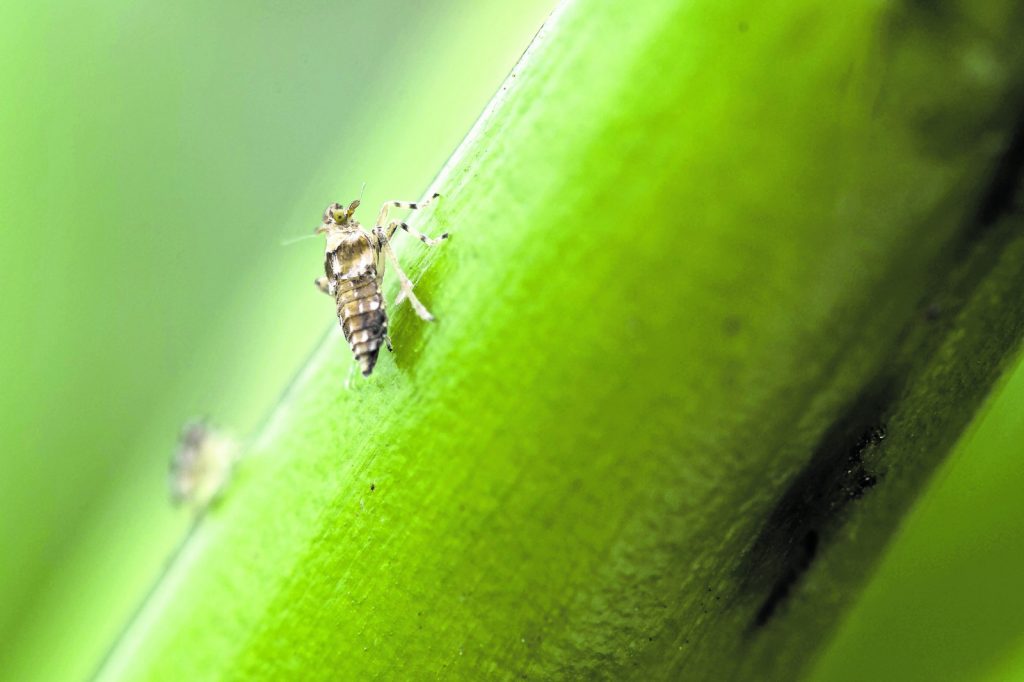 Water hyacinth hoppers. (Delwyn Verasamy/M&G)
By that stage, salvinia covered 48% to 50% of the dam’s surface in dense mats, frustrating residents, business owners and tourists. A harvester was deployed by Harties stakeholders to remove the dense mats of the water fern. Funding constraints meant that progress on the testing of a biocontrol agent for the salvinia by the CBC was thwarted, slowing down the application for release process.
“And then, in late November, the catchment areas of the dam around northern Johannesburg, Magaliesburg and Pretoria received well above average rainfall, filling the dam and the sluice gates were opened. Because of this, much of the salvinia washed downstream.”
At the same time, pollution by nutrients such as nitrogen and phosphorus — mainly from sewerage works — which act like fertilizer, are washed down the rivers and into Hartbeespoort Dam.
This created the “perfect environment” for the few water hyacinth plants that had remained to proliferate.
“Increased nutrient availability, low insect population numbers because of the small water hyacinth population size, and the absence of competition from salvinia allowed water hyacinth to explode,” said Coetzee.
Each water hyacinth flower produces thousands of seeds, which remain viable for up to 25 years.
Coetzee said the department of water and sanitation needs to address the sewage that flows daily into the dam.
“Without nutrients, which come from our waste, aquatic plants can’t grow and spread, making their populations an order of magnitude easier to control. How this is addressed is another issue entirely.”
The department of forestry, fisheries and the environment, which has a mandate to control invasive species, funds the CBC to work on biological control solutions for many invasive species, including water hyacinth — hence the hopper programme at Hartbeespoort Dam.
Because the CBC alone could not supply the water hoppers required for the dam needed, in late 2021 and in 2022, it appealed to people living around the dam to contribute to rearing the tiny bugs so that there would be masses available when the water hyacinth returned.
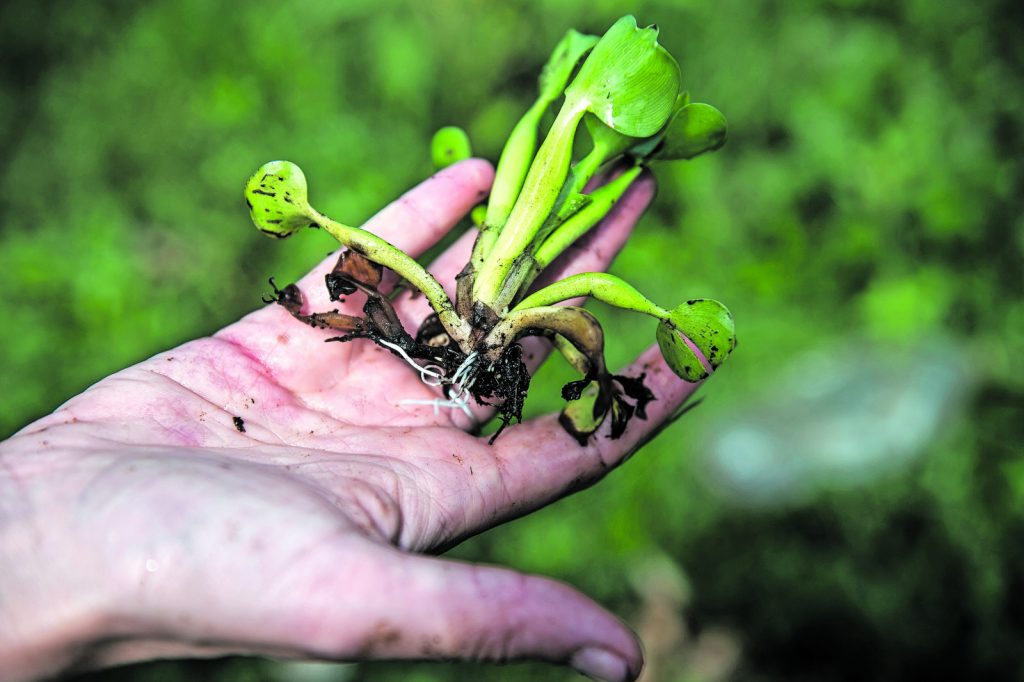 The water hyacinth hoppers are bred and released to tackle the invasive water hyacinth (above). (Delwyn Verasamy/M&G)
“Some stakeholders responded, but certainly not enough. Currently, the CBC is working with community stakeholders at some housing estates and with private individuals to rear the hoppers and release them on the dam.
“We’ve got five or six more estates coming on board,” Coetzee said. “We’ll set these rearing stations up and hopefully increase the bug populations that way.
“What we were trying to promote is not having to wait for the bugs to build up by having millions of them on standby for release as soon as the plants exploded. And they exploded over December when people were down at the coast and now we are sitting with a lot of green — you’re looking at, like, 600 hectares of this stuff.”
She said the CBC is also sending hoppers from its rearing facility in the Eastern Cape for release on Hartbeespoort Dam.
“It is going to take time for the hopper populations to build up again to the levels that they have been at since 2020, but we know that they will if given the chance,” said Coetzee. “By March hopefully, we’ll start to see damaged plants, thousands of insects per plant, and people will start complaining that they’re in their houses again. But we just keep doing what we are doing, knowing it’s the most cost-effective and sustainable means of controlling this plant until the water is sorted.”
Wisane Mavasa, spokesperson for the water and sanitation department, said this week that it is now reinstating its programme at Hartbeespoort Dam.
“In the past couple of months, hyacinth has grown excessively in a short space of time, exacerbated by the load-shedding and the sewer spillages in various catchments, because, remember that the dam is fed from various catchments.
“The department working together with the DFFE [department of forestry, fisheries and the environment] is looking at reinstating that programme but right now, we’re also looking at involving communities and all sectors of society that are part of that because it’s more of a tourism site, than anything,” Mavasa said.
[/membership]