Large-scale corruption by staff members at the Kruger National Park is soaring and at least 40% of law enforcement employees are involved in graft.
This is according to Enact’s transnational organised crime report, which states that internal corruption is the greatest threat to the park. The February report by Enact — a European Union programme to enhance Africa’s response to organised crime — suggests corruption at Kruger, a local and international tourist destination.
The Kruger National Park acknowledged the report and welcomed its “overall sentiment”.
“It [the report] does not surprise us at all as it is something the organisation has always alluded to — that wildlife crime is orchestrated by sophisticated criminal syndicates and should be addressed by law enforcement agencies and those with relevant competencies,” said Isaac Phaahla, communication manager at Kruger National Park.
He said that public sector corruption, including bribery and abuse of position, is not unique to SANParks “but is widespread in South Africa, largely driven by several factors including access to high value assets, lack of rule of law, low social capital, low wages, the nature of bureaucracy, and failure of governance.
The report states: “Some put the figure of [Kruger] staff involvement ‘conservatively at 70%’, including staff who may not be involved directly in poaching but help facilitate it by providing information or concealing weapons.
“Today, however, the Kruger’s gravest threat is not poaching but the internal corruption that has metastasised as poaching syndicates have entrenched themselves around the park and organised crime has spread.”
The prevalence of corruption among its own ranks is, according to the report’s author, Julian Rademeyer, “a symptom of a breakdown in trust, staff cohesion and professionalism within the park”.
Phaahla said the park is implementing its “integrity management plan”. He reiterated the park has an emergency fund for employees who seek financial support.
“The organisation is also working on a career pathing for rangers, to improve employee engagement and [a] sense of belonging and purpose, with recognition of skills and performance.”
He added that more than 90% of staff members are from, and live in, areas next to the park, “which may put them at risk for being coerced or threatened into involvement in crime”.
Quoted in the report, head ranger Cathy Dreyer said: “It is impossible for someone to come into Kruger now without some sort of inside link or inside information.”
Quoting an unnamed official, the report noted: “The easiest way for syndicates to poach is to ensure they have done their homework internally.”
Most (96.9%) park rangers live in areas near the Kruger. Rademeyer found there were risks to rangers and their families living in the same places as the poaching gangs. Criminals would threaten the rangers’ family members.
“You work in the park, your wife is alone at home with the kids, and this is where the kids go to school. You make the choice,” reads a quote in the report by a poacher addressing a ranger.
The murder of Anton Mzimba, head ranger at Timbavati Private Nature Reserve, in July last year was a warning to rangers who decided to act against poachers.
Mzimba was shot outside his home in Edinburgh Trust in Bushbuckridge, Mpumalanga, after receiving several death threats. His wife was severely wounded in the attack but survived. His attackers have not been traced by the police.
According to Phaahla, improvements by Kruger National Park have been made.
“SANParks continue to forge good relations with local partners, including the SAPS [South African Police Service] communities, tribal authorities, and municipalities, as we strongly believe that’s its going to take an ‘all of society’ approach to overcome the scourge of criminality within KNP and surrounds,” he said.
“SANParks is on record that it is intolerant of criminality or corruption within its workforce.”
 (John McCann/M&G)
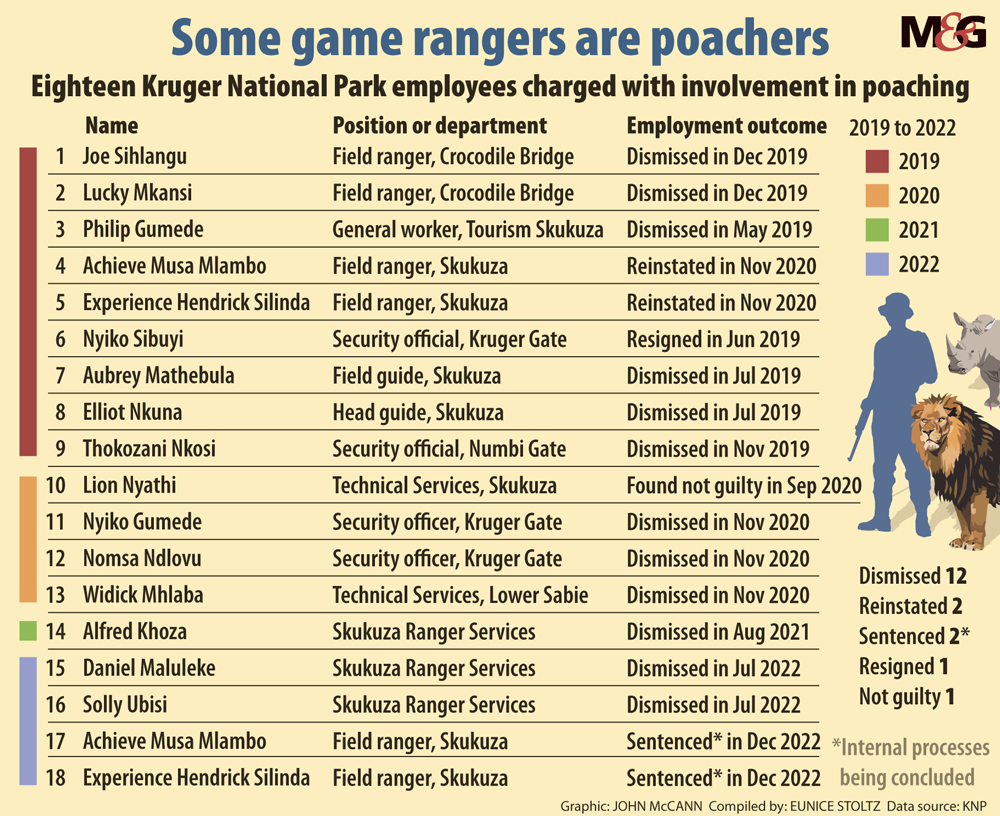
Phaahla confirmed that since 2012, a total of 54 employees were dismissed for their involvement in criminal activities, of which the majority continue to face criminal charges, while others have been convicted and sentenced.
Efforts to combat rhino poaching at the park have seen successes over the past few years.
The 2022 poaching statistics show a slight decline in poaching losses from 451 rhino in 2021 to 448 in 2022. The toll for private rhino owners was 86 rhinos countrywide.
Of the 448 rhinos killed for their horns last year, 124 were in the Kruger, representing a 40% decrease compared with those killed in 2021.
Rademeyer, the director of East and Southern Africa at the Global Initiative against Transnational Organised Crime, found relationships between Kruger’s staff members and management have become strained and increasingly toxic, poisoned by mutual mistrust and suspicion.
The report mentioned an investigation by the private auditing firm KPMG and the Special Investigating Unit that uncovered evidence of payments from syndicates to “at least 50 staff ‘from all walks of life’. And these numbers are likely to increase.”
In addition, the Convention on International Trade in Endangered Species Conference of Parties in Panama, in November, heard a report that warned of “targeted efforts by organised syndicates to infiltrate Kruger National Park employees to solicit information that assists them in poaching, such as rhino locations and ranger deployments”.
The role of employees has become more crucial as the park’s anti-poaching efforts and a programme to dehorn most of its rhinos have taken effect.
The value chain of corruption does not end with rangers; it includes game guards, trail guides, protection services and housekeeping staff, some of whom have been arrested.
Efforts to address internal corruption are in progress, Dreyer told Rademeyer, such as improving work conditions and relationships and reinstating training programmes put on hold for the past six years because of the focus on anti-poaching efforts.
Phaahla said that some programmes were suspended for two years as a result of Covid-19 but that “the organisation is slowly getting back to training programmes, creating cohesion, and focusing on the working environment becoming conducive to employee satisfaction”.
[/membership]