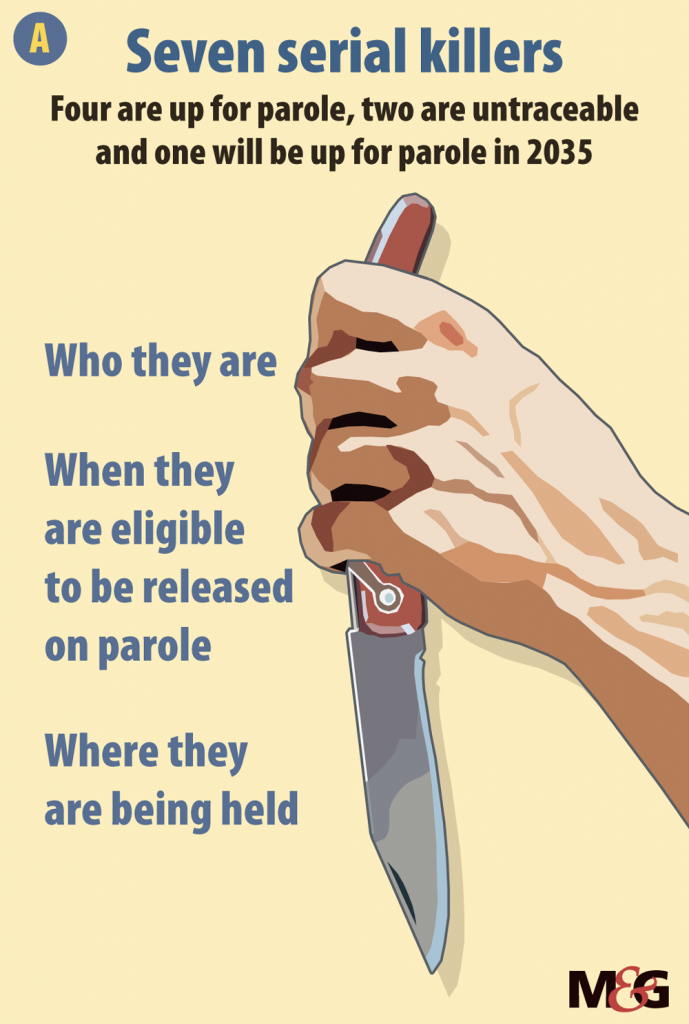
Four South African serial killers who collectively killed more than 105 people and were sentenced to life behind bars are under consideration for parole before the National Council for Correctional Services (NCCS).
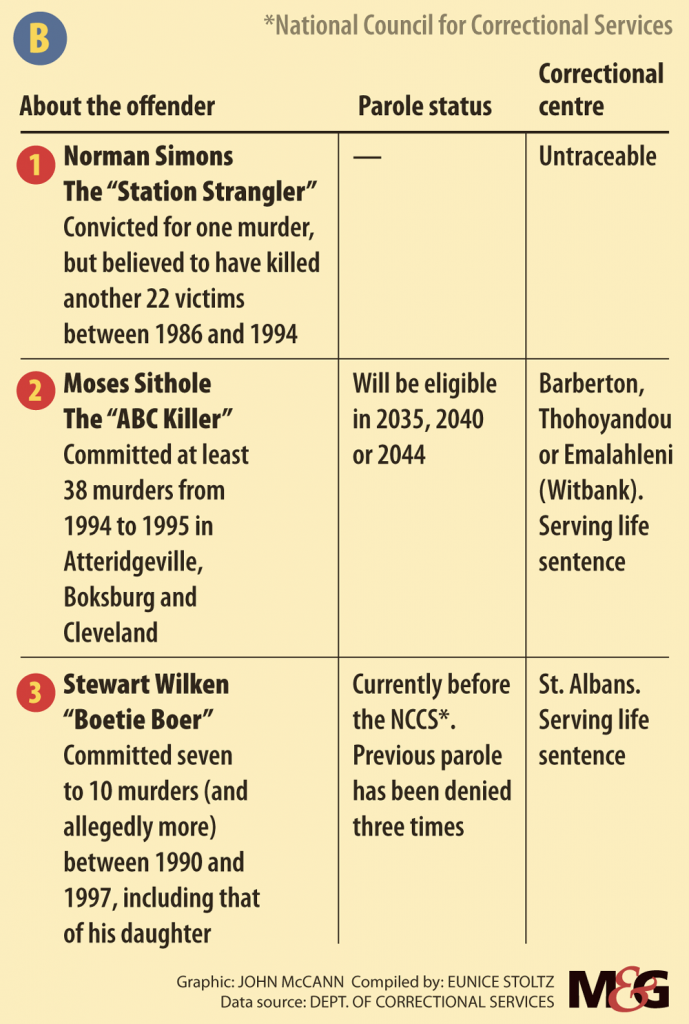
It is not the first time that convicted serial killers Christopher Zikode, Stewart Wilken, Cedric Maake and Lazarus Mazingane have been considered for parole. Both Zikode and Wilken have been denied parole three times, while Maake and Mazingane have had their applications rejected twice.
This has raised the question of how many times someone can be denied parole before the system eventually releases them.
Parole is an automatic process and “every offender is considered for possible placement on parole upon reaching their minimum detention period regardless of the nature of their offences”, according to the Department of Correctional Services.
Zikode, known as the “Donnybrook Serial Killer”, murdered and raped 18 people between 1994 and 1995 and was sentenced to 140 years in prison. Wilken, who confessed to murdering 10 people in the 1990s, is “a paedophile, incest offender, necrophiliac, cannibal, serial murderer who targeted children, adults, his daughter, an ex-girlfriend’s son [and] sex workers”, forensic psychologist Gérard Labuschagne noted.
“No matter how well he behaved in prison, he should never be released,” Labuschagne told the Mail & Guardian.
 Gérard Labuschagne
Dubbed the “Wemmer Pan Killer”, Maake was sentenced to 1 340 years in prison after he was found guilty of 27 of the 34 murder charges he faced in the late 1990s. Mazingane, the so-called “Nasrec serial killer” who was investigated by late top detective Piet Byleveld, was handed 17 life sentences in 2002 for murder, rape and robberies.
“It is correct that every person will get to a point in their sentence where they become eligible for parole hearings, not necessarily eligible for parole itself. But the reality is that almost everyone will get parole at some point,” Labuschagne said.
According to Singabakho Nxumalo, spokesperson for the correctional services department: “All offenders sentenced to life imprisonment between 1 August 1993 and 30 September 2004 must be considered for parole after serving a minimum imprisonment of 12 years and four months.”
Before coming to the NCCS, Zikode, Wilken, Maake and Manzingane’s cases were before the department’s internal body, the Case Management Committee, and also went through consideration by the correctional supervision and parole board. The final step after appearing before the NCCS would be a sign-off by the justice minister.
The department recorded a 99% success rate for parolees and probationers complying with conditions of release for the past three financial years. The 1% of former inmates who did violate parole conditions, and went on to commit serious and violent crimes, were “dealt with following legal process”, according to Nxumalo.
There are 58 977 parolees and probationers in South Africa.
 (John McCann/M&G)
“The progressive parole system in South Africa today is based on international best practice. It allows for independent decision-making by various role-players,” Nxumalo said.
But Labuschagne describes the parole system as “absolutely bizarre”.
One flaw, he said, occurs at the moment that a convict arrives at the prison without their relevant case file, judgment or sentencing details.
“Oscar Pistorius was convicted of one times murder. But so were Chané van Heerden and Maartens van der Merwe who lured their victim to a graveyard in Welkom, killed the victim, cut up his body, took body parts home, kept them in the fridge and skinned the face off the skull the next day,” Labuschagne said.
“They can’t be seen to have the same level of risk, even though they were both convicted of one times murder, however, without the details of the crime, you can’t adequately assess what you are dealing with.”
Another flaw, he says, is that none of the six people on a parole board are required to have a legal background. A parole board consists of a chairperson and vice-chair — both of them public representatives — as well as a representative from the department, two community members and an additional option for a police official.
“Decisions are made by people with no understanding of violence risk, no knowledge of psychology (who) must assess a psychologist’s report and make a recommendation for further treatment. It is absolutely bizarre,” Labuschagne said.
Recalling his involvement in the parole process of Morné Harmse, or the “Samurai killer”, who killed a fellow pupil and wounded two others at his high school in 2008, Labuschagne said psychologists’ reports were often ignored by parole boards. Harmse was released on parole in March last year.
In addition, there seems to be no standardised methodology for how the psychologist assesses the offender and “each psychologist seems to do what they see fit”, Labuschagne said.
It is only when a parole profile reaches the NCCS that a high court judge, clinical psychologists, social workers and medical doctors are present. The NCCS reviews the parole files and recommendations provided by the Case Management Committee as well as the correctional supervision and parole board.
Labuschagne believes the parole system needs a complete overhaul “from start to finish”.
 (John McCann/M&G)
“We need professional people on parole boards, not lay people. We need effective mechanisms to prevent corruption and an effective mechanism for a review of parole board decisions that is accessible to the public,” he said.
Gaps in South Africa’s parole system are continuously identified and addressed, Nxumalo told the Mail & Guardian, conceding that the current 2004 parole system “may require some restructuring and be in need of a review”.
“Such a review is currently underway,” he added.
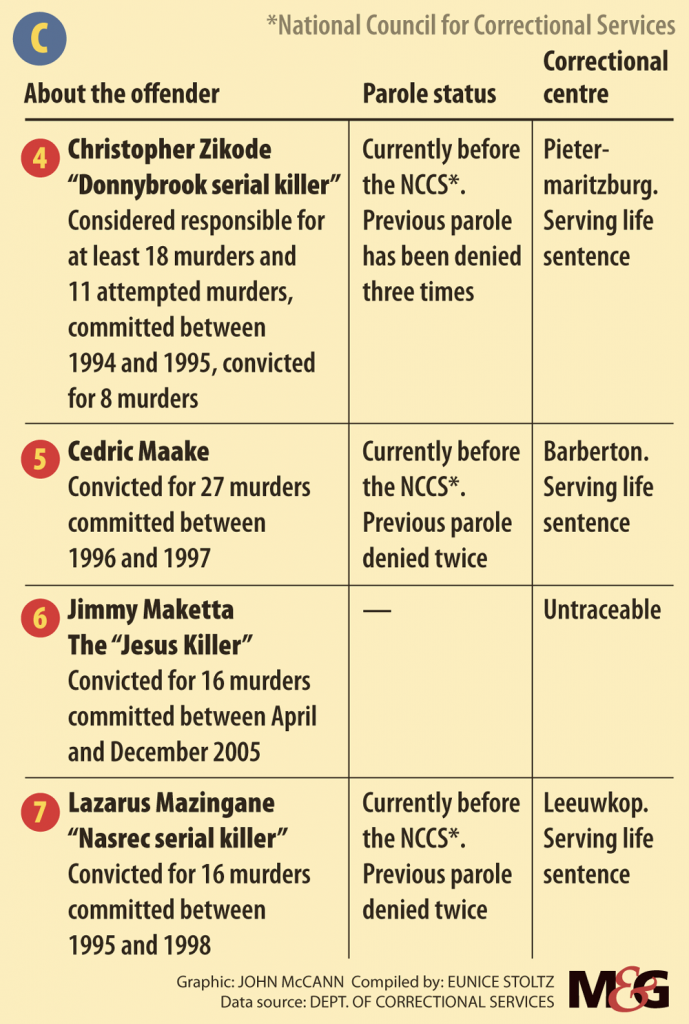
Meanwhile, the department of correctional services in the Western Cape has not been able to trace serial killers and rapists Norman “Station Strangler” Simons and Jimmy “Jesus Killer” Maketta, who are serving life sentences.
Between 1986 and 1994, the community of Cape Town was terrorised by a killer who targeted boys under the age of 13. Although charged with 22 murders, Simons was only found guilty of murdering 10-year-old Elroy van Rooyen and sentenced to life in prison.
Over a period of nine months in 2005, Maketta killed 16 victims and raped 19. He pleaded guilty to all counts in 2007 and was handed a life sentence.
 (John McCann/M&G)
When the M&G asked for details of all the convicted serial killers in the South African justice system, Nxumalo submitted a list which included Simons and Maketta but stated their statuses as “untraceable”.Western Cape spokesperson for correctional services Candice van Reenen was unable to confirm a rumour that Maketta had died in prison, while the National Prosecuting Authority in the province told the M&G that it did not keep records of people once they had been convicted.
[/membership]