‘The New Medium is an intersection between technology and fine art through the works of 12 South African artists’
‘The purpose of art is washing the dust of daily life off our souls,” said Pablo Picasso. As a pioneer in cubism and surrealism, his work depicts the realities of the human experience in a thought-provoking and often emotional way.
That notion of unravelling the soul and displaying the complexities of being continue to be a thread in the art world, despite how it has evolved over the years, mainly through the adaptation of technology and the development of non-fungible token (NFT) art — that’s a unique digital piece of data that is not exchangeable.
South Africa’s first fine-art physical NFT gallery, Usurpa, in collaboration with Samsung, has put on its latest exhibition titled The New Medium — an intersection between technology and fine art through the works of 12 South African artists.
There’s no denying in recent years art lovers have adapted and changed the manner in which they experience works through digital art.
“Imagine you have a stunning image of a lake on your wall and, just once a year, a sea creature makes an appearance in the lake, there are now so many more layers of the artist’s narrative that can be explored,” explains Usurpa chief executive Steve Tanchel.
For the gallery, the intention is to break away those barriers of consuming art through our phones by conceptualising an experience that allows this art form to be interactive in an imaginative fashion. The artworks will be brought to life using Samsung’s Frame Technology, merging art, design and decor that provides an opportunity for digital art appreciators to add these into their homes or work spaces.
One of the themes explored by three young artists whose work is being displayed as part of the The New Medium exhibition include the importance of investigating self without being self-deprecating but instead forgiving.
Nene Mahlangu
For 30-year-old Johannesburg-based visual artist Nene Mahlangu, representation and expressing the joys of life are at the forefront of her artwork, investigating the duality of people in her exhibition piece.
“I played with light and shadow with this piece. I didn’t want to complicate it because, when it’s simple, it gets the message across.
“It represents the two parts of ourselves. We have a duality within us that every day is a dance of showing the one and hiding the other.
“The wonderful thing about merging technology with two-dimensional art is that it gives the piece movement. It deepens the story. If it’s just hanging on a wall it doesn’t communicate as much as it potentially could,” explains Mahlangu.
“There’s two figures standing in front of a blue background but, when the animation comes to life, you never see them lit up together. One is revealed, while the other is hidden, as the light and shadow dance around them.
“The essence of the piece is about life, how we navigate it and revealing the parts that are hidden within ourselves,” she says.
After years working in healthcare, Mahlangu embraced her passion for art. She keeps her work simple, yet impactful, intentional and meaningful, drawing inspiration from knowing each day is a privilege and every opportunity must be appreciated.
“When I approach my work each day I try to capture the beauty of being alive. I love creating beautiful work because life can get very vain and dense so, as a visual creator, it’s my duty to create work that, when people let their eyes rest on it, they enjoy a beautiful creation .That’s the foundation of my inspiration.”
Last year, Mahlangu was the lead visual artist for renowned South African DJ Black Coffee’s residency in Ibiza, Spain. “It felt like a creative boot camp,” she giggles.
“But it brought out the best in me,” Mahlangu says, recalling how important it was for her to overcome self-doubt and create pieces that would live up to the vibrancy of the island.
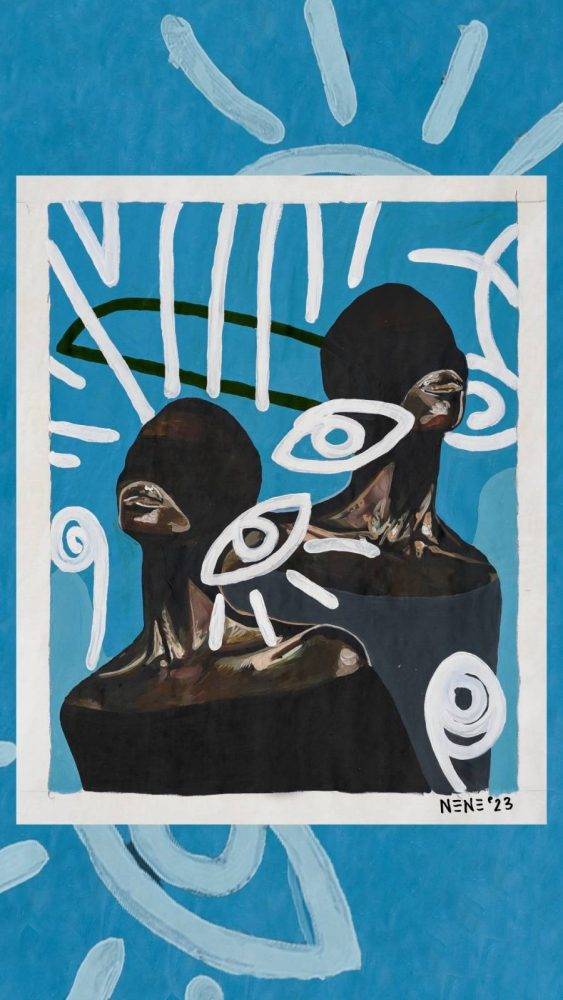 Nene Mahlangu’s ‘The Duality Within’
“It was stressful, exciting, scary and wild. I had to create 23 artworks in two months and what I loved about the experience was the complete creative freedom they gave me.
“What I envisioned about the work was that it isn’t meant to be consumed in a gallery but on an island where people are having a good time, so I used that as inspiration for the project. I used a lot of colour, fashion, bold figurines in order to dictate the spirit of his residency.”
A career-defining moment for the young artist was making history in 2019 as the youngest woman ever to design coins for the South African Mint. She featured a woman’s face on one of the coins.
“I’ve never seen a woman or girl on money and I don’t understand why. It’s always men,” Mahlangu remarks.
“I also thought about people who use coins. It’s usually people who aren’t so privileged who have their hands on coins and, for me, when those people come across the coins maybe they can see a representation of themselves that might ignite inspiration in them to dream beyond their circumstances.”
When asked if she had concerns about artificial intelligence (AI) replacing the work of artists, Mahlangu says, “I see it as a tool to help artists work faster, more efficiently and bounce off ideas — and artificial intelligence can help you see whether your ideas make sense.
“Craftsmanship will always be welcomed. Yes, people will be excited about the best newest thing on the market but AI in music can never replace a singer live on stage because of the power of human connection.
“It’s natural to get excited about it but it’s just a tool that needs to be guided and now we can play faster,” says Mahlangu.
Seth Pimental aka African Ginger
Seth Pimental —African Ginger — was isolated during his childhood and animation and cartoons became his way of escape.
“My parents were really strict, so I never really got the opportunity to play so much. The only thing I did was sit at home and draw.
“And I’d always have as many cartoon characters or as many animation characters as I possibly could and, by drawing, I kept on experimenting and pushing more and finding my own style.
“I always want to make something new and just create work that no one’s seen before,” says the Johannesburg-based illustrator.
“African Ginger”, which started out as a joke between friends at university, has over the years become not only a nickname but a signature statement on his diverse approach to art creation.
“Depending on how I feel on the day, the medium of art changes. Some days I wake up and feel the urge to paint, so I go into the studio, stretch my canvas, sketch out my grip, I paint and then other days I just want to illustrate.
“But they go hand in hand and complement each other because a lot of the paintings started out as illustrations of how I can get the idea on paper and then I translate that sketch into a canvas piece,” says the 28-year-old artist.
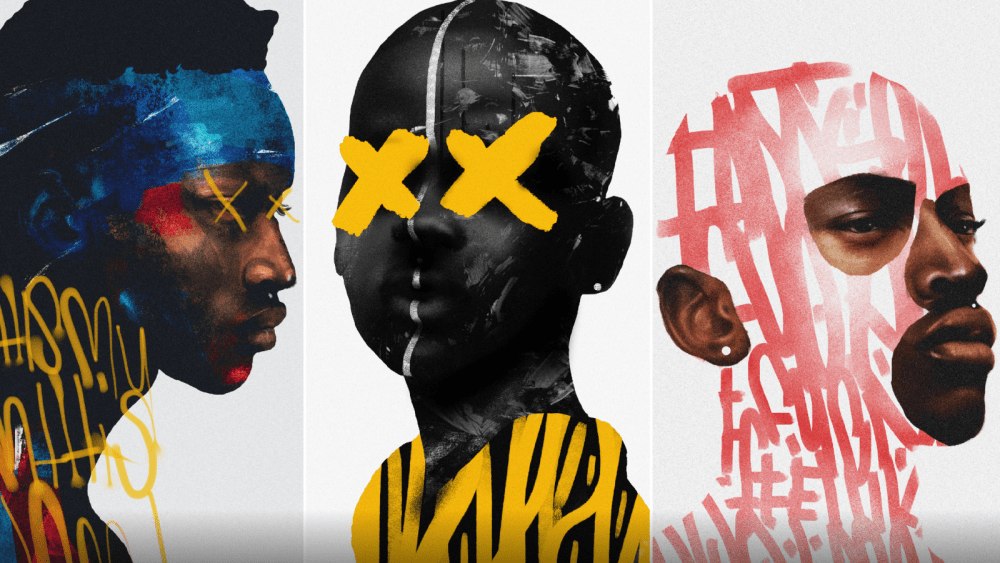 Afro-surrealism: Seth Pimental’s piece ‘Black Ice’. The artist explores the idea of how people would react if our internal dialogues were exposed to public scrutiny.
At the forefront of his work is the representation of black bodies, challenging societal norms, and the exploration of mental health through Afro-surrealism.
“For me it’s about the celebration of the black body,” he says. “I feel like society, media and art has been Eurocentric and focused on Western approaches when it comes to subject matter, art, and I’m obsessed with surrealism, so I wanted to celebrate the people in my life.
“[I wanted] to create art that’s about them in Afro-surrealism, which is the black interpretation of surrealism. It has to do with society, pop culture, media.”
Pimental’s work is based on his own experiences and thoughts on mental health. “I don’t want people to experience any dark depression. I want them to feel a sense of relation to my work, that they are not alone.
“So, the piece that I have created is a conversation around having your feelings and thoughts exposed.”
He hopes societal challenges and norms will be challenged through his work.
“The creation process started with an idea. I was watching the show Heroes and there was one character that has the ability to read minds.
“I said to myself, ‘Imagine if all of us had our internal dialogues exposed?’ Your deepest, darkest secrets, darkest thoughts — even your thoughts in general — were exposed to the public.
“How would we interact with each other if we had the ability to see transparently?” asks Pimental.
His hope is to continue pushing the boundaries in art by capturing the interstices of the human experience while continuing to perfect his niche in Afro-surrealism.
“I want to make consistently relative art. I have a really long career ahead of me — 60 years, if not 70, because as an artist you never really retire, I just want to keep making work that validates me and the people around me.
“I want people to leave the exhibition with a sense of validation of whatever they are experiencing and their feelings. It’s all valid, their beauty and the darkness. That’s the thing about this human experience, it’s about loving yourself and those around you. If my art can add to that, I’ve done my job.”
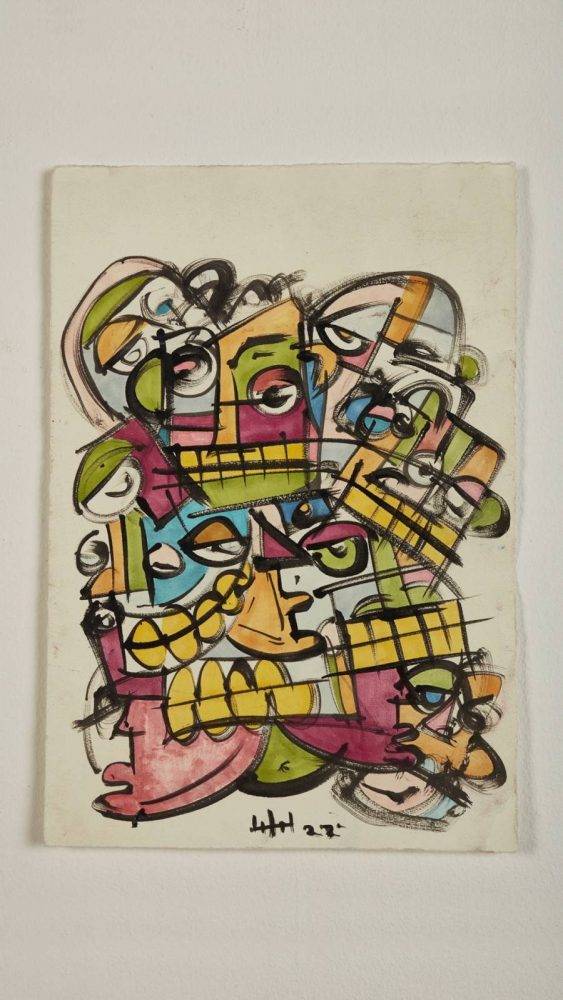 Bright and bold: Samurai Farai’s artwork ‘Anecdote’, 2023
Farai Engelbrecht aka Samurai Farai
Visual artist and mental health advocate Samurai Farai has a piece on The New Medium exhibition focused on self-exploration through digital art that is reflective of his own struggles and outlook on life. The work has an introspective feel to it that’s relatable to the human experience, a common thread throughout the exhibition.
One of the works displayed, The Remedy of The People, sheds light on Engelbrecht unpacking individualism from various perspectives, highlighting that humans can find solace in creating different versions of themselves.
“I believe that we have so many different sides … I don’t believe that we are the same people who we are with our friends, our family, our colleagues.
“I feel that we have layers of identity that we kind of switch between, to keep ourselves safe in certain unknown situations.
“So, I really enjoyed unravelling that narrative and kind of guiding the conversation of the witness to the human identity from different angles, because I’m so fascinated with harmony and conflict,” explains the Johannesburg artist.
After years of struggling to gain recognition and support from art galleries, yet still remaining passionate about art, Engelbrecht pursued self-representation, which he now advocates, even though he admits he’s had his fair share of struggles.
“I want to use my creativity for positive upliftment, not just for myself, but the people around me.
“I guess, three or four years of hustling, working in hospitality, paying to put myself through university, and within this time, I knocked on so many gallery doors, got denied so many times, so I actually worked abroad as crew for the cruise ships, as an art curator for about a year.
“It was a great experience; I learned how to sell, how to talk about art and how to understand sales psychology surrounding the art market,” says the 26-year-old.
The New Medium exhibition is on until 1 June at the Usurpa Gallery, 70B Oxford Road, Riviera, Johannesburg. The gallery is open between 10am and 5pm from Tuesday to Friday and by appointment only on Saturdays.