The survey found that although the proportion of respondents who are connected to piped water remains high (92% in 2023-24), the percentage of respondents who believe their water is “always clean” declined from 75% in 2020-21 to 60% in 2023-24. (Photo by Phill Magakoe / AFP)
Magalies Water will install a portable water treatment plant that will result in the residents of Hammanskraal having piped drinking water by March next year, said the director general of the department of water and sanitation.
“In the meantime, residents will continue to be supplied with drinking water from tankers, with strict monitoring and controls,” Sean Phillips said on Thursday.
He was speaking at a briefing where Minister of Water and Sanitation Senzo Mchunu and Tshwane mayor Cilliers Brink revealed further details of their joint project to resolve water and sanitation problems in cholera-hit Hammanskraal.
So far, there have been 173 reported cases of cholera, which has killed 24 people — 23 from Hammanskraal and one person from Parys in Ngwathe municipality in Free State.
The department and the city said the cost of a full rehabilitation and upgrade of the dysfunctional Rooiwal wastewater treatment works is R4 billion and will be completed by 2026.
Problematic plant
Rooiwal is polluting the Apies River, which flows into the Leeukraal Dam, from which water is abstracted at the City of Tshwane’s Temba water treatment works.
“And that water treatment works is supposed to clean the raw water that is abstracted from the dam so that it’s fit for human consumption but the pollution from Rooiwal … is so heavy and has been going on for so long that the water in the dam is now so polluted that the Temba water treatment works is not able to treat the water such that it meets the required standards for drinking water,” Phillips said.
He said the Rooiwal project can be implemented in stages, “with an emphasis on work to stop or reduce the pollution into the Apies River from Rooiwal in the early stages”.
Discussions have been held between the department, the city and the treasury and it has been agreed that there’s a need to secure funding to fully fix and upgrade Rooiwal.
“We have formed a financial team between us to work together with the Development Bank of Southern Africa (DBSA) to develop a financing plan, which identifies the optimal financing structuring for the project,” he said.
Options being considered include sourcing funds from other grants and DBSA loan and bridging finance, among others.
In the meantime, the project will start using the R450m allocation, which has been made from the city’s Urban Settlements Development Grant over the next three years, which will possibly be supplemented by a DBSA loan or bridging finance.
The department and the city had started the process of appointing the DBSA as the implementing agent for the project.
“It’s a huge project, which can’t be done overnight but in the short-term we are going to install improved wastewater technology in the Rooiwal wastewater treatment works to improve the way in which it works and treats the sewage and to improve the quality of the discharge effluent that goes into the Apies river,” said Phillips.
This will reduce the levels of E coli from Rooiwal that is released into the Apies between August and March 2024.
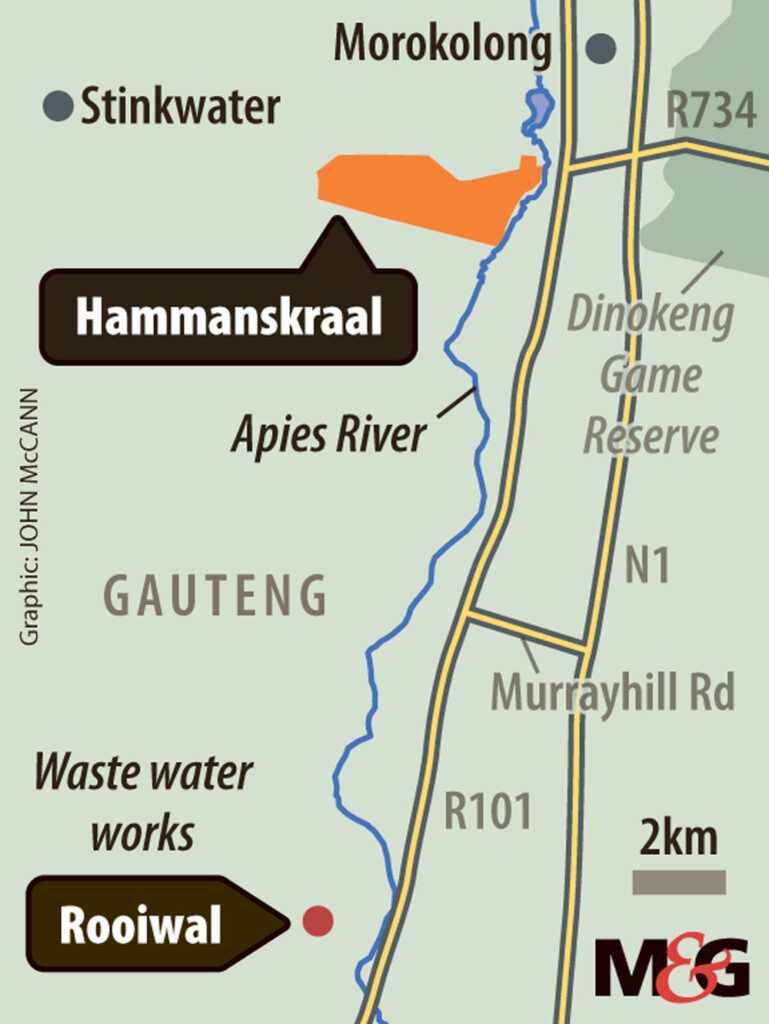 (John McCann/M&G)
Package plant
Magalies Water will install a portable water treatment plant at its Klipdrift water treatment works near Hammanskraal. It will produce 30 to 40 megalitres (million litres) a day of treated drinking water, which will be fed into Hammanskraal’s piped water distribution system.
Phillips said this package plant will be implemented in stages with 10 megalitres a day capacity being installed at a time to get up to the required capacity.
“Magalies Water plans to start installing this plant from July and to complete installation by March next year. By the time it is complete, this package plant will provide sufficient drinking water to supply the residents of Hammanskraal with drinking water from their taps,” he said.
“And at the time when the package plant is complete, the city will be in a position to be able to stop supplying residents with water from the Temba water treatment plant and rather supply them with water from the package plant until the quality of water at Temba meets drinkable standards.”
The supply of drinking water from the package plant will also enable the city to stop supplying water using water tankers at the point that it is fully established.
 Sludge flows from the Rooiwal treatment plant into the Apies River and irrigation dams. (Andy Mkosi)
Three phases for Rooiwal
Rooiwal’s repair and upgrade will be done in three phases. The first phase is the complete repair of a project by companies belonging to controversial businessman and state capture accused Edwin Sodi, which is at 68% completion. They were awarded tenders worth R295 million to upgrade Rooiwal until the contracts were cancelled last year.
The result of this repair work will be to improve the quality of effluent and will get under way in September and is scheduled to end in November next year.
The second phase will involve upgrading the plant’s treatment capacity by 50 megalitres of wastewater a day coupled with desilting sludge at the Leeukraal Dam. The desilting will enable Temba to “function better and to produce drinking water”, which meets minimum standards, Phillips said. This phase would start in October next year and end in June 2025.
The third phase will involve adding a further 80 megalitres a day of capacity to the Rooiwal plant. Its current capacity is 250 megalitres. “After phase two and three, it will improve to a capacity of 380 megalitres per day. This will be sufficient to treat the current and future projected wastewater load in Hammanskraal.” Work will start in July next year and be completed by June 2026.
Phillips said the repair and upgrade of Rooiwal will result in the Temba water purification plant being able to provide drinking water, which meets the required standards, by June 2026, which “can then replace the water from the package plant”.
Mismanagement, tender irregularities
Brink said: “In essence, the problem we have with the quality of Hammanskraal’s water is that the Rooiwal … plant has reached its capacity and we don’t have the money or the expertise to fix it quickly enough.
“In that, was an important admission [to Mchunu] that it’s a problem that has come almost two decades and with every year, the population of Hammanskraal grows, and with every year, the infrastructure deteriorates.”
Brink said the mismanagement of Rooiwal has to be faced. “If we don’t change that, we’ll simply repeat the mistakes of the past. There were also various instances of tender irregularities, which had the effect of making what now needs to be done more complicated and more expensive.”
The partnership is crucial to get the money and expertise to upgrade Rooiwal and to “do so in a way that avoids the delays, irregularities and the wastage of the past”.
“There are thousands of houses currently relying on water tankers as a semi-permanent source of potable water. That is a terrible control environment, open to abuse and exploitation and is very expensive for the people of Tshwane as a whole”.
The government must be “very careful” of its promises to people “but the commitment is clear,” he said.
“A lot of work needs to be done in Tshwane to clean up our supply chain management system … but this agreement will allow us to partner with the DBSA, with water and sanitation playing an important monitoring and supporting role … We must make sure that public money is spent in a way that is cost effective and competitive. And, of course, that no person or company implicated in state capture is allowed to come close to this money or to derail this project.”
Mchunu said his department and the city are working together to resolve the water crisis in Hammanskraal. “Indeed, if it were not for the deaths that have taken place in Hammanskraal — 23 of them — I would have said I’m quite happy that we are getting to this journey, the department and Tshwane.
“And it offers us a great lesson in terms of how we should approach things in future. And indeed the future looks tougher in water and sanitation than we have seen before. Therefore, for us to be able to move faster and catch up with deficits that we foresee, and that we are seeing, we need this kind of spirit.”