In an appeal posted on the party’s social media, EFF president Julius Malema called on supporters to donate online, saying that “all peace-loving South Africans, revolutionaries from the African continent and the diaspora are implored to finance the revolution”. (Photo by Laird Forbes/Gallo Images via Getty Images)
ActionSA is the latest South African opposition party to add crowdfunding to its fundraising methods as it moves to build up a campaign war chest ahead of its first foray into provincial and national politics in next year’s election.
The party, which has only contested local government elections since its formation in August 2020, is not eligible to collect funding from the Represented Parties Fund (RPF), which allocates money on a pro-rata basis to parties represented in parliament and the provincial legislatures.
Last week, ActionSA national chairperson Michael Beaumont launched the initiative, which will allow supporters to donate R30 at a time, using a five-digit SMS number, to contribute to the party’s election campaign.
The party plans to contest elections in all nine provinces, having taken more than 540 000 votes — 2.36% nationally — in the 2021 local government poll, which earned it 90 seats across six municipalities in Gauteng and KwaZulu-Natal.
Beaumont said the organisation had first used crowdfunding during the “people’s dialogue” in 2020, when supporters came forward with donations as small as R20.
Crowdfunding, he said, inverted the principle of soliciting large donations from a small number of people and achieved the same result by collecting small amounts of money from a large base of supporters.
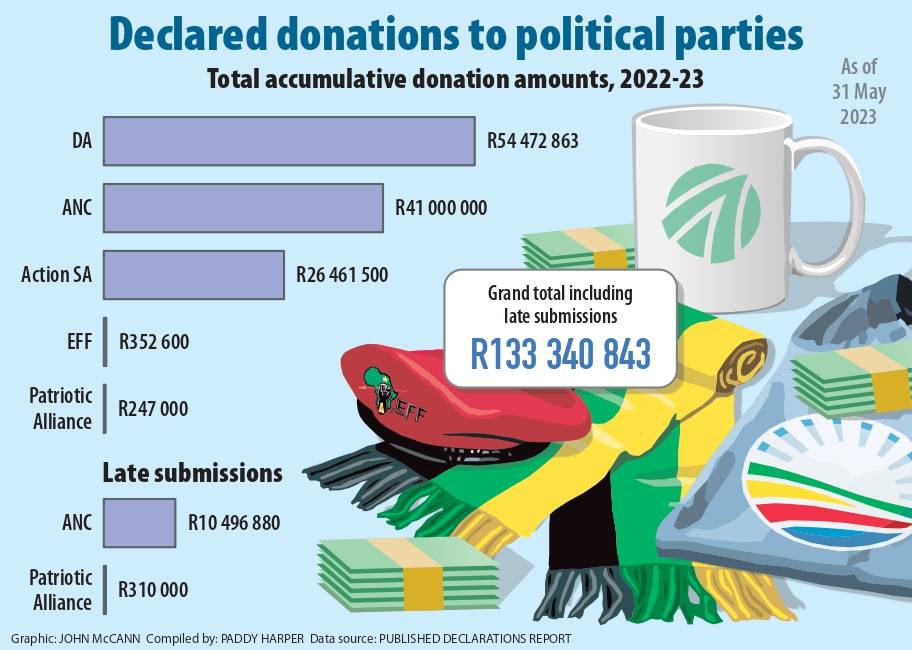
According to the fourth quarter report by the Electoral Commission of South Africa (IEC), ActionSA received R26 461 500 from corporate and individual donors during the 2022-23 financial year.
During the final quarter, which ended in May, the party declared a total of R3.7 million in donations, R3.5 million of which came from technology entrepreneur Martin Moshal.
“What we are really saying to members is we have to compete with parties that have legislated themselves into R1.3 billion in state funding. We have to compete with these parties somehow and want to leverage the power of a large number of members’ contributions,” Beaumont said.
ActionSA hasn’t attached a figure to what it needs to fight the election, with Beaumont describing the amount as “a moving ball” but adding that it was unlikely the party, as a newcomer, would be able to raise figures of R400 million to R500 million.
Beaumont said the changes to the party funding laws, which compelled them to disclose all donations of more than R100 000, would reduce the amount of money available to all parties due to donors wanting to remain anonymous.
ActionSA was at a disadvantage against the ANC, the Democratic Alliance and the Economic Freedom Fighters (EFF) in that it did not receive a share of the R1.3 billion split among the parties.
“They are taking millions from public funding for the running of their organisations and for funding their campaigns. They are at a huge advantage in that they have predictable, regular income and are able to plan around overheads as there is money coming in every month,” Beaumont said.
“A party like ours, which has already proved itself at local government level to be a serious contender, is denied that opportunity to receive state funding and instead has to raise every cent privately.”
“Newcomers, even if credible, are being disadvantaged in such a manner that the kind of funding the parties [already in parliament] are getting will dampen the contest,” Beaumont added.
 (John McCann/M&G)
ActionSA’s move to online crowdfunding sees its following in the footsteps of the EFF, which has launched a “fund the revolution” SMS donations line, through which members and supporters can contribute amounts of R10, R20 or R30 to the party using different codes.
In an appeal posted on the party’s social media, EFF president Julius Malema called on supporters to donate online, saying that “all peace-loving South Africans, revolutionaries from the African continent and the diaspora are implored to finance the revolution”.
Malema appealed to supporters to “finance our own revolution or the counter revolutionaries will hijack it,” saying they could donate via SMS or using the party’s website.
“It is possible. It is in our hands that the organisation formed by black people can remain a genuine organisation that continues to represent black people,” Malema says in the appeal.
Last month, the IEC reported that parties had disclosed a total of R145.4 million collectively for the year, R137.3 million of which was money and R8.1 million was in-kind assistance.
Parties received a total of R162.9 million from the RPF and a further R5 million was distributed by the Multi-Party Democracy Fund.
Of the 15 represented parties, only four — African Independent Congress, the Congress of the People, the National Freedom Party and the Pan Africanist Congress of Azania — had failed to submit financial statements to the IEC.
They have all had their funding withheld.