Preparing the workforce for a just energy transition requires a fundamental rethink of how education and training are approached. Photo: Dwayne Senior/Getty Images
The country may be experiencing a welcome winter decrease in load-shedding but it would be naive to believe that lasting relief is coming soon by way of the state procuring significantly more renewable energy supply.
Mineral Resources and Energy Minister Gwede Mantashe this week sounded another warning that renewable energy projects will have to take the backseat as Eskom exhausts its grid capacity in areas that were earmarked for their development.
No new wind generation was procured in the sixth bid window of the Renewable Energy Independent Power Producer Procurement Programme, which aims to add megawatts to the electricity system through private sector investment.
According to experts and stakeholders in the industry, this was directly due to the fact that grid capacity had been taken up in the Eastern, Northern and Western Cape and no new projects could be allowed in these areas without further studies.
There are variations of available capacity in each of the other provinces, with a total remaining grid capacity of about 22 754 megawatts that is available in Gauteng, KwaZulu-Natal and Mpumalanga.
This is according to Mantashe, who was responding to questions in parliament on Tuesday about the woes of the grid that has left bidders out in the cold, waiting their turn to provide solar and wind capacity to the utility.
Mantashe said at present the grid could accommodate projects for only 1 000 megawatts despite bid window five and six promising access to projects over 3 000 megawatts.
Grid access requires bidding independent power producers (IPPs) to apply for a cost estimate letter — which helps Eskom and the department of energy to determine the interest in grid access in each province for the IPP office.
Eskom said the interest in each province exceeds grid capacity, except for Gauteng, Mpumalanga and KwaZulu-Natal.
Mantashe said again that Eskom, as the custodian of the national grid, was best placed to address the actions that were being taken to resolve grid capacity constraints for future projects.
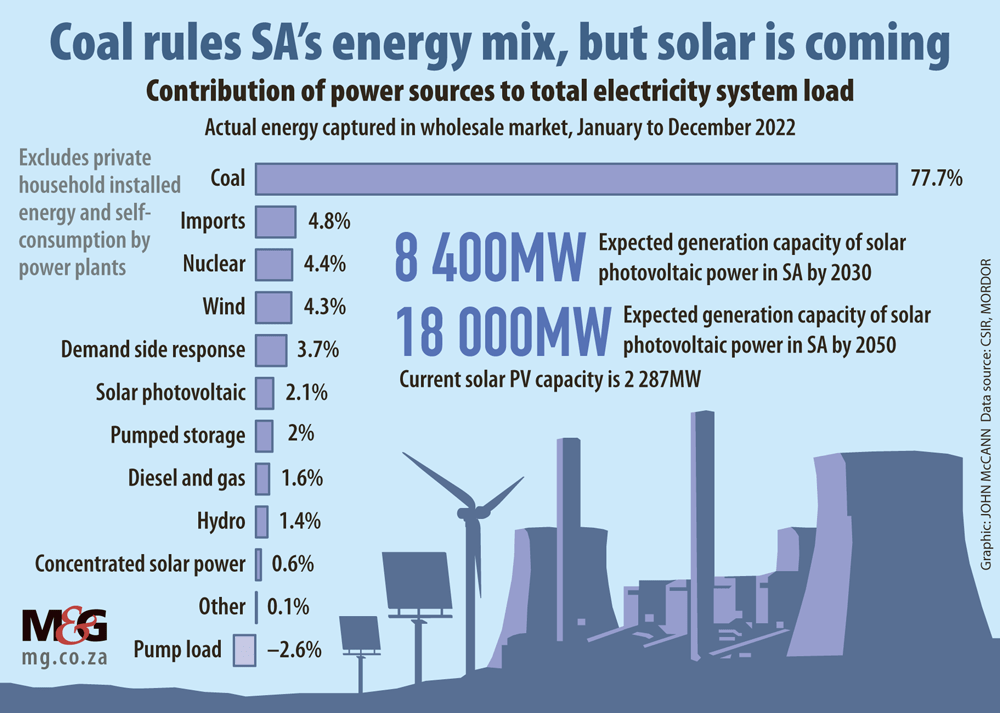
According to his department, the country’s renewable energy procurement programme has 102 renewable energy projects, totalling more than 7 823 megawatts of renewable energy, with solar photovoltaic making up a capacity of 3 267 megawatts.
The Renewable Energy Grid Survey by Eskom showed that 66 gigawatts of wind and solar projects are at various stages of development and that a number of these projects are envisaged to be coupled with battery storage.
The report included responses from 209 companies that are developing, or intend to build, renewable power plants.
 (Graphic: John McCann/M&G)
According to the survey, 21 gigawatts of wind and 13 gigawatts of solar is being progressed independently of storage, while 300 megawatts of battery storage is being pursued independently of a renewables generator.
But, speaking to the Mail & Guardian, South African Photovoltaic Industry Association spokesperson Frank Spencer said although renewable energy was facing a boom in growth, the bottleneck in the grid meant that not all projects in development could come on line.
To address the grid capacity problems, Eskom plans to raise capital through investments from international partners and private companies.
Funding constraints have delayed efforts to bring the transmission system into compliance — a fact that has been further complicated by the condition attached to Eskom’s R254 billion bailout that bars it from borrowing more money.
This dilemma, Electricity Minister Kgosientsho Ramokgopa said, required innovative solutions.
Those outlined in the National Energy Crisis Committee report, which Ramokgopa described as “revolutionary”, include tapping into private-sector liquidity, not relinquishing state ownership of the grid, and ensuring that Eskom’s systems’ manager is solely responsible for the management of the grid.
The government is looking at its international partners like China to help it expand its grid. In May, Eskom’s acting chief executive, Calib Cassim, accompanied Public Enterprises Minister Pravin Gordhan to China to find ways to address the grid problem.
Responding to questions from parliament’s standing committee on public accounts, Eskom’s chairperson, Mpho Makwana, said there was an offer of assistance for the current grid infrastructure problem from various entities in China.
In January, Finance Minister Enoch Godongwana sparked public debate when he stated that the country has a plan to improve energy provision that will end the need for load-shedding within the next 12 to 18 months.
It’s an assumption against which experts have argued.
Echoing Godongwana’s sentiments, the acting director general of the mineral resources and energy department, Mthokozisi Mpofu, said the country can benefit from renewable energy by creating a conducive environment to enable adequate and large-scale use of solar photovoltaic energy.
Observers in the field said Ramakgopa’s recent mission to China rightly included meetings with manufacturers of solar photovoltaic inverters and battery energy storage.
“China has incredible capability in the field of renewable energy and that is why the minister of electricity was there,” energy analyst Chris Yelland said.
He added that the strong trade and diplomatic ties between the two countries made China a natural fit as a partner in developing future energy security.
This included partnering with China in fulfilling Eskom’s vast grid expansion ambitions.
“I don’t know how it is going to be met without some kind of partnering arrangement, to be frank. And it just seems to me logical and ideologically aligned,” he said.
“South Africa should be talking very seriously to the transmission grid company in China because of the kind of finance, technical and people skills and managerial skills, but also the supply of cables and transformers and switchgear and overhead lines. In South Africa these kinds of resources have been very seriously depleted.”
For now, transmission expansion is stuck in the starting blocks.
Yelland said: “The ball is firmly in Gordhan’s court at the moment to appoint a board for the new national transmission company of South Africa and he has been procrastinating for a long time now, since January 2021. He keeps saying that he is going to.”
Yelland said Mantashe’s insistence that grid insufficiency meant signing up more independent power producers would be futile should be taken with much salt.
“This is not correct, it is not true to say we can’t do anything because of grid constraints.
“There are grid constraints in certain parts of the country, like in the Western Cape, the Eastern Cape and the Northern Cape,” he said, listing the windiest parts of the country.
But all of South Africa had superlative solar and wind resources, certainly compared to Europe, where about 22% of energy consumed comes from renewable sources.
“So we are significantly behind the curve. But we can start now, and we can increase renewable energy now,” Yelland said.
It was worth remembering, he added, that rooftop solar photovoltaic (PV) on homes and businesses premises brought relief without requiring new transmission reticulation.
“A factory has grid access, a farm has grid access, so does an office block and your house and my house … About 3 000 megawatts was installed in this sector, and this is one of the reasons why we are having reduced load-shedding at the moment.
“There is a lot of under-the-radar solar PV and battery storage being implemented in thousands and thousands of smaller and medium-sized installations across South Africa. This is where there are quick wins and it is happening.
“About 3 000 megawatts was installed in this sector, and this is one of the reasons why we are having reduced load-shedding at the moment.”
What is needed now, Yelland said, is more storage of self-generation and allowing households and businesses to feed excess into the grid.
Only the Western Cape has had a feed-in tariff for embedded generation so far, but Johannesburg announced this week that it would follow suit.
“What Eskom is seeing is that because supply is increasing through self-generation, the demand for grid electricity is reduced. So this is the contribution that renewables are making. It’s a quiet revolution taking place.”
Mandisa Nyathi is a climate reporting fellow, funded by the Open Society Foundation for South Africa.