(Phill Magakoe/Getty Images)
South Africans are not coping with spiralling food price inflation, as well as soaring electricity and transport costs, and are quickly slipping deep into the quicksand of poverty and food insecurity, economists have warned.
On the lower- to middle-income scale, people are moving back in with parents, to village homes or are being forced out of unaffordable township accommodation into informal settlements on the fringes of cities. In the upper- and middle-income segment, they are battling to pay bonds.
The average repayment on a R2 million home has increased by more than R4 000 a month on the back of the SA Reserve Bank’s 10 rate hikes, taking the repo rate to 8.25%, the highest it has been in 14 years.
Headline consumer inflation may have cooled for a second consecutive month in May to 6.3%, but the annual rate of food and non-alcoholic beverages inflation — the number that matters most to consumers — was 11.8%, albeit lower than April’s 13.9% print, according to Statistics South Africa’s latest data released last month.
Economists have warned that the country’s households are buckling under the burden of debt and food price inflation, with one quarter of the population no longer able to put nutritious food on the table.
For that quarter, it is a meal of plain mealie meal twice a day, a tragedy that will reap a harvest of malnourished children destined to become obese adults.
Professor Julian May, director of the NRF-DST Centre of Excellence in Food Security at the University of the Western Cape and a member of the National Planning Commission of South Africa, says mothers are bearing the brunt of the food price crisis.
“Probably about one quarter of our population aren’t coping. People are substituting and eating food like maize meal and have abandoned putting anything on top like soya mince. This provides calories and energy but doesn’t provide nutrients,” May said.
“Mothers start to go without so children can eat, so I suspect between the negative impact of Covid-19 and jobs lost, and the food price increases, we are looking at a generation of children where higher numbers are malnourished and stunted; there is a long-term consequence coming.
“These children are going to be obese as they get older, so we will have the irony of people malnourished but being obese because of how the body reacts to shock,” he added.
Compounding the problem, May said, is that load-shedding is hitting the food value chain as farmers and retailers are unable to keep the cold chain unbroken.
“We are also seeing a tragedy of citrus farmers dumping oranges because of the issues of importing into Europe, so it has been difficult to get the fruit into the EU and it is difficult to get their fruit out of SA.
“They are dumping, not because they are bad people, but it would cost them money to take it to places where people need the food, so in most productive parts of SA, oranges are being fed to cattle.”
He added that the deteriorating condition of rural roads is making it more costly for farmers to get their food to market, a factor local governments should resolve rather than focusing on the adoption of “vanity projects” such as smart cities.
 (Graphic: John McCann/M&G)
May said the National Food Nutrition and Security Plan adopted by parliament in 2007 provided for the establishment of a National Food Council, which would include members of the government, civil society and the private sector.
“A council won’t solve all the problems but, at the moment, there is very little opportunity for engagement between the state and the private sector to discuss food and nutrition, so the council will provide an opportunity for this discussion.”
In cities, the scenario is changing due to the pressure of the rising cost of living, said Professor Nkosivile Madinga, head of marketing at UCT’s school of management studies.
“Due to high levels of unemployment and rising prices for food and petrol, many low-income individuals have resorted to illegally occupying land and building shacks as a means of securing a place to live.
“This is because they are no longer able to afford rent in townships,” Madinga said.
He cited several examples of land invasion in Cape Town.
“For instance, a new settlement has emerged between Dunoon and Rivergate, known as Zwezwe.
“Additionally, in Emfuleni, towards the N2, a new settlement has been formed, referred to as Covid.
“There are informal settlements in Atlantis, [such as] Wits towards the N2, in Khayelitsha towards False Bay College, [in] Delft towards the N2, and [in] Strand, Nomzamo.”
Dr James Lappeman, head of projects at the UCT Liberty Institute of Strategic Marketing, said while everyone else is feeling the pressure of inflationary shocks, the wealthy are thriving.
“The poor, by contrast, are feeling the effects in very real ways. As our research shows, trade-off behaviour is not just between brands but between categories. A household may cut down on airtime to purchase staples, or vice versa. The middle class, while not homogenous, is also experiencing the squeeze.
“One thing we know, however, is that South Africans are experienced in weathering storms. They improvise, cut back and rely on each other.
“The ‘unseen economy’ thrives during tough times. People borrow from each other, friends give a place for families to sleep if they have had to move out. Extended family digs deep for extra money to pay for school fees,” Lappeman said.
“The formal financial ecosystem serves the middle class, but for the poor, the informal economy is where help comes from. Those who have managed to keep their breadwinner status are squeezed tight by their own needs and the needs of those they love.”
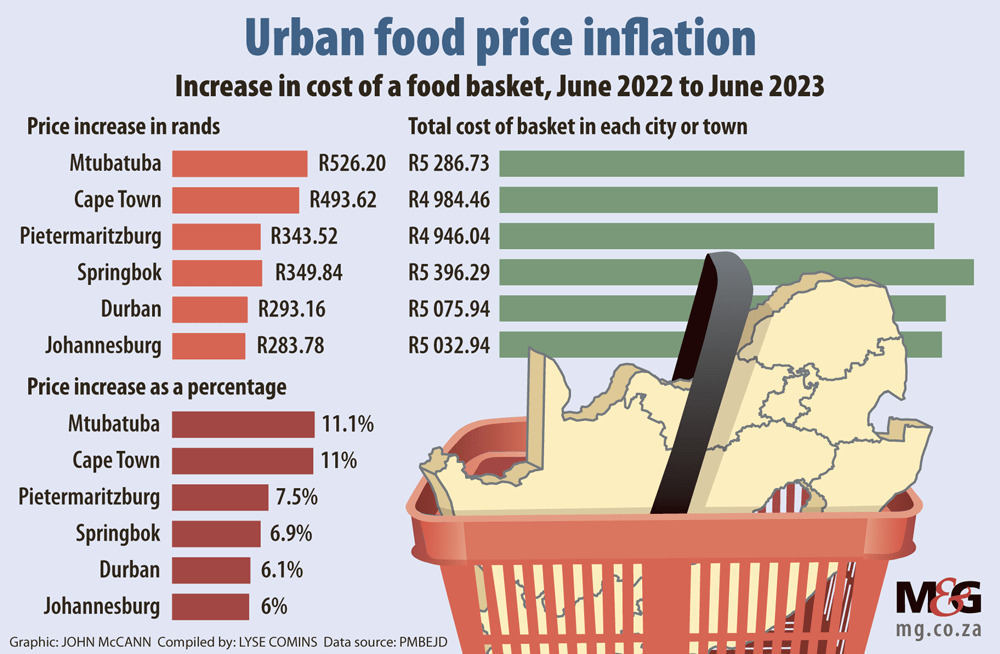
Affirming this scenario with food price and wage data, the Pietermaritzburg Economic Justice and Dignity (PMBEJD) group’s latest Household Affordability Index, released on 28 June — which tracks food prices from 47 supermarkets and 32 butcheries in Johannesburg, Durban, Cape Town, Pietermaritzburg, Mtubatuba and Springbok — shows the average cost of a household food basket increased by R367.65 (7.8%), from R4 688.81 in June last year to R5 065,45 last month.
Last month, which had 21 working days, the maximum national minimum wage (NMW) for a general worker was R4 270.56.
“For black South African workers, one wage typically must support four people. Dispersed in a worker’s family of four persons, the NMW is reduced to R1 067.64 per person —this is below the upper-bound poverty line of R1 417 per person per month,” the report noted.
The June cost of just a basic nutritional food basket for a family of four was R3 505.56.
“On our calculations, using Pietermaritzburg-based figures for electricity and transport, and the average figure for a minimum nutritional basket of food for a family of four, puts electricity and transport taking up 53.8% of a worker’s wage (R2 299.50 of R4 270.56).
“Food is bought after monies for transport and electricity have been paid for, or set aside, leaving only R1 971.06 for food and everything else, and so in June 2023, PMBEJD calculates that workers’ families will underspend on food by a minimum of 43.8%,” the report noted. “In this scenario there is no possibility of a worker being able to afford enough nutritious food for her family.”
PMBEJD researcher Julie Smith said women are spending entire days shopping to find the cheapest food at six or seven supermarkets.
She said they can no longer afford to buy maize in bulk. However, friends were pooling their money to buy staples on special.
“There has been a big change in terms of how women deal with the higher costs of food. When they see the price of maize meal has gone up, and they are sure they can get it cheaper somewhere else, they leave that supermarket and go and find it elsewhere — they are not switching a brand, they are switching a supermarket,” Smith said.
She urged the government to intervene to reduce the cost of electricity and transport and to make nutrition a priority, adding that there were suspicions retailers were profiteering.
“The government needs to take a stance on nutrition, and if we invest in this, we save money on education and health. Let this be a priority of the state to ensure all children and mothers eat well and our food is affordable,” Smith said.
University of KwaZulu-Natal agricultural economics professor Lloyd Baiyegunhi said the pandemic was still affecting people and Russia’s war on Ukraine was fuelling a rise in the cost of imported inputs, such as fertiliser, affecting crop production.
“It pushes the price of commodities up. Load-shedding and electricity infrastructure challenges are also impacting farmers because they cannot store products and produce to capacity.
“Salaries are not increasing, inflation is high and the repo rate has increased 10 times to 8.25%, decreasing households’ disposable income, so they must cut back on other items, like food, to pay their bonds,” he said.
“People cannot afford to eat nutritious food the way they did in the past. All these factors are making households more vulnerable. A lot of households have been pushed from the category of mild food insecurity in the last year to severe food insecurity now,” Baiyegunhi said.