Deputy President Paul Mashatile. (Leon Sadiki/Bloomberg via Getty Images)
The government and major political parties hope to come out of this weekend’s dialogue on coalitions with the basis of an agreement to prevent replication of the chaos in South Africa’s hung municipalities at national and provincial level after next year’s elections.
Although municipal level coalitions have been in existence in South Africa since 2000, hung councils have grown exponentially in number since, along with instability that has caused governance and service delivery to deteriorate further.
With national and provincial coalitions a possibility after next year’s poll caused by the ANC’s electoral decline, the government wants to avoid the instability that has gripped many of the 81 hung municipalities from worsening — and from playing itself out nationally and provincially.
The dialogue has been convened by Deputy President Paul Mashatile and is set to be attended by the parties represented in parliament, labour, business and a number of research institutes asked to assist with the process, which began in May.
Parties and institutions have already submitted their proposals for regulation — including a threshold for participation in coalitions and a limitation on the frequency and nature of no-confidence motions — to the presidency.
Mashatile hopes to secure a framework agreement out of these submissions at the weekend’s dialogue, table it in parliament and have it adopted by the National Assembly and the National Council of Provinces by the end of September.
While the process is aimed at urgently stabilising coalitions, it will also look at longer-term reforms to the country’s electoral system to allow for better and more effective representation.
A discussion document circulated among participants ahead of the dialogue said that although coalitions were the product of democracy, they had become a source of instability, through the cynical use of no-confidence motions that are not regulated or limited.
Coalitions had “fallen short on performance”, largely because of “opportunistic political behaviour, enabled by institutional loopholes”, which had caused coalitions to collapse with “extra-ordinary frequency”, the document noted.
Mayors and speakers had been removed and replaced up to six times in a single term in a number of the worst-affected municipalities, which prevented councils from completing their meetings and their work.
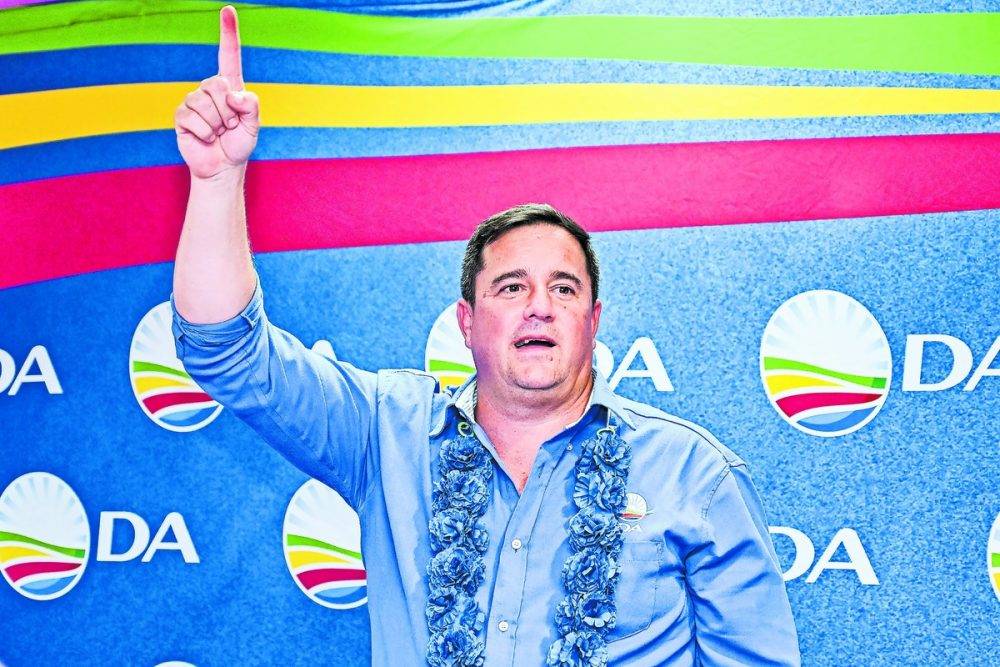 Sense: Coalition instability is a threat to the country, the ANC’s deputy president Paul Mashatile and Democratic Alliance leader John Steenhuisen (above) agree. (Darren Stewart/Gallo Images)
“Frequent tabling of motions of no confidence disrupts the programme of council. This, in turn, impedes the functioning of the municipality in its entirety,” the document said.
Although council meetings were affected, budgets were still passed and were “rarely a casualty”, because failure to do so would see the council being dissolved and result in a by-election.
“It’s not far-fetched, therefore, to imagine that the only reason feuding councillors attend meetings to adopt a budget is to preserve their jobs.
If failure to adopt a budget did not lead to that harsh punishment, it would be common for budgets not to be adopted,” the document said.
Speakers and mayors had been removed on the basis of vague motions that did not suggest any evidence of breaches of the code of conduct, allowing for the abuse of the system. “The threshold for the admissibility of a motion of no confidence is nonexistent. All that is required is compliance with procedures for submission.
“The aim is simply to get the motion admitted for tabling in council. Once tabled in council, it then becomes a matter of numbers,” the document noted.
Votes and seats appeared to have been monetised and “turned into a commodity that can be sold to the highest bidder” in a number of councils around the country, while in some KwaZulu-Natal municipalities councillors had been given council positions in return for resigning their seats and forcing by-elections.
The document suggested that principles such as commitment to service delivery and good governance, and a commitment to non-racialism and economic transformation, should be central to future agreements.
The principle of allowing the largest party to lead a coalition, with executive positions distributed proportionally among the parties, should be agreed upon to “make coalitions work in the interest of the greater good”.
The document said that in countries where coalitions worked, they tended to be made up of a smaller number of parties, which created a greater level of stability.
This was achieved by restricting participation to parties above a threshold of support, which had been pegged at 2% in Sweden, a country in which they worked well.
In a number of countries, including Kenya, coalition agreements were legislated and legally enforceable, which improved stability and durability of governments and prevented their collapse through spurious means.
The two largest parties — the ANC and the Democratic Alliance (DA) — had agreed that coalition instability could be contained, if not minimised, through regulation, the document said.
Both had suggested a threshold that would allow only parties with a certain level of support to be considered for participation in a coalition; a formal, public agreement enforceable by an independent body or ombud; and an extension of the time for coalition formation to 30 days from the current 14.
The ANC had also proposed that the coalition-formation process be led by the biggest party and should take the form of an executive committee model, with representation in the government formed based on proportional representation. It also wanted the mayoral committee system scrapped.
The DA has also proposed limiting the number of no confidence motions within a certain time span to allow councils to focus on their work without the disruption of constant and frivolous motions, it said.
Research by the Mapungubwe Institute for Strategic Reflection and the Dullah Omar Institute for Constitutional Law, Governance and Human Rights had also pointed towards the need for legally binding agreements; the need to have coalition agreements based on proportional representation; and lengthening the coalition-making period.
The discussion document said that in addition to these proposals, coalition governments also needed to allocate portfolios on the basis merit and interest in a particular issue because “expertise and activism in an area increases prospects of success”.
Other recommendations included that parties form coalitions not on the basis of ideological compatibility, but rather on policy issues and service delivery; that bureaucracy be insulated from coalition politics; and that open votes be considered to reduce the opportunity to monetise votes.
Speakers should apply the mandamus principle of getting a court order to have councillors sit throughout a meeting in fulfilment of their public duties as a way of stopping meetings being collapsed through walkouts by parties, while no-confidence motions should only be allowed on the basis of demonstrable grounds of incompetence, neglect of duties and breach of the code of conduct.
DA chief whip Siviwe Gwarube said the party was advocating for “tangible outcomes” from the gathering, because there was an urgent need for the parties in parliament and government to find solutions to the instability in local governments.
She said the DA had proposed and introduced a number of bills in parliament aimed at creating a framework for stable and accountable coalition governments at all three levels.
These would introduce an electoral threshold to stabilise over-fragmented coalition governments, increase the time allowed in the Constitution to negotiate and swear in a government from 14 days to 30 days at all levels, and limit the number of no confidence votes to one a year.
The party wanted others to support the bills and was open to additional proposals to stabilise coalitions from 2024.