The 15th Brics summit, which was hosted in South Africa, was met with a decreased market index, moving from 3,816.83 on the 21 August to 3,792.01 on 22 August, which also happened to be the actual starting day of the Brics summit. (Delwyn Verasamy/M&G)
The debate around Iran’s inclusion in “Brics plus” has dominated talks among the five member states, with Russia aggressively supporting the move.
Insiders privy to the talks at the 15th Brics Summit, which took place this week in Sandton, Johannesburg, told the Mail & Guardian Russian President Vladimir Putin led the fight for Iran to be included, which gave rise to protracted negotiations. India’s Prime Minister Narendra Modi and China’s President Xi Jinping had to be convinced of the move.
High-level diplomats told the M&G that South Africa supported Saudi Arabia, the United Arab Emirates (UAE), Egypt and Iran as permanent members of the bloc.
Debate around whether Iran should join the group lasted through to Wednesday night, with the Brics leaders having ended their retreat on Tuesday without a consensus on whether the Iranians should join, the insiders said.
The deadlock resulted in the five nations extending their closed sessions. The decision to include Iran was made on Wednesday after several bilateral meetings between the five nations.
Indonesia had received support from all the Brics member states, except for Brazil, but declined membership. This opened the room for Ethiopia to be admitted as a new member.
Brazil had initially pledged its support for all partner countries but the Latin American country then opted to support Saudi Arabia, Argentina, Egypt, UAE and Iran.
On its candidate list, Russia had Saudi Arabia, Indonesia, the UAE, Iran, Egypt and Argentina, while India backed the Saudis, UAE, Egypt, Indonesia and Argentina.
China is said to have supported Saudi Arabia, Egypt, Indonesia, Argentina and the UAE.
A high-level South African diplomat said Cuba had petitioned Pretoria to advocate for the country joining the group.
“President Miguel Díaz-Canel asked President Cyril Ramaphosa to motivate for them.
“They say South Africa must understand their economic condition and that they cannot meet the criteria for expansion.
“The problem with Cuba and Iran is that there are sanctions imposed against these nations,” they said.
Other countries whose potential membership came up for debate included Algeria, Bangladesh, Bahrain, Belarus, Bolivia, Honduras, Kazakhstan, Kuwait, Morocco, Nigeria, Senegal, Palestine, Thailand, Venezuela and Vietnam.
The inclusion of Iran, Saudi Arabia and the UAE means Brics has six out of the nine top oil-producing countries as members.
Africa has two new members — Egypt and Ethiopia — while the other new entrant, Argentina, is the third-largest economy in South America.
With the inclusion of the six new members, the Brics alliance’s collective economy has climbed to 37% of the world’s GDP in terms of purchasing power parity, from approximately 32%.
In contrast, the G7 now contributes 30.7% of global GDP, down considerably from the early 2000s, when the group accounted for more than 40% of the world’s GDP.
However, Brics is also welcoming the two biggest debtors to the International Monetary Fund — Argentina and Egypt — according to figures published on the fund’s website.
President Cyril Ramaphosa, Brics chairperson, announced the expansion on the last day of the summit.
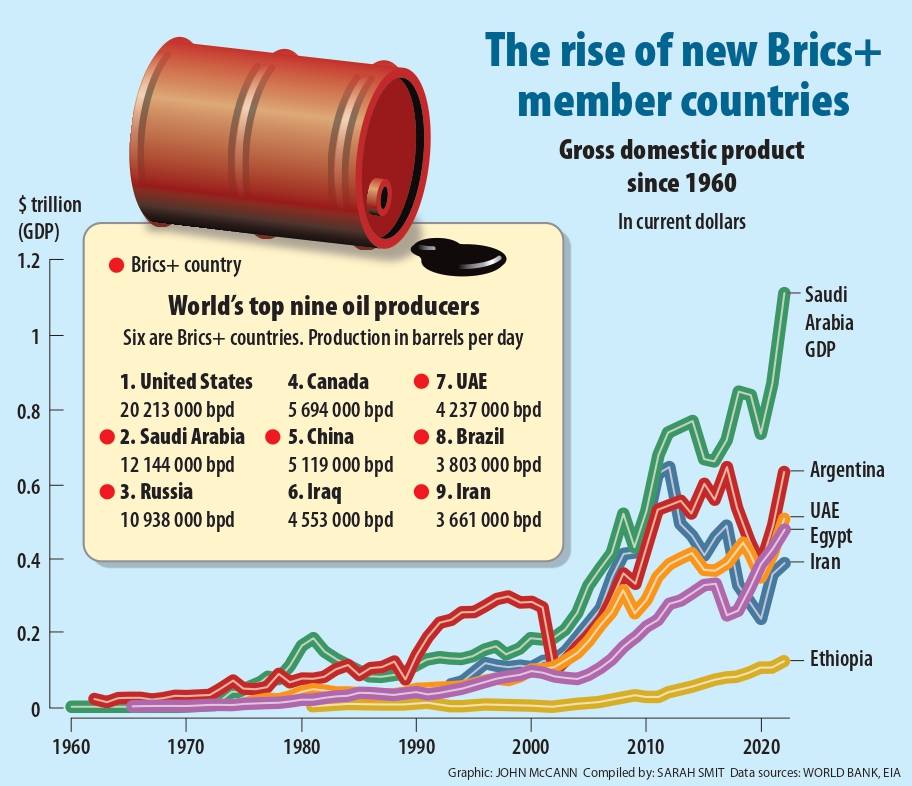 (Graphic: John McCann/M&G)
The addition of the six countries was welcomed by the leaders of the other current Brics members. Putin delivered his address virtually.
Ramaphosa noted that this is only the first phase in the Brics expansion and that others would follow.
The Brics leaders, he said, have tasked their foreign ministers with developing the bloc’s partner model and making a list of prospective partner countries by the next summit.
The leaders have agreed on the guiding principles, standards, criteria and procedures to be followed for the bloc’s expansion.
Notwithstanding human rights and climate-related concerns, the inclusion of oil-rich Saudi Arabia is considered a coup for Brics.
The M&G understands that all existing members of the alliance — including Brazil, which initially did not back expansion — endorsed Saudi Arabia’s membership. Of the six additions, the Saudi economy is the largest in dollar terms.
Notably absent from the final list was Indonesia, which has a bigger economy than the oil giant’s.
In his address on Thursday, Brazilian president Lula da Silva noted the Brics alliance’s growing relevance, saying this was confirmed by the number of countries interested in joining.
Lula extended his congratulations to Argentina’s president Alberto Fernández, who, in a recorded speech, said its inclusion in Brics opens a new opportunity for the South American country.
Putin highlighted the push to advance the use of local currencies in international trade and other financial transactions.
No resolution on the matter has been adopted as yet, though the Brics leaders have tasked their respective finance ministers and central bank governors with considering this issue.
“Let me assure all our colleagues that we will keep up with the work that we have launched to expand Brics’s influence in the world by ensuring practical collaboration with new Brics members and those that will be working with Brics through the outreach format,” the Russian president said.
Modi said India “has always believed that the addition of new members will further strengthen Brics as an organisation”.
“And it will give our shared efforts a new impetus. This will also strengthen the belief of many countries in the world in a multipolar world order.”
Xi, who leads the largest economy in the bloc, called the membership expansion “historic”.
“It shows the determination of Brics countries for unity and co-operation with the broader developing countries.
“It meets the expectations of the international community and the common interests of emerging market countries … The expansion is also a new starting point for Brics co-operation.”