(Graphic: John McCann/M&G)
NEWS ANALYSIS
A Human Rights Watch report revealed in August that black people are the subject of rampant racism on Chinese social media. The organisation called on the Chinese government to condemn the acts and exercise efforts to promote tolerance.
Hundreds of posts and videos have been analysed — on sites such as Bilibili, Douyin, Kuaishou, Weibo, and Xiaohongshu — since 2021 to paint a frightening, dystopian account of a realm rife with unchecked hatred.
But how is this level of bigotry different from that which has always plagued Western social media? And what are the dynamics of “Chinese internet”, in particular, that allow it to flourish?
The Mail & Guardian asked Yaqiu Wang, the New York-based lead researcher of the report.
“The biggest reason that the level of racist content in the Chinese internet is very high, compared with international platforms, is because it’s not subject to the same criticism from people,” she says.
“If you are a Chinese person, and you say racist things on the Chinese internet, you are not subject to social pressure. At the same time, the platforms don’t restrict your content as much as Facebook or TikTok.
“The racist content is subject to a lot less social pressure.”
The sites are, in essence, closed loops.
“Echo chambers” has become a key concept in a polarised 21st century. This is the idea that we place ourselves into groups — with a nudge from algorithms — in which we are unlikely to have our beliefs challenged but instead have our confirmation bias stroked.
What Wang is describing is a digital echo chamber taken to its logical extreme. Those trapped inside have no way of getting out and no one else has any way of getting in.
This is by design. Freedom House’s annual net freedom report scores China easily last out of the 70 countries it ranks, far below other contenders, such as Iran, Saudi Arabia and Russia. It’s a goal the Chinese Communist Party has worked hard to achieve.
The first email ever sent from China was in 1987, proudly declaring: “Across the Great Wall we can reach every corner in the world.” In the years since, the state has done everything in its legislative power to enforce the opposite and stop that world from clambering over its digital divide.
Beijing’s regulations began almost immediately but the framework for how the web operated thenceforth was established in 1998 with the launch of the “Great Firewall”.
The purpose of the firewall is to block any content or website that the government deems is contrary to its values or objectives. To this day its creator Fang Binxing is reviled among netizens — so there was a greet cheer when he was reportedly pelted with eggs and shoes during a lecture at Wuhan University in 2011.
The next seminal era of censorship began after Xi Jinping assumed leadership of the country in 2012. Early in his tenure, he published the Seven Base Lines. These guidelines governed how internet users and companies should behave.
Many outside observers would describe the strategy as one which sought to maximise the web’s e-commerce potential but simultaneously garrotted its capacity as a democratic mouthpiece.
The Cyber Security Law of 2017 further steeled up the philosophy. Among other regulations, Chinese citizens require identification and proof of address to set up an internet connection.
Many sites too can only be accessed with documentation — which explains why outsiders cannot access these platforms, even if they can understand Mandarin.
This equates to a complete removal of anonymity and sets up the hovering threat that anybody could be “invited to tea” — the net euphemism for a visit from a state official.
A state report in 2013 by The Beijing News estimated that two million people were employed full-time to “police internet”. With its growing security infrastructure to herd 1.022 billion netizens, that number might be conservative today.
In that ecosystem, the stream of racism is allowed to flow unfettered.
“To what extent the Chinese government plays a role in the moderation of the racist content is hard to say,” Wang says.
“I think, given that the Chinese government is very active in telling social media companies to censor criticism of the government, they are obviously not invested in trying to tame the racism on the Chinese internet. That is for sure.
“Then, it’s obviously the responsibility of the social media companies because it is in their guidelines. But at the same time we say the government has failed to face this issue, failed to promote tolerance and educate the public.”

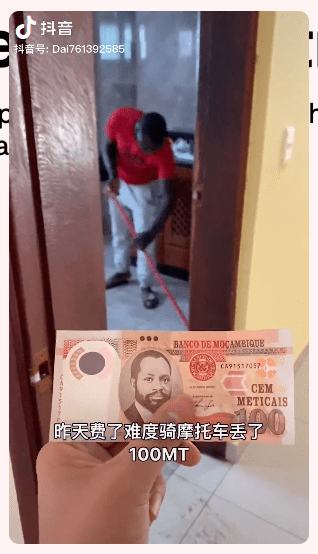
 Black mark: Screen grabs of videos made by Chinese personalities in Africa.
The M&G reached out to the companies listed by Human Rights Watch but did not receive a response by the time of going to print.
The extent of racism on Chinese social media arguably first began to be peeled back in June last year, when the BBC published a documentary that exposed how vulnerable children in Africa are exploited in viral videos. (The investigation itself had been prompted by a 2020 video in which black children were told to chant a phrase that, unbeknown to them, translated to “I am a black monster and my IQ is low.”)
An article in Rest of World, a nonprofit publication covering the effect of technology beyond the West, a month later, headlined “Racist videos about Africans fuel a multimillion-dollar Chinese industry”, further elaborated on the shocking tactics internet personalities use to gain notoriety and profit.
One confessed to the publication: “Chinese people love watching how other places are not as good as China.”
Soon after the BBC exposé, and the subsequent backlash, much of Chinese social media blocked users from searching for accounts that explicitly mentioned “Africa”. Chinese influences on the continent were also reportedly encouraged to halt their streams.
It’s a reaction, says Emmanuel Matambo, a director at the Research Centre for Africa-China Studies at the University of Johannesburg, that can only be expected when mounting media pressure threatens diplomatic relations.
“The last time I heard about any state censure was immediately after that BBC documentary,” he says.
“This happens frequently in China but it rarely produces an international storm. The government only reacts if these things filter into African media spaces.”
Given the state’s undisputed efficiency in stamping out political descent, there can be no excuse for its failure to do likewise for bigotry, he says.“Why then, we should ask, has the Chinese government been seemingly less successful in tracking down people who post racist content on social media? That is what I find most troubling.”
China, which has the most sophisticated internet monitoring system in the world, is facing increasing criticism for its perceived unwillingness to stamp out hate on the web.
In its report, Human Rights Watch called on the state to acknowledge and condemn any prejudice on its platforms but also to explore avenues of educating and breeding tolerance.
In mainland China, most researchers agree, many citizens have had minimal interaction with black Africans. Thus, determining the genesis of such vitriolic hate is contentious and probably arises from a number of factors.
But here too the state often receives criticism for fostering a patronising attitude in its official communications about its involvement in Africa.
“To me, the Chinese government’s propaganda portrays Africans as poor, in need of Chinese help; they can’t help themselves,” Wang says.
“That is one of the reasons Chinese people express these sorts of racist attitudes on the Chinese internet which are much more severe.
“The government does have this undertone of Africans being lazy and unintelligent.” Matambo adds evidence of that condescension can be seen as recently as Xi’s letter ahead of the Brics summit, published by Independent Online and its print titles.
“It was written in a way: ‘Ja, we are coming to save South Africa’. When he was talking about the equipment that China has given to South Africa, not many details were given. It was just presented in a way that ‘Okay, we are helping them out of this quagmire that they’re in’.”