Motivated: Farmers such as Angus Williamson work in a brutal environment but they carry on because they love what they do
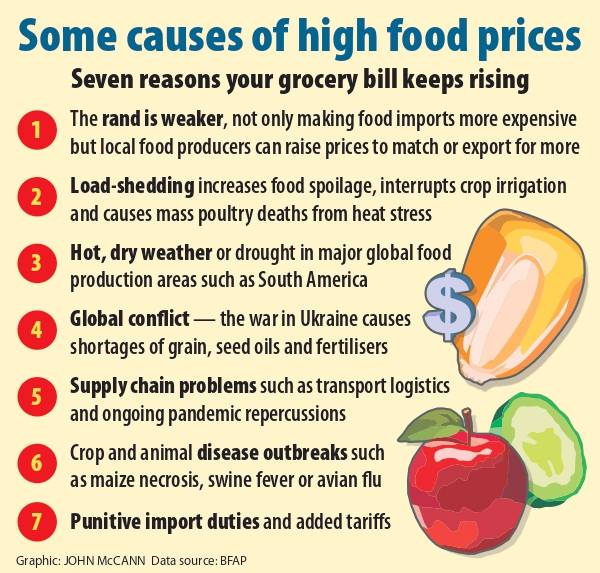
Supermarkets, farmers and economists have blamed rising food prices on the high cost of transport, labour and agricultural inputs as well as load-shedding, broken infrastructure, weather, disease and declining demand for certain produce.
But the answer to the problem of food price inflation lies more in growing the agricultural sector and competition, and not in governmental implementation of price control measures, according to economists.
Food price inflation softened from 9.9% in July to 8% in August according to the latest data released by Statistics South Africa on Wednesday, but this doesn’t mean consumers will benefit now that food inflation has eased from a high of 14.4% in March.
Supermarket food prices often tend to be “upwardly sticky”, meaning that once these have increased on the back of higher costs, such as transport, there isn’t usually a correlating drop if the fuel price decreases.
“We come from that era [of price controls] and as a country we have learned a lot from that dispensation. Deregulation of agricultural markets post-1994 helped correct inefficiencies in the agriculture value chains,” said Paul Makube, FNB’s commercial senior agricultural economist.
“It is not desirable to introduce price controls. Rather identify critical challenges such as the deteriorating logistics and municipal infrastructure that have been part of the added costs and inefficiencies in the agriculture value chain.”
He said despite these problems, the sector had continued to perform well, as evidenced by higher production in major crops.
But the strength in recent prices of fresh produce staples such as tomatoes, onions, potatoes, carrots and cabbage had been underpinned by “supply tightness” caused by weather-related production cuts.
“There is a likelihood of a production rebound in the medium term, correcting the imbalance in the market,” Makube said.
He said the gap between retail and municipal market prices remained wide, in favour of the former because of mark-ups in the value chain.
Makube attributes rising beef and cheese prices mainly to the cost of feed and the weaker rand but adds that fuel prices have also been “relatively high” in recent months.
“Grain prices, which are huge inputs into livestock feed — +70% — were high last year and although they have moderated in 2023, the pass-through has been slow. Producers still had to deal with tight margins. Fuel is critical for sourcing animals from local farms and auctions, including importing from neighbouring countries,” Makube said.
“Load-shedding has compounded the problem as generators are run for extended periods to avoid breaking the cold chain due to perishability, and this comes at a huge cost, which is then recovered from the consumer.”
But supermarket chains such as Woolworths and Shoprite Checkers say they have not passed on the costs of diesel generators and renewable energy installations to consumers.
Woolworths says load-shedding primarily affects its fresh food business as it has experienced “almost 5 000 hours of load-shedding in the past year, resulting in increased food waste and increased diesel costs across our stores and supply chain, to the extent of around R20 to R30 million a month”.
“It’s important to note we haven’t passed any of these incremental costs on to our customers. We’ve ring-fenced all load-shedding costs, so that as and when load-shedding dissipates, these savings will drop to our bottom line,” the retailer says.
Shoprite Checkers said it too had not passed on these costs to consumers, and had instead made “substantial investments” in “alternative power solutions to enable uninterrupted operations” at all its supermarkets.
 (Graphic: John McCann/M&G)
Shoprite Checkers says food price fluctuations are linked to market forces — supply and demand — seasonality, fluctuating exchange rates, inflation rates and supplier input costs, which influence the cost price to the retail industry.
Beef farmer Angus Williamson, who is KwaZulu-Natal Agricultural Union vice-president and chairperson of the Red Meat Producers Organisation, says farmers face myriad production problems including stock theft, rising input costs, diseases such as foot and mouth and brucellosis.
“Stock theft is a major challenge, when you go out and check your cattle in the morning and there are some missing, it is an absolutely gut-wrenching feeling. The other is producing quality calves and then when they are market-ready the price is not what you expect.
“The price of weaner calves dropped by around 20% early in the year but have recovered somewhat to around R34 per kg,” he says.
He said the number of beef farmers had declined because of smaller margins, low returns on capital compared with other industries, rising debt and struggles with foot and mouth disease, which has forced smaller farmers to diversify into other forms of income.
South African Milk Producers Organisation chief executive Alwyn P Kraamwinkel said the organisation’s latest report, Key Market Signals for the Dairy Industry, shows that the Food and Agricultural Organisation’s price index of dairy products traded internationally decreased in August 2023 to a level lower than in 2022 and 2021.
Similarly, retail sales quantities of dairy products in South Africa have been declining in recent years and sales in 2023 were lower than in 2022.
“The decrease in the retail sales quantities of dairy products … is the result of the erosion of the purchasing power of consumers by the widespread increase in the prices of consumer goods and services — including high increases in the prices of dairy products — poor service delivery by the public sector, high unemployment, and weak economic growth,” Kraamwinkel said.
“The sharp price increases in respect of unprocessed milk and dairy products were not intended to meet additional demand, as the demand for dairy products, which determines the demand for unprocessed milk, did not increase.”
Amid sharp increases in the production costs of unprocessed milk and dairy products, the price increases were motivated by the need to maintain supply at a level close to the demand.
He said it was likely that the price increases prevented a significant drop in the production capacity of the dairy industry.
“Due to the demanding and complex nature of the dairy industry, it is very difficult to regain production capacity previously lost.”
He said the industry was faced with high levels of uncertainty about economic growth and political developments internationally and in South Africa, as well as the interrupted electricity supply and poor delivery by the public sector in respect of roads, water and security, which increased production and distribution costs.
“Recent increases in the price of crude oil, together with the weakening of the value of the rand, will result in increased production and distribution costs as well as erosion of the purchasing power of the consumer.”
David de Jager, Tip-Top Milk’s chief executive, says soaring input costs, interest rate hikes, fuel prices increases and load-shedding as well as low demand are the drivers of milk and cheese price hikes.
The latest information as published by Lactodata shows that the number of dairy farmers is also on the decline. There were just 891 dairy farmers in January 2023, down from 1 593 in 2017 and 5 000 in 2006.
“The decline of dairy farmers is a worldwide phenomenon. The general consensus is that there are much easier ways to make a living than dairy farming. Dairy farming is a very ‘ungrateful’ job, 365 days a year of early mornings in mostly miserable weather conditions while margins are rapidly deteriorating,” De Jager said.
“One must also view this in context of the age we live in. Nowadays everything is industrialised in the search for economies of scale. Farming is not exempt from this and the basic force driving this structural change in the dairy industry is competition,” he said.
“The more competitive members within the industry become to increase their own market share, the bigger the impact on the less competitive or smaller members.”
He said the role of technology and sound farm management protocols should not be underestimated either. “Farmers who have embraced technology and manage their dairy herds well are known to also be more profitable.”
But for farmers like Williamson, despite all these problems, it is worth waking up every day to persevere.
“We work in a fantastic environment but yet it can be so brutal — from droughts to pandemics to floods — but we work with positive people who are motivated to get up every day and do what they love,” Williamson said.