Succulent sniffers: Delta is one of three dogs trained to detect rare, endangered and threatened plant species that have been poached in the Succulent Karoo. Photos supplied by Endangered Wildlife Trust
They have become crucial in the fight against wildlife contraband in South Africa — and now dogs are being used in a first-of-its-kind project to sniff out smuggled rare succulents.
The project, run by the Endangered Wildlife Trust (EWT) in collaboration with CapeNature, the South African National Biodiversity Institute (Sanbi) and the police, has trained three young dogs to help tackle the illegal trade in succulents. Delta, a border collie, is almost two while Ike, a German shepherd, and Reaper, a Belgian malinois, are four.
“This is a first for South Africa, and as far as we know, these dogs are the only detection dogs worldwide that are specifically being used to help combat plant poaching,” said Carina Becker-du Toit, the scientific coordinator for the plant poaching response at Sanbi.
Over the past few years, there has been a rise in the global demand for collectable “ornamental” plants, the EWT said.
South Africa’s Succulent Karoo Biome, which stretches from Southern Namibia into Northern Cape and Western Cape, is a global biodiversity hotspot, and home to many of these desirable plant species. It has recently become heavily targeted by poachers to supply the “insatiable demand” of overseas markets.
By the end of June, more than a million illegally harvested plants had been confiscated in South Africa. This equates to roughly 3 000 to 6 000 plants a week, with most originating from the Northern Cape’s Namaqualand region.
“While law enforcement operations and reporting of the illegal harvesting is proving valuable in the fight against succulent poaching, it is suspected that less than 25% of the trade is intercepted by enforcement officials. As such it is very likely that [more than] 1.5 million plants have been removed from the wild in the past three years,” the EWT said.
Close to 650 indigenous and endemic plant taxonomic groups have been affected, many of which are rare or endangered. Different types of succulent plants as well as bulb species in South Africa are prized for their alluring characteristics and rarity. The Conophytum genus, in particular, has been hard hit, pushing most of the species to critically endangered levels.
The illegal harvesting and trade in plants is one of the biggest biodiversity problems facing the country, according to the EWT. In July 2021, the department of forestry, fisheries and the environment, Sanbi, WWF South Africa and other groups joined forces to tackle the issue.
By February last year, a national plan was developed and approved for implementation. Sanbi is one of the lead agents in implementing the response plan and works closely with law enforcement, assisting them with the identification of confiscated plants and other critical information required for criminal investigations.
During the same period, the EWT said it had embarked on a project to train three conservation canine unit dogs to detect succulent plants as part of a feasibility study to use scent detection dogs to help combat the growing plant poaching problem.
This project, it said, “dove-tailed perfectly” with the aims of the national strategy and provides one of the potential tools in the toolkit to help combat the poaching problem.
The scent detection dogs are being deployed across the Western and Northern Cape at strategic locations as part of a study to assess their effectiveness. The project is showing very promising results, Becker-du Toit said.
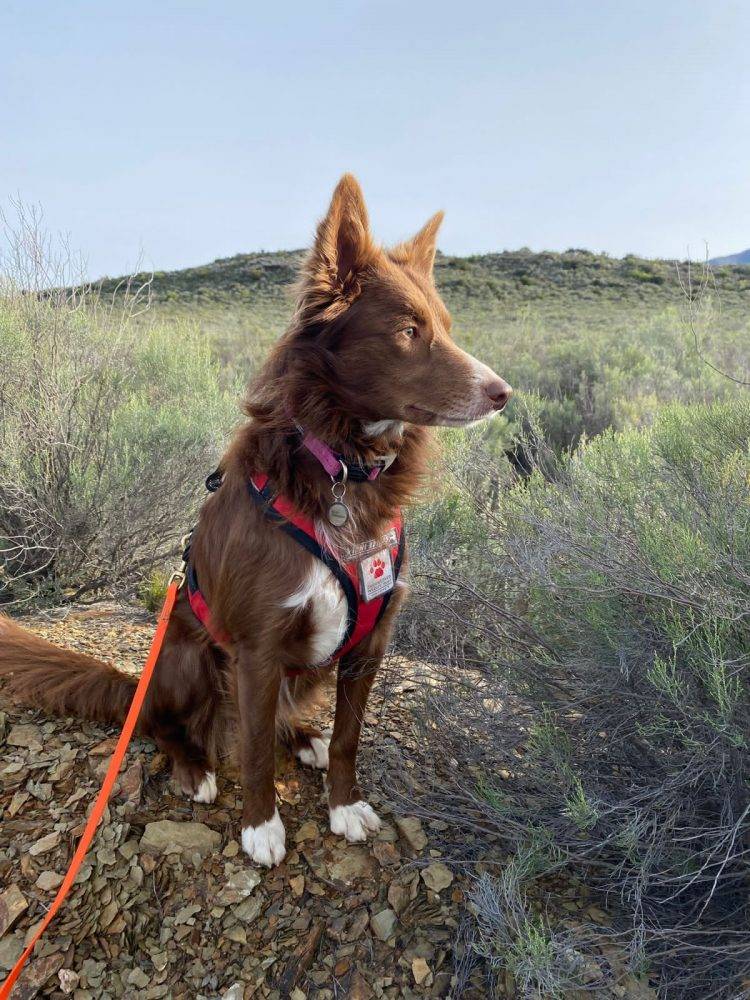 Succulent sniffers: Delta is one of three dogs trained to detect rare, endangered and threatened plant species that have been poached in the Succulent Karoo. Photos supplied by Endangered Wildlife Trust
The EWT’s succulent detection dog project is funded by the Mohamed bin Zayed Species Conservation Fund, with operational support provided by CapeNature, Sanbi and the police.
Shadi Henrico, the canine coordinator at the EWT, explained that both Ike and Reaper are scent detection dogs who normally work at OR Tambo International Airport.
“They are trained on rhino horn, arms, ammunition, ivory, pangolin and lion bone — so that’s what they are trained to sniff out or to detect,” Henrico said.
The three dogs have been trained to detect four succulent species, including Conophytum, she said.
In September, the team worked with the dogs on roadblocks, bus searches and vehicle searches in the Western Cape.
“We work with the police, CapeNature and the traffic cops so with the roadblocks they will pull off a vehicle and do their normal jobs with licences,” Henrico said.
“Then we will ask for permission and just do a routine search. We just walk with the dog once or twice around the vehicle and then — it’s not a fixed number — but every fourth or fifth or seventh vehicle, we’ll take a piece of Conophytum plant that we took with us and we will plant it in the vehicle for the dog to find something.”
She said it’s important to keep the canines motivated. “The dogs lose motivation if they just search and search and there’s nothing to be found. We need to keep them positive and happy to get their ‘ball’, to get their reward.
“The dog finds a little plant, and then gets a ‘good boy’ or ‘good girl’, gets a toy and that keeps the dog motivated.”
On one of the bus searches, they cleared the bus and decided to put a little Conophytum plant underneath a bag of biltong. “Reaper found that plant, she didn’t eat the biltong. That was quite impressive.”
Henrico sees scent detection dogs as a valuable tool in the fight against plant poaching. “If I were to be a smuggler or a poacher … and I drive towards a roadblock with, say, Conophytum in my boot and I see a dog, my first thought will be, ‘Ag, it’s a drug dog’ because that’s what you know.
“I would never think that this dog would sniff out the plants I took from the field. Obviously the moment we put dogs in, the word will travel that these dogs can smell plants,” she said.
“We will make it just more and more difficult for them so it’s not easy to smuggle them.”
Henrico describes how they have hidden scent tubes, infused with odours of plants, for example, on the trailers of taxis or stashed them between pieces of luggage.
“And the dogs find it. They sit on that [tube]. Their noses are incredible. They always say dogs can smell one drop of blood out of a large swimming pool, so that’s how delicate and how good their noses are.”