Pravin Gordhan
2018 – present. Photo: Bongiwe Gumede/Gallo Images/Foto24
Public Enterprises Minister Pravin Gordhan has come under fire from the ANC’s national working committee (NWC) after a wave of resignations at Eskom and Transnet.
The Mail & Guardian understands that Gordhan made a presentation at this week’s NWC, where high-ranking ANC leaders questioned his ability to stabilise the two key state-owned entities (SOEs) — both of which have been left without permanent chief executives.
Speaking to the M&G this week, ANC deputy secretary general Nomvula Mokonyane said the party would be making an intervention at key SOEs when its national executive committee (NEC) discusses the issue this weekend.
“But, remember, at the end of the day, all these deployees serve at the behest of the president.
“Should there be an issue, it will be engaged internally in the organisation. We have not yet arrived at that stage where we’ve been discussing individuals,” she said.
At least three NEC members, two of whom also sit in the NWC, said that Gordhan and the state of SOEs would form a major part of the weekend discussions.
According to the insiders, Gordhan had failed to inform the ANC’s top seven officials, as well as the NWC, about the instability at Transnet and Eskom.
Eskom — and by extension Gordhan — was accused by senior ANC leaders of being partly to blame for a weak turnout of its supporters at the 2021 local government elections.
One NWC member said that there was a concern that the recent resignations and the reputational damage suffered by the SOEs would add to the ANC’s woes in next year’s general elections.
They said there were some in President Cyril Ramaphosa’s historical camp who thought Gordhan should be relieved of his duties.
“He does not consult. He does as he pleases and that has always been the problem,” one NWC member said.
ANC Youth League president Collen Malatji said the resignation of key governance leaders in SOEs was a clear sign of a growing problem in need of an urgent resolution.
He said the league would meet Gordhan next week to get clarity on the matter, adding that the minister needed to explain whether the resignations were a result of unhappiness and bad treatment.
“The ANC can’t leave anything at the hands of deployees.
“Transnet and Eskom are at the top of our agenda. We discuss them at every meeting and how we can turn them around.
“The deployees are on top of our agenda every day. We are coming up with solutions on how to resolve the matter of both Transnet and Eskom,” Malatji said.
“We feel that those that are responsible for these entities have not been doing what the ANC says they must do and we will act on all of those issues. We will act urgently.
“We know, as the ANC, we can’t go to elections with a collapsed Transnet and a collapsed Eskom. That will be bad for the election campaign.”
Malatji said the youth league had communicated to Ramaphosa that non-performing ministers must be reshuffled before the elections.
“We must do that urgently because South Africans are waiting for the ANC to act on people who don’t work.”
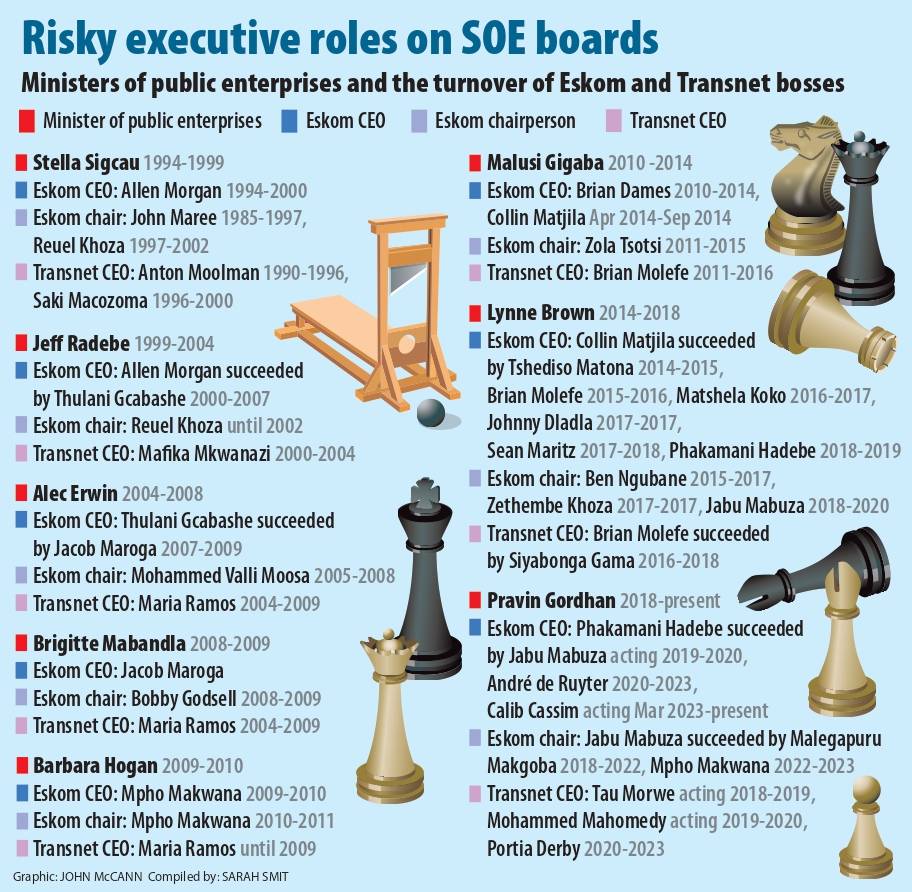 (John McCann/M&G)
During a recent media briefing, ANC chairperson Gwede Mantashe said there needed to be an investigation into why senior executives were leaving SOEs.
“A number of executives [are] just running like mice, running from methane in a very short space of time. Chairperson of Eskom, three black executives in Transnet and all those things.
“What is the methane that they’re running away from? I will not know that, I’m not in that space.”
In the most recent leadership change, Gordhan’s department announced on Monday night that Eskom board chair Mpho Makwana would be stepping down at the end of this month.
Eskom board members who spoke on condition of anonymity told the M&G about a rift between Makwana and Gordhan, which had allegedly escalated after the board chair stopped participating in meetings.
Gordhan consistently questioned Makwana’s decisions in the hunt for a new chief executive, they said.
The falling-out allegedly culminated in an investigation into Makwana’s conduct during the recruitment process.
According to insiders Makwana allegedly exerted undue influence in the process of hiring an agency to undertake the recruitment of a new CEO. An investigation, however, found no evidence against the outgoing Eskom chair, one insider said.
Last week, Gordhan’s department released a statement refuting claims he had overstepped his mandate in the process of finding André de Ruyter’s replacement as Eskom chief executive officer.
“Minister Gordhan said there needed to be an understanding that, as the government’s shareholder representative he has given the boards of Eskom and Transnet the latitude to fulfil their fiduciary responsibilities and said any suggestion he was standing in the way was patently false,” the statement reads.
In response to questions relating to the perceived governance crisis at Eskom and Transnet, spokesperson for the department of public enterprises Ellis Mnyandu said it had “worked very hard to stabilise the SOEs under its oversight”.
“The fact is, our detractors are peddling deliberate distortions about what has been accomplished.”
Mnyandu said that the chief executive positions at Eskom and Transnet would be filled.
“There is no truth to suggestions that there is a leadership vacuum.
“We have full control of these entities through the respective boards who are working tirelessly to ensure that they can deliver on their responsibilities. There is a clear path that they are following.
“We will get through this phase.”
Both Makwana and Mnyandu referred the M&G to the statement announcing the board chair’s resignation.
Gordhan has come under scrutiny for the many leadership changes, specifically at Eskom, during his term.
When Gordhan was appointed minister, he vowed to restore good governance at SOEs. In his first budget vote speech in May 2018, he said his department would work to “re-capture” the entities under its remit.
Under the tenure of Gordhan’s predecessor, Lynne Brown, there was a revolving door of Eskom chiefs.
During her four-year term, the power utility had Collin Matjila, Tshediso Matona, Brian Molefe, Matshela Koko, Johnny Dladla and Sean Maritz at its helm. Phakamani Hadebe served as interim chief executive at the tail end of Brown’s term, before he was appointed in a permanent capacity by Gordhan.
None of them, except for Molefe, spent more than a year in the position. The entity also had three board chairs during this time.
Up to that point, having more than one or two Eskom chief executives during a minister’s term was an anomaly. The breakdown of SOE governance under Brown coincided with the worst of the state capture era for Eskom.
Molefe’s short-lived reappointment as chief executive in 2017 prompted a parliamentary inquiry into Eskom.
This as the portfolio committee on public enterprises expressed concern over the board’s ability to provide effective leadership. The committee flagged that governance at Eskom had been compromised.
Despite vowing to clean up governance when he came, Gordhan soon faced accusations of interference after Hadebe’s resignation in 2019.
Hadebe — who previously did a stint at the treasury and who helped overhaul the Land Bank as its chief executive — was widely regarded as the right fit to get Eskom’s finances back in order following state capture’s onslaught.
At the time, it was speculated that Gordhan’s involvement in an Eskom wage dispute, which ended in labour trouncing the utility’s management, pushed Hadebe over the edge. Hadebe, however, cited ill health.
Gordhan has rebuffed accusations that he became overly involved in the dispute.
De Ruyter was hired five months later in January 2020.
Gordhan appointed Portia Derby — the first permanent Transnet chief executive since Siyabonga Gama was fired in October 2018 — that same month.
The reported tensions leading up to De Ruyter’s resignation are well documented. During this period, Eskom’s board was also allegedly at loggerheads with Gordhan, culminating in Busi Mavuso’s resignation in September last year.
De Ruyer’s resignation was announced three months later.
Meanwhile, load-shedding intensified, dealing a blow to South Africa’s already fragile economy.
Amid delays in the search for De Ruyter’s replacement, Derby’s resignation was also announced. Derby’s departure followed calls by six business organisations calling for Gordhan to intervene at Transnet, which, like Eskom, found itself at the centre of the country’s economic malaise.
In a statement responding to these calls, Gordhan noted Transnet’s annual financial results, which he said “have made it very clear that the entity urgently requires serious interventions that will address the root causes of the deficiencies that are having a negative impact on our economy and are hurting our export competitiveness”.
Ten days later, Derby resigned. Transnet chief financial officer Nonkululeko Dlamini’s exit was announced the same day. Towards the beginning of this month, Transnet Freight Rail chief executive Siza Mzimela followed suit.