Former president Jacob Zuma. Photo: Masi Losi/Gallo Images
The Government of National Unity, led by Nelson Mandela, faced a daunting task when it took office after the first democratic elections on 27 April 1994.
President Mandela’s first cabinet contained members of all the parties that had secured more than 10% of the vote — the ANC, the National Party and the Inkatha Freedom Party (IFP) — and was set up in terms of the interim Constitution.
The previously warring parties had to lead the process of building a nation — in the cabinet, in parliament and in the streets — and also had to create a new civil service, education, health and welfare systems, defence force, intelligence service and police force.
Under apartheid, separate administrations existed for white, black, coloured and Indian citizens, with the bulk of resources channelled into meeting the needs of white people, who made up only 13% of the population.
In 1994, there were 19 racially and ethnically based education departments, all designed to perpetuate apartheid, which had to be combined into a single, unified education system with one curriculum.
The country also lacked a unified housing provision system, while at a municipal level the spatial apartheid that had influenced town planning since the days of colonialism had to be undone.
Just over half of South African households had electricity, 14 million people had no running water and 21 million had no sanitation in 1994 because of racially skewed service provision.
Members of the first parliament were also tasked with drafting a Constitution for the new republic, in addition to replacing apartheid legislation with new laws based on justice and equity.
In KwaZulu-Natal, where political violence between the ANC and IFP continued after the elections, they also had to consolidate a peace process to try to end the killings, and the culture of impunity that had prevailed through nearly a decade of state-sponsored violence.
South Africa was also broke as a result of years of isolation and the cost of fighting a civil war, and the new administration introduced the Reconstruction and Development Programme (RDP) as its economic policy centrepiece.
A period of rapid delivery of low-cost housing followed, which began with 60 000 houses in 1994 and peaked at 235 635 houses in the 1998-99 financial year, one of the highlights of the first administration in terms of delivering tangible benefits introduced in terms of ANC policy.
New municipalities were proclaimed in areas where none existed, while within existing councils, racially defined wards had to be demarcated along geographic lines, as did services including electricity, water and waste reticulation.
Derek Hanekom, who served as minister of land affairs in Mandela’s cabinet, recalled the first administration as “a very exciting period, a period where hopes were high and the enthusiasm was high”.
Policy clarity and a sense of unity in the ANC, along with an ability to make compromises and “find ways around problems”, allowed progress to take place despite “challenging moments”.
Hanekom said that although deputy president Thabo Mbeki had played a strong role in the Mandela administration, the first president’s management of a multi-party cabinet had been “superb”.
As a result, they had remained on board after the National Party pulled out in the wake of the adoption of the permanent Constitution on 8 May 1996.
Hanekom said the first administration had believed that it had the ability to bring about major change in people’s lives.
“We were aware that there was this massive challenge, but we came in confident — maybe overconfident — knowing that we could turn things around,” he said.
“A lot changed in a very short time — and an incredible amount was achieved in those first five years. On the land reform side, within a year we had passed a restitution Act. Nothing like that had ever happened before. We made mistakes as we went along, but we made a massive change,” Hanekom said.
For all the progress, it was during the first administration that corruption in the state and the governing party first became apparent, with the advent of the notorious arms deal, which cost South Africa R142 billion by the time it was paid off in 2020.
A major shift in economic policy took place in 1996 with the introduction of the Gear policy (Growth, Employment and Redistribution) aimed at getting South Africa on a 6% growth path by 2000.
The shift was the result of the ascendancy in the ANC of Mbeki, who believed the RDP to be too idealistic and too heavily influenced by the left in the party, and who went on to become president in 1999.
The decision was unpopular with Mbeki’s rivals in the governing party — and its alliance partners, the South African Communist Party and trade union federation Cosatu — and would come back to haunt him when they joined forces to oust him at the party’s 2007 conference in Polokwane.
 High hopes: The administration of Nelson Mandela in five years made ‘massive change’ by shifting apartheid South Africa to a democracy. Photo: Per-Anders Pettersson/Getty Images
The Mbeki years
If Mandela’s presidency was about reconciliation and giving birth to a constitutional democracy, Mbeki’s was about consolidating it — and about defining South Africa’s role as a leader in continental and international affairs. Mandela was about nation-building, Mbeki built the state.
He focused on South Africa’s economic growth, with the government making its first attempts at privatisation, with some municipal services outsourced at council level as a first step. It was South Africa’s strongest period of economic growth, a feat never achieved by his successors. Together with his finance minister, Trevor Manuel, the two ANC leaders were a formidable combination and the most successful for the South African economy, despite the opposition to the “96 Class Project” from the left in the party and the alliance partners.
South Africa experienced 36 consecutive quarters of positive economic growth during the period in which Mbeki was president and Manuel was finance minister.
Unemployment during the Mbeki years averaged 24.8%, with the lowest level achieved being 22.525% in 2008.
Poverty levels also decreased during his two terms of office.
During Mbeki’s tenure, strong economic growth, fiscal consolidation and good governance of both state-owned enterprises and departments had a positive effect on the country’s rating.
This meant the country significantly reduced its debt-to-GDP ratio.
South Africa punched above its weight on the continent. Pretoria ensured that there was a regional hegemony, evidenced by the fact that South African companies such as MTN were to become multinationals, expanding across the continent during this period.
Mbeki’s leadership resulted in the ANC receiving a two-thirds majority in the 1999 national elections, numbers that had not been achieved by Mandela.
The ANC also did well in provincial elections. It kept the seven provinces it already controlled and unseated the National Party in the Western Cape and the IFP in KwaZulu-Natal. Coalitions would be needed in both provinces.
This period also saw the rise of the black middle class. In 2007, Mbeki’s then economic adviser Joel Netshitenzhe called it the “real tsunami in South Africa.”
Mbeki was also credited for his work on the continent and abroad.
South Africa was involved in negotiations between the United States and Saddam Hussein’s government in Iraq, while Mbeki played a leading role during the formation of the African Union, the New Partnership for Africa’s Development and the African Peer Review.
While Mbeki excelled in these areas, his denialist stance on HIV/Aids was the low-water mark of his administration, delaying the provision of antiretroviral drugs, a decision that cost thousands of lives.
Mbeki’s consolidation of power made him many enemies in the ANC and among its alliance partners, and this “coalition of the wounded” ousted him at the party conference in Polokwane in 2007 and replaced him with Jacob Zuma.
Mbeki’s alleged abuse of the organs of state in the prosecution of Zuma over bribes he collected from arms dealer Thint and his financial adviser Schabir Shaik would result in his recall by the party shortly thereafter.
The failure by Mbeki’s administration to invest in Eskom’s power station fleet after being asked to do so in 1998 — and to address the energy crisis in its early stages — contributed greatly to South Africa’s current precarious electricity situation.
In 2006, after a spate of electricity failures, Mbeki declared that “there is no electricity crisis”, saying the situation presented an opportunity for the private sector to invest in the energy sector.
A year later, in November 2007, South Africa experienced its first wave of load-shedding, which lasted until January 2008 — and which still threatens the country’s economy today.
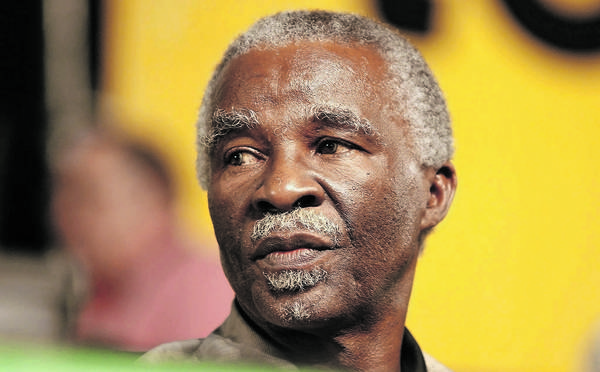 Mixed bag: Thabo Mbeki led the country during a period of economic growth and the ANC received a two-thirds majority in the 1999 elections, but the Eskom crisis started in this time. Photo: Felix Dlangamandla/Gallo Images
The Zuma years
Zuma’s presidency was marked by the worst corruption and the capture of the state in democratic South Africa’s history. He was captaining the ship as state agencies were hollowed out and the state-owned entities and assets looted and collapsed.
The work of both Mbeki and Manuel to ensure economic stability was undone during the Zuma years — although Zuma inherited the country during the worst economic global crisis to hit the world after the great depression of the 1930s.
During his tenure, South Africa saw 12 cabinet reshuffles, with one costing the economy more than R500 billion, when he appointed Des van Rooyen as financial minister, replacing Nhlanhla Nene.
The National Prosecuting Authority, the South African Police Service, the Scorpions and the South African Revenue Service were decimated during Zuma’s tenure, along with the intelligence services, which were used to the benefit of Zuma’s business allies.
The Zondo commission’s findings were scathing of the former president and many of those who served in cabinet under him — and of the governing party for its failure to intervene and its complicity in the looting of the state.
“President Zuma enabled, indirectly, the members of the Gupta family as businesspeople to occupy a place of prominence over other businessmen, to the detriment of the empowerment legislative imperative of South Africa,” Chief Justice Raymond Zondo said in his report.
“He, as president, abused his office for his own benefit, that of his son and that of his friends, the Guptas. He placed himself in a situation of a conflict of interest and abused his position as president of the country.”
Zuma has been credited for having led the fight against the HIV/Aids pandemic.
The Institute of Race Relations report said that during the Zuma presidency, life expectancy increased from 58.8 years in 2007 to 64.3 in 2015 while the death rate fell from 11.6 to 9.6 over the same period.
On World Aids Day in 2009, Zuma announced a new approach to the treatment and management of HIV and Aids, which included a new treatment regime. This led to South Africa having the biggest treatment programme in the world with more than 3.9 million people being treated by August 2017.
HIV-positive South Africans had access to antiretroviral drugs, which led to increase in life expectancy and low levels of mother-to-child HIV transmission rates.
Zuma built two universities, the Sol Plaatje University in the Northern Cape and the University of Mpumalanga. He separated the department of education into two departments, one focusing on basic education and the second on higher education and training. This was applauded by even his biggest rival and predecessor, Mbeki.
In his last days as ANC president, Zuma announced expanded access to free education for children from poor households.
But Zuma left behind a state looted by his cronies, a dysfunctional police force and prosecution service and a trail of decimated state-owned entities that continue to place strain on the fiscus after his recall by the ANC in February 2018.
The culture of impunity created during Zuma’s tenure has remained a problem for his successor — and the state — long after his removal from office by the party he once led.
The Ramaphosa era
Never before had any president come in with as much public goodwill as President Cyril Ramaphosa, including Mandela.
Ramaphosa received support from all corners of society. Politicians and civil society were yearning for change after the Zuma years, which almost brought the country to collapse. The newly elected president had promised transparency, rooting out corruption, the recovery of the economy and the renewal of the ANC.
He became a beacon of hope for the nation, which had been under the abuse of politicians and their business handlers for the last nine years of Zuma’s presidency.
Unlike his predecessor, the new ANC president was not afraid to criticise the party for having failed in its project to advance South Africa.
In his inaugural State of the Nation address in 2018, he promised to clean house, which would include an overhaul of governance in ministries and agencies such as the National Prosecuting Authority and the South African Revenue Service.
He did just that.
The National Prosecuting Authority received a new head, Shamila Batohi. He appointed Edward Kieswetter at the South African Revenue Service, created the Investigating Directorate to investigate corruption and the Special Investigating Unit became more aggressive in its investigations.
Internally, Ramaphosa’s term resulted in the disbandment of ANC leagues which were used to advocate for Zuma. They would be resuscitated by his ally, Fikile Mbalula, after he was elected as ANC secretary general.
But the goodwill Ramaphosa experienced would dwindle. His support from the trade union movement is at an all-time low. And his consultative approach to leadership lost him favour with the business community, which wanted results.
Ramaphosa’s promise to unbundle Eskom and end load-shedding did not materialise. According to the Council for Scientific and Industrial Research, South Africa had more blackouts in 2022 than at any other time.
The state-owned entities have failed to recover under the Ramaphosa-led government, with Transnet receiving a R47 billion guarantee from the treasury at the beginning of December being the latest evidence of this.
 Goodwill dwindling: Cyril Ramaphosa is running out of support.
Ramaphosa was criticised for having created a kitchen cabinet at the Union Buildings. He took the State Security Agency, which had been hollowed out during Zuma’s term, to Pretoria.
Despite these initiatives, the security cluster failed to proactively anticipate the July 2021 unrest, which saw the country losing billions at the height of the Covid-19 pandemic.
In the high level report on the violence and looting during the eight days of unrest, it was found that factional battles in the ANC had a direct effect on the riots. The report also said Ramaphosa’s cabinet should take overall responsibility for the unrest.
The pandemic was a big test for Ramaphosa. As powerful nations hoarded vaccines, Ramaphosa demanded that they share the life-saving vaccines with Africa.
But his optimism and naivety towards his comrades during that time meant that he failed to put strong measures in place in anticipation of corruption during the Covid recovery programme.
Some in the ANC’s high-ranking members — including then health minister Zweli Mkhize — were implicated and would later resign from their posts after it emerged that they were involved in corruption related to Covid-19 funds.
Despite having implemented some of the state capture commission’s recommendations, including its public procurement processes, none of those implicated in widespread looting of the state’s assets have been convicted.
In June, Zondo said he had seen no changes to protect the country from rampant corruption and the kind of state capture engineered by the Gupta family.
“If another group of people were to do exactly what the Guptas did to pursue state capture, parliament would still not be able to stop it. That is simply because I have seen nothing that has changed.
“If parliament won’t be able to protect the people’s interests, who will protect the people?” Zondo asked.
South Africa was placed on the grey list in February by the Financial Action Task Force for its shortcomings in tackling illicit financial flows and combating terror financing. This led to the European Union adding South Africa to a group of high-risk countries.
The World Bank’s report found that the country’s high crime rates damage the economy and contribute to the misallocation and inefficient use of resources, inflicting an estimated cost of at least 10% of GDP every year.
Thirty years after taking power, the party that replaced the National Party seems to be on a similar arc — albeit for very different reasons.
As South Africa prepares to go to the polls next year, a number of surveys have indicated that the ANC may, for the first time, lose the parliamentary majority it has held nationally since 1994.
The party faces a strong likelihood of losing Gauteng and KwaZulu-Natal to the opposition Multi-Party Charter for South Africa — and of being forced into the opposition benches in both provincial legislatures.
Surveys conducted throughout the year polled the ANC in the mid-40%, but a survey in early December suggested it would take from 48% to 53% nationally — a more positive picture for the governing party than surveys in October and November.
The ANC being forced to constitute another coalition government was not the outcome that Mandela and his colleagues in the first administration would have predicted — or hoped for — in 1994, but is one that the decades of corruption, infighting, worsening economic conditions, poor policy choices and failing service delivery may have made inevitable.