Johannesburg is submerged in darkness during load-shedding . (AFP)
The South African delegation to the World Economic Forum travelled to Davos with the express intention of laying bare the country’s investment case.
Although re-invigorating the economy has been a key priority of the current administration these past six years, the promised groundswell of investment has yet to come — and, according to analysts, probably won’t for some time.
This is as investors continue to adopt a wait-and-see approach on an economy with little potential to grow amid substantial energy constraints, as well as deteriorating port and rail infrastructure.
The SA pitch
Speaking to journalists ahead of this week’s World Economic Forum meetings, Finance Minister Enoch Godongwana said the delegation’s main focus during the trip would be investment.
“With investment this country grows. With growth I get better revenues,” he quipped.
“That’s our key focus: How do we go to that part of the world — with that kind of platform — to sell South Africa and argue a better case for our country? And I think we are moving together with that common message.”
Godongwana conceded that South Africa’s investment case isn’t exactly at its best given the country’s structural constraints.
“Are we doing so without challenges? Let me say upfront that we do [have challenges]. Some of them are well documented. We are not going to hide them,” he said.
Among those “challenges”, perhaps the most documented is the energy crisis, which, after 16 years, has battered the economy. Last year signalled a severe escalation, with South Africans experiencing a record 335 days of load-shedding — rolling blackouts enforced by power utility Eskom to avoid a total collapse of the grid.
But South Africa’s energy quagmire may also whet investors’ appetites.
So says Electricity Minister Kgosientsho Ramokgopa, who noted at last week’s briefings that the country’s transmission deficiencies — which need to be fixed before additional renewable capacity is installed — signal a huge investment opportunity.
Renewable infrastructure has been a key source of private investment in recent years.
According to the South African Reserve Bank’s latest quarterly bulletin, recent growth in gross capital formation was driven by private non-financial firms investing machinery and equipment for renewable energy generation. The recently published draft 2023 Integrated Resource Plan notes that a pipeline of private sector generation projects could see 10.4 gigawatts installed by 2030.
South Africa’s Transnet-induced logistics setbacks — which have triggered a decline in revenues, stalling growth — could also attract foreign investors.
After all, private investment is a key aspect of the draft freight and logistics road map, which sets out the government’s plans to rehabilitate the country’s ailing port and rail infrastructure.
Last year, Transnet entered into a 25-term contract with Manila-based International Container Terminal Services to develop the state utility’s container terminal at the Port of Durban.
A difficult case
Although there may be good reasons to put money into South Africa’s network industries, the case is less clear for the rest of the economy, which is unlikely to experience a sustainable growth upswing in the absence of more wide-ranging investment.
“It’s a difficult case to make,” said Stanlib chief economist Kevin Lings.
“We’ve got certain binding constraints in South Africa. And those constraints pretty much say that until you fix that, it’s very difficult to move the country forward in terms of investment.”
According to International Monetary Fund (IMF) data, total investment in South Africa’s economy fell from 21.29% of GDP in 2007 to 15.89% in 2019. This collapse was largely triggered by a decline in private investments. In 2020, as the country reeled from the Covid-19 pandemic’s economic blitz, investment fell much further to just 12.54% of GDP.
It has taken years for investment to only just recover to its pre-pandemic levels. The IMF expects investment will remain muted at 16.57% of GDP in 2024.
According to Lings, it’s difficult for investors to look past South Africa’s energy and logistics woes, especially if they have aspirations to set up shop in the country.
“That overrides everything,” he said. “And so, what you would then have to then try to explain to people is that you are in the process of remedying those constraints. You are in the process of alleviating them and trying to convince people about the time horizon for that.”
 (Graphic: John McCann/M&G)
Growth woes
But selling investors on South Africa’s future potential is difficult given the other options on the table.
“If you go into other markets — Asian markets, or wherever — and you don’t have those same constraints, then it is going to be much more appealing,” Lings said.
Momentum Investments economist Sanisha Packirisamy agreed, noting that other emerging markets don’t have the same constraints. They also have higher growth potential than South Africa, which has tended to lag behind its emerging market peers in the wake of the pandemic.
South Africa’s low growth potential is something ratings
agencies have flagged along the country’s arduous journey towards having its investment grade rating restored.
Despite performing better than some expected, the economy probably recorded growth of less than 1% last year. And although the next couple of years will probably be better, forecasts suggest that growth will still average less than 2% over the medium-term.
“South Africa’s growth dynamic is not vibrant. It’s a hard sell. I don’t quite know what you would put on the list,” Lings added, noting that the only real opportunities are in energy and logistics public-private partnerships.
He also noted that foreigners are much less willing to invest in an economy when locals seem to be holding off.
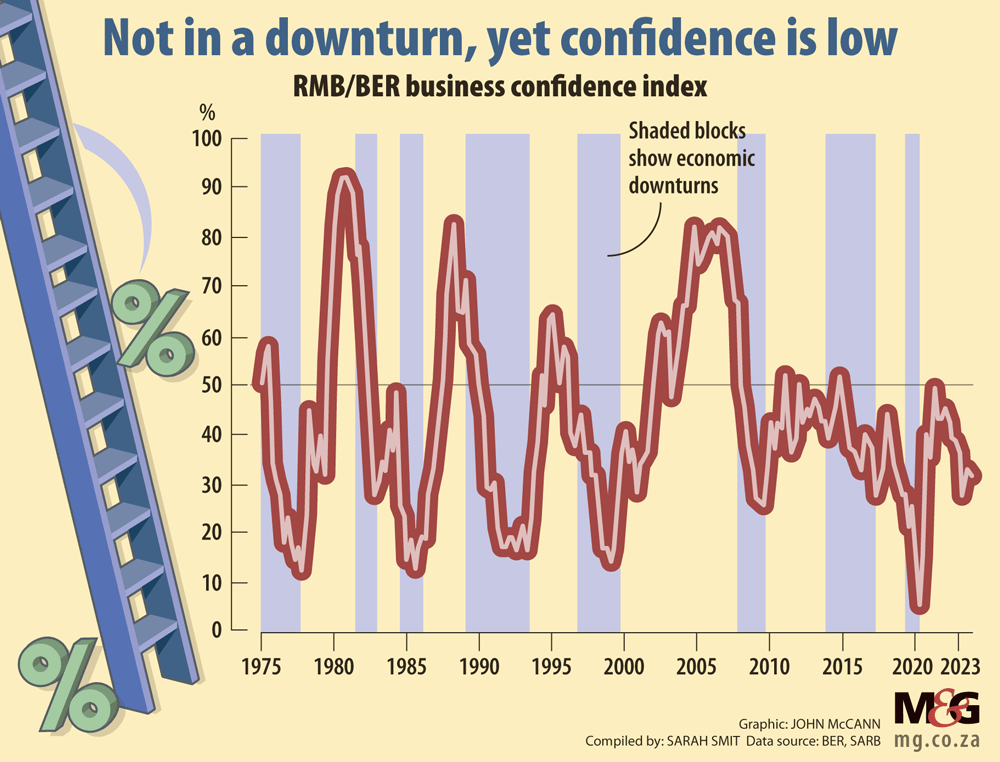
South Africa’s private sector has shown low levels of confidence in the economy for some time now. An index compiled by Rand Merchant Bank and the Bureau for Economic Research shows that business confidence has, for the most part, remained in depressed territory since about 2008. And despite recovering since hitting ultra-low levels in 2020, confidence has trended downwards in recent years.
Crisis of confidence
“Local business is more in the mode of cost-cutting — cost containment. They’re not really in expansion mode,” Staanlib’s Lings said.
“They are more concerned about high interest rates and an economy that is barely growing … They don’t want to take on a whole lot of projects that don’t work out.”
New capital expenditure is very much linked to South Africa’s growth prospects, according to Packirisamy. In 2024, growth will probably be helped along by lower inflation and interest rates, which should stoke demand among South Africa’s pinched consumers.
“Remember that over the past 10 to 15 years, private sector investment has averaged close to zero in year-on-year growth,” Packirisamy said.
“That means that a lot of the stuff that needed to be fixed and maintained just wasn’t addressed. So you could get an upturn coming through, but I think a lot of that is going to be due to maintenance capex by companies that have sort of run down their equipment during the very weak economic growth cycle.”
By its nature, investment has a sort of habit-forming effect, Lings explained. “Once you get it going, then it encourages further investment. Because people see stuff happening. They gain confidence from that and decide that maybe they should also be investing,” he said.
“But the problem is they don’t want to be the driver of that. They don’t want to be the initiator of that. They want to know that there are projects going ahead. The economy is developing. Then they will get involved.”