Former president Thabo Mbeki. Photo: Phill Magakoe/AFP
The ANC is set to deploy its strongest artillery in former president Thabo Mbeki to the Western Cape as part of its plan to ensure the Democratic Alliance’s (DA) electoral support drops below 50% in the coming elections.
In an interview with the Mail & Guardian this week, ANC head of elections Mdumiseni Ntuli said the party believed that Mbeki would be in the strongest position to rival the DA’s campaign in the province, where the blue party has been weakened, as shown by recent elections.
“[Mbeki] has been one of the ANC presidents that has enjoyed the biggest support among the coloured communities during his tenure as president, if you look at our performance in the 2004 and 1999 [elections] in Western Cape [and] if you look at the coloured vote during that period.
“Even now, when you walk into a meeting with president Mbeki and it’s a multi-racial meeting, his reception is quite exceptional and I do think it’s something that we have to think very creatively about,” Ntuli said.
The DA could potentially lose its majority in the province; in the 2021 local government elections, it lost its majority in some rural municipalities to smaller parties and independent candidates. The party held on to the Cape Town metro with 58.2% of the vote, but this was down from 66.7% in the 2016 elections.
The party has been losing its strong support from Afrikaans, Muslim and coloured voters to smaller parties in recent by-elections.
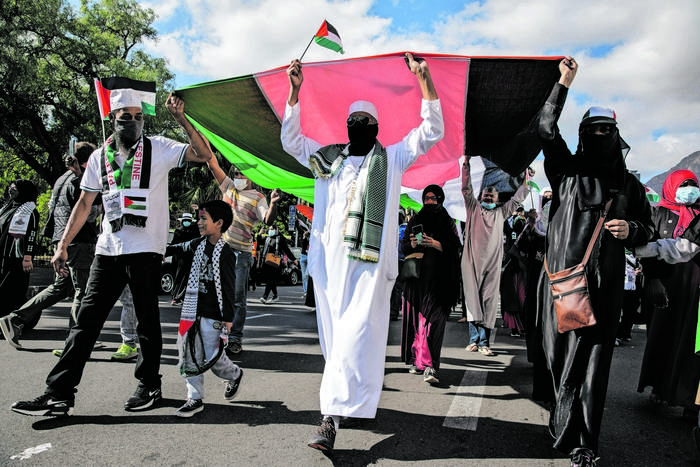 Western Cape residents march in support of Palestine. Photo: ER Lombard/ Gallo Images via Getty Images
Its position on the Israeli war on Gaza could spell trouble for the already vulnerable John Steenhuisen-led party among voters sympathetic to Gaza. The DA has been haemorrhaging black and coloured voters who have felt neglected by the blue party.
Ntuli said Mbeki was still held in high regard in society including among coloured voters. The former president is expected to make an appearance at the ANC’s manifesto launch in KwaZulu-Natal next weekend.
“It’s advantageous for us in the ANC that he belongs and remains a loyal member of the ANC who is also very active. I’m very certain that as one of the ANC stalwarts and a former president of ANC he would be one of the important players in the ANC to secure victory in the elections. We have to determine what kind of interventions we want him to make and within which sectors of society and provinces,” Ntuli said.
He said Mbeki would also play a role in campaigning in Gauteng.
“He lives in Gauteng, which makes it easier for him to be more accessible for the ANC work in Gauteng but I think we will have to make use of him beyond Gauteng.”
A poll by the Social Research Foundation last year ranked Mbeki as the most popular politician in the country, scoring above President Cyril Ramaphosa. The survey measured the opinions of 1 412 people.
Ntuli said the ANC was making inroads in the Western Cape because of its work regarding Palestine. The party had given a clear mandate to its members at grassroots level to take advantage of two factors, the growth of the black population in the province, and the Muslim sentiment on Gaza, he added.
“What has led to us losing the Western Cape has been predominantly the decision of the working- class coloured communities voting with the DA. It’s not about their middle class but the working-class coloured community deciding they are going to vote with the DA.”
 Wooing: Western Cape Premier Alan Winde and Cape Town mayor Geordin Hill-Lewis canvass for the Democratic Alliance. Photo: Gallo Images/ER Lombard
Census 2022 data shows that the black population in the Western Cape grew from 32.8% in 2011 to 38.8%. The coloured population decreased by almost 6% to 42.1% while the white population grew from 15.7% to 16.4%.
The Indian and Asian population has stayed steady at 1.6%.
Ntuli said the ANC’s work on the Middle East conflict had elevated its stature in the province to a much better position than it has been since the DA took over in 2009.
Ntuli said that while the big debate has been around the ANC losing its majority in KwaZulu Natal and Gauteng, the ANC was paying close attention to possible coalition being formed in the Western Cape.
“We can’t see how it will be possible with those Muslims campaigning with and without us against the Democratic Alliance because of the position it has taken on the Israel/Palestine conflict. How would it be possible suddenly on election day for these people to say, ‘No, no, we’re walking away from the position we have been articulating throughout the year, and we are going to vote with the DA.’ We don’t see how this will be possible.”
Elections analyst Wayne Sussman said the DA approaches the upcoming elections with significant difficulties after losing ground in 2019 and 2021.
“The DA struggled in by-elections in the Western Cape. The DA certainly has challenges in places like George [and] West Coast and does seem to have challenges in the Cape winelands which are the second-most popular places in terms of votes in the Western Cape,” Sussman said.
“They are on less certain ground than previous elections because of parties like the Patriotic Alliance [PA] and the National Coloured Congress and those should be the parties the DA should be concerned about in these elections.”
He said should the DA continue on the same trajectory seen in the by-elections, it would find itself in a coalition government and forced to partner with the PA.
“Although the coloured areas experienced less by elections, the DA will have to contend with the PA to get the voter base back because the PA has been making inroads in these areas. The PA won a ward in Kensington formerly belonging to the DA. I think Gayton Mckenzie will make inroads in the City of Cape Town; we just don’t know if they will have the same effect on the DA,” Sussman said.
The Western Cape is critical to the DA’s support in the country. A report by Inside Politics, which is managed in his personal capacity by Gareth van Onselen, who is also the chief executive of international market research company Victory Research, highlighted how the DA support in the Western Cape grew exponentially from 1999 to 2009.
The report said the DA systematically consolidated its support from the coloured demographic from 1999 onwards, reaching 24% in 2004 to 78% in 2014. The backing of its coloured constituents helped push the party’s national support above 20% and ensured its majority in the Western Cape.
Political analyst Sanusha Naidoo said one question that should be asked was to what extent the International Court of Justice case opened by the South African government against Israel would pull voters away from the DA because of the party’s support for that country.
Another valid question was how much foreign policy featured on the mind of the electorate given that people were mostly worried about domestic issues affecting them daily, Naidoo added.
“It could play a role but is it sufficient to sway the voter not to vote for the DA because the alternative is the ANC and the other opposition parties?”
Naidoo said it should also be remembered that the Muslim and the Indian electorate were not homogenous in who they voted for. Even if both these groups opted not to vote for the DA and the ANC and other political parties used the issues in Palestine to campaign against the DA, it did not mean the ANC would automatically gain the votes lost by the DA, she said.
“Will they vote for this ANC given the track record of the ANC nationally?” she asked, adding that she still believed the DA would retain the Western Cape although its support would decline.
The Patriotic Alliance, which has openly declared support for Israel, is also in a vulnerable position, while the ANC goes into the 2024 national elections without one of its popular stalwarts — former president Jacob Zuma, who defected to the uMkhonto weSizwe party in December.
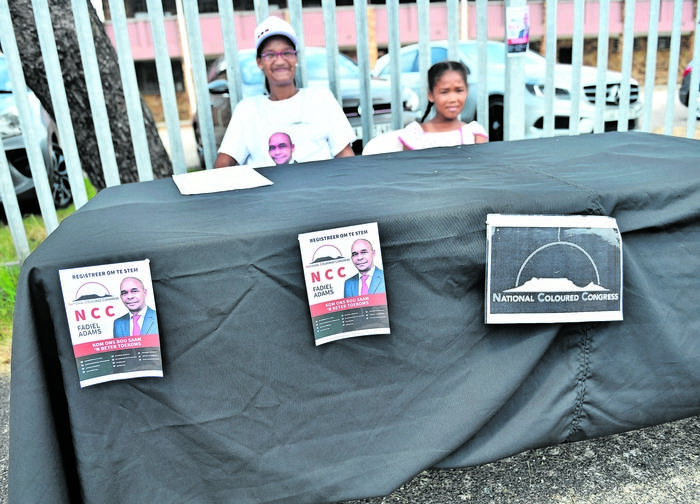 . The National Coloured Congress participates in a voter registration weekend. Photo: Ashley Vlotman/Gallo Images
DA Western Cape leader Tertuis Simmers said the party’s internal polling showed that it would do better this year than it did in the 2019 elections. He said the party was working towards consolidating its historic majority in the Indian and coloured population, which it lost in the 2019 elections to smaller parties including the Freedom Front Plus.
Simmers said the party’s provincial manifesto, whose launch will follow that of its national manifesto this weekend, would “tell us more about where to improve and how the polling results have been in the past months and what to focus on in the next five years”.
“One thing our polling shows is that we will not be needing any other party to govern the province,” he added. Simmers said the party had held discussions with its local electorate and various sectors in the coloured and Muslims on their stance on the war on Gaza.
“As much as many people think our stance will cost us a lot of votes, our focus is within the Western Cape and we believe the consequences that can occur would not be for the province.”
Social Research Foundation associate Gabriel Makin concurred with Simmers, saying it would take a lot for the DA to lose its majority in the province.
He said the foundation’s polls show that despite the DA’s position on the Israeli war on Gaza, it stood a better chance in the province compared with other parties.
But Western Cape human rights activist Faizal Sayed said there was a growing sentiment that the DA was a “Zionist party supporting the atrocities of Israel”.
“As a Muslim what [is] now as a modern dilemma is I used to love voting for the DA on the perspective that they were running the city well, but now that they have shown their colours, is it not morally right for me to vote for them when they are on the other side,” Sayed said.
“The president came to Athlone stadium, the people were applauding but when the mayor came, they started booing, they started chanting ‘Free Free Palestine’. They [DA] were a force to be reckoned with in the Cape in the past but I think they are losing ground. If they continue in this way then maybe in the next election they are not going to retain the ground at all. That’s my view.”
A survey by the Social Research Foundation last November on whether the government of Israel practised apartheid policies against the people of Palestine found that 60% of surveyed coloured people in South Africa “strongly agreed” while only 3% “disagreed”.
The coloured population constituted the highest demographic of those agreeing with the statement compared with black, white and Indian respondents.