Lawfare: The ANC anniversary celebrations in Mpumalanga, on 13 January. The party was forced to hand its deployment committee records to the Democratic Alliance but a court ruled that it had not violated the Constitution. Photo: Dirk Kotze/Getty Images
The handing over of the ANC’s deployment committee records to the Democratic Alliance (DA) on Monday night has provided the official opposition with potential evidence to use against the governing party’s policy in the longer term.
It also provided the DA with a key opportunity to embarrass the ANC on the eve of its manifesto launch in Durban this weekend, through a planned timed public release of records showing how the party dictated which state posts were occupied by whom.
But a Pretoria high court ruling on Wednesday that the ANC’s cadre deployment policy did not violate the Constitution — and that the official opposition had failed to provide any evidence of illegality — soured the taste of the DA’s victory.
The 1 117-page bundle of deployment committee minutes, emails, screenshots and WhatsApp messages shows how — and by whom — the shots were called in the ANC with regard to filling key posts in the civil service, state-owned entities and even the judiciary.
But the court finding — and the tactical public release of the records by ANC secretary general Fikile Mbalula before the DA could do so — have robbed the DA of the smoking gun it had hoped to secure through the court order forcing the handover.
They have also allowed the ANC to avoid a major public relations disaster before President Cyril Ramaphosa’s address and have blunted the effectiveness of cadre deployment as a DA weapon against the ANC in its election campaign.
The DA will undoubtedly head back to the courts but it is unlikely to make any significant headway in either an appeal or an attempt to secure further meeting records — those before 2018 have apparently been lost — before election day on 29 May.
On Monday night, the ANC announced that it had met the court-imposed deadline to hand over the records of the committee — traditionally chaired by the party deputy president — to the DA.
The DA’s legal team then began the process of assessing the bundle, which contained a number of documents that had been redacted to remove the names of people who had not given permission to use them.
While the ANC has maintained that its deployment committee did not micromanage state presidents and the cabinet, the minutes revealed a much clearer picture of the governing party’s participation in the deployment of individuals to key state entities.
The role of the late ANC deputy secretary general Jessie Duarte, who was part of the deployment committee under former party deputy president David Mabuza, is also apparent, as is the extent of the influence of the committee.
The committee does not account to the national executive committee, the records showed, and has in the past summoned both ministers and the president to account for their failure to implement its recommendations.
In a letter to the then party secretary general Ace Magashule, Duarte said that the committee was only answerable to the top party officials and the national working committee.
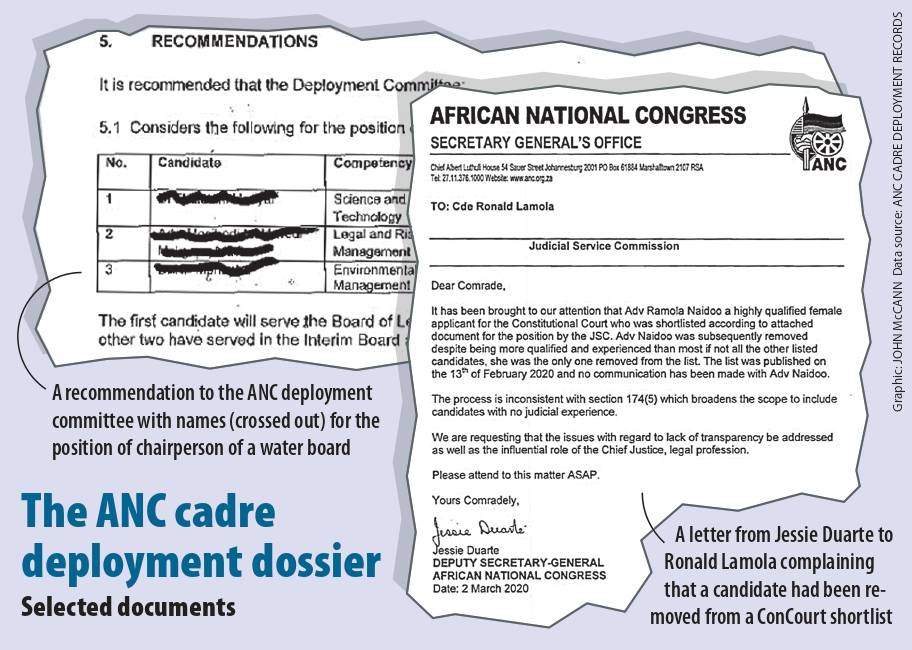 (Graphic: John McCann/M&G)
In a letter dated March 2020, Duarte gave Justice Minister Ronald Lamola a lashing after advocate Ramola Naidoo failed to make the shortlist for candidates at the judicial service commission (JSC).
The JSC had overlooked Naidoo for a coveted position in the constitutional court.
“The list was published on 13 February 2020 and communication was made with Adv Naidoo. The process is inconsistent with section 174(5) which broadens the scope to include candidates with no judicial experience. We are requesting that the issue with regard to lack of transparency be addressed as well as the influential role of chief justice, legal profession,” Duarte wrote.
In another email, addressed to all deployed members and undated, the deployment committee demanded that all its deployees inform the deputy secretary general of all posts prior to them being advertised.
“This process is to allow for comrades who meet the criteria on the database to be allowed to apply,” the email said.
These critical posts included directors general, CEOs, chairpersons and all members of boards.
“No appointment should be taken to cabinet without passing through the deployment committee first,” it said.
Another letter, signed by Duarte and directed to then water and sanitation minister Lindiwe Sisulu, underscored how the committee was integral in the appointment of the interim water boards.
A number of the entities to which individuals recommended by the committee were appointed have since been the subject of probes by the Special Investigating Unit, while several of those appointed have been dismissed and subjected to legal action.
A WhatsApp message in the records bundle also showed how the committee made recommendations around the appointment of directors general in government departments.
In another WhatsApp message, an individual in the group wrote that the “the deployment committee is hesitant about putting things in writing, it will however consult and get back to you”.
The message was seemingly in response to a query around a recommended candidate.
Some emails were clear that the committee could only make recommendations to the affected ministers.
In one email, an inquiry was made about whether a late applicant could be considered, to which the response was that “if they didn’t submit the application as prescribed in the advert then they cannot be considered”.
However, the impact of the disclosures has been lessened by Wednesday’s Pretoria high court ruling on cadre deployment which favoured the ANC.
In its judgment, the court said it was “not common cause that the policy has resulted in corruption, maladministration and state capture”.
“Thus far the DA has not placed any admissible evidence before the court to sustain these claims,” the court said.
“From plain reading of the words used by the chairperson [Chief Justice Raymond Zondo], his remarks are directed at the conduct of public officials.
“He states that it would be unlawful to take into account recommendations of any political party when making decisions on who should be employed into public service. There is no reference to the policy, much less a finding of its unconstitutionality.”
The full bench of high court judges said the DA’s argument that individuals such as Tom Moyane, Lucky Montana, Brian Molefe and Siyabonga Gama had been recommended by the ANC’s deployment committee during former president Jacob Zuma’s tenure could not be justified.
“In order to conclude that the committee usurps power from the minister, that it is directly involved in interviews and selection of candidates and that the committee influences appointments of judicial officers, this court would need to speculate as to what occurred at the point of the minute,” it said.
Mbalula told a media briefing in Durban on Thursday that the court ruling showed the DA had “no case” and that its attack on the ANC policy was ideologically driven.
Describing the DA as “breathtakingly dishonest”, Mbalula said it “should be expected” that a governing party would be interested in who the people appointed to key positions in the civil service were.
“There is indeed no law preventing a private body, such as a political party, from discussing potential candidates for any position. What is wrong is where the prescribed legal processes are not followed, where it be to the public service, the judiciary or state-owned enterprises.
“If the due legal process is flouted, then those doing the flouting should be held to account,” Mbalula said.
In response to questions on the amount of power held by the committee, which summoned ministers and the president, Mbalula said it “does not fire DGs (directors general)”.
“The deployment committee does not micromanage the state,” Mbalula said. “Its task is very simple. It is to deploy in relation to what is in front of it and process those matters in relation to deployment.”
He said the deployment committere “does not hold anybody accountable”, adding: “Accountability is a matter that belongs to the ANC, including holding the president accountable. It doesn’t have the mandate to convene people on operational matters and micromanage the state.”
While the ANC appears to have won this round, the DA is intent on both appealing the Pretoria judgment and on returning to court to secure further deployment committee records.
Speaking outside the court on Wednesday, DA leader John Steenhuisen said while the party respected the judgment, it would appeal as it believed that “a number of errors of interpretation and law were made”.
He said the court had underestimated the impact of state capture.
“This also flies in the face of the comments made by then deputy chief justice at the Zondo commission, who said it should be illegal for anybody to influence the appointment of people based on nothing but their party,” Steenhuisen said.
DA MP Leon Schreiber, who brought the court action, said the minutes “reveal that the ANC unlawfully interfered with appointments across the state, reaching all the way to the highest court in the land”.
Schreiber said the DA would continue with its fight to ensure that appointments to the civil service benefited the country and not just the governing party.