Sibanye-Stillwater released dire results on Tuesday, showing that the mining company had a R37.4 billion loss last year, after recording a R19 billion profit the year before. (Waldo Swiegers/Bloomberg via Getty Image)
Mining giant Sibanye-Stillwater’s revenue has been hit by plummeting platinum group metal (PGM) prices — and, if it was not for the company’s gold assets, things might have been a lot worse.
Sibanye-Stillwater released dire results on Tuesday, showing that the mining company had a R37.4 billion loss last year, after recording a R19 billion profit the year before.
A sharp decline in metal prices, as well as specific operational performance factors, saw the company having to recognise impairments of R47.5 billion against various assets, which was a primary reason for last year’s loss.
Speaking at the Sibanye’s results presentation, chief executive Neal Froneman suggested that, although the company has diversified significantly, its gold portfolio has been worth holding on to.
“Gold is a good commodity to have when you have a large base of industrial commodities. Gold’s favoured status is a positive and, if we could create value by growing our gold portfolio, we would,” Froneman said.
According to the company’s results presentation, Sibanye’s South African gold operations have enjoyed a significant financial turnaround, moving from a R3.5 billion loss in 2022 to a R3.5 billion profit for last year.
“This achievement illustrates that relative stability in production and exposure to a higher gold price can drive strong financial results, underlining the important contribution of the SA gold operations,” Froneman said in the presentation.
Simon Brown, an independent analyst, noted that Sibanye-Stillwater was initially a gold company, aptly called Sibanye Gold, but Froneman believed there was no future in the safe-haven asset and wanted to get into more industrial metals, such as PGMs.
“Now that gold is at $2 100 an ounce, it is gold that is saving them,” Brown said.
“It is now in that middle ground where gold is doing great, but it is quite small [in its portfolio]. PGMs are doing horribly and it is the vast majority of its business.
“Is the product mix wrong for 2024? It absolutely is,” Brown said.
As of 2022, Sibanye’s South African and US PGM operations accounted for 31.4% and 26.3% of its business, respectively. Gold only made up 7.3%.
“Gold is just looking stronger and stronger. Froneman thought that gold is pretty but, beyond that, not of much utility. So, he moved into PGMs and those prices have totally collapsed,” Brown said.
However, Froneman was steadfast in the belief that he had made the right decision by diversifying Sibanye.
“Our view has been consistent. We recognise the issues of the day but the underpin to PGMs remains very solid and very positive. We remain positive and constructive regarding the PGM markets. Our South African PGM operations are a solid performer,” Froneman said.
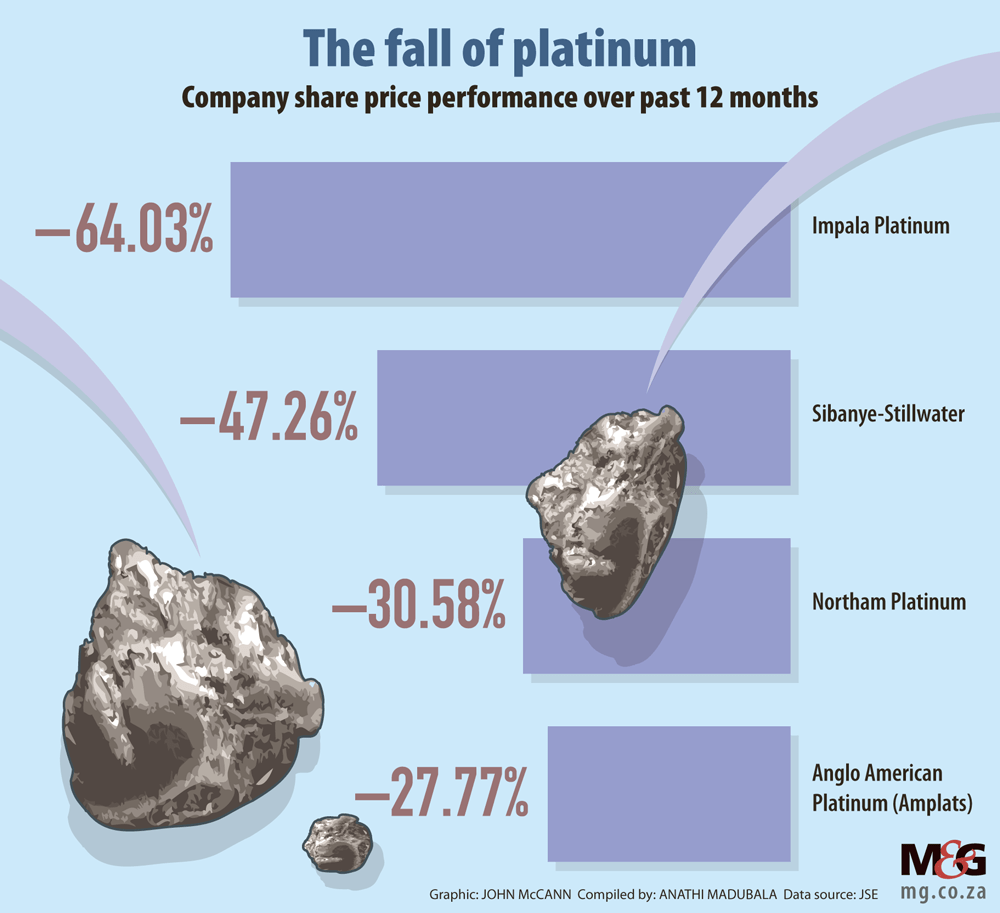 (Graphic: John McCann/M&G)
In the same results presentation Sibanye’s chief financial officer, Charl Keyter, said PGMs have had a serious impact on results and have weighed down the portfolio.
Seleho Tsatsi, a resource analyst at Anchor Capital, noted that 92% of profits for the company come from PGMs — 86% from its South African operations and 6% from the US.
“PGMs are very important in terms of profitability for Sibanye,” he said.
“What helped this year is that the gold business had a bit of a recovery. Volumes were up by about 31% and the gold price is now about $2 100.
“Gold is counter-cyclical. There is some truth to that. But, at current prices, the PGM business still brings in the majority of their profits.”
According to the latest edition of the World Platinum Council’s Platinum Quarterly, the significant decline in the PGM basket price has eroded profitability at a number of operations. All the major producers have announced plans to restructure, it noted.
According to Tsatsi, Sibanye is less exposed to PGMs than its peers, which are less diversified. This shields it from volatile commodity prices.
Impala Platinum recently reported that its revenue fell 25% from R57.7 billion to R43.4 billion during the six months to December.
Northam Platinum’s revenue declined slightly more (by 25.5%) from R20.1 billion to R15 billion for the six months ending 31 December.
Anglo American Platinum reported revenue of R124.6 billion in the year ended 31 December, a 24% decline from R164 billion the previous year.
Tsatsi noted that some mining companies have said they anticipate prices remaining low for the next 12 to 24 months but it’s not definite at this point. He said companies just have to get their cost bases and balance sheets right and be prepared for the current bear market.
Brown said if PGM prices do move higher, it might be only next year, adding that there is no clear catalyst that would cause a rise.
One could be motor vehicle sales, but low interest rates and muted economic growth will hinder these.
“The US GDP is okay but rates will start coming down at some point this year, which will allow consumers to fix their balance sheets so that sometime next year we’ll start seeing car sales pick up again and that will translate to the rise of PGM prices,” Brown said.
“I don’t see a big change happening this year.”