Amazon will shake up the online retail sector – but it might take some time. (Photo by Beata Zawrzel/NurPhoto via Getty Images)
When Takealot.com was launched in South Africa in 2011, it had one objective in mind: “to be the largest, simplest, most customer-centric online shopping destination in Africa”.
But after 13 years of dominating the online retail space, the platform is bracing for a shake-up and a battle for customers, with the entrance of Amazon into the South African market.
Takealot.com assumed command of the online retail sector in South Africa through major acquisitions and mergers over the years, notably purchasing Mr Delivery in 2014, which enabled it to have its own logistics network.
In the same year, Takealot.com acquired the fashion website, Superbalist.com, and later merged with Kalahari.com. In 2018, multinational technology company Naspers increased its stake in Takealot.com to 96%, which gave it a significant presence in the South African retail market.
It has more than 21 departments, which include electronics, lifestyle, media and gaming and fashion.
According to Ecommerce Insights, Takealot.com ranks second when it comes to online fashion stores, after Superbalist, which it owns.
Amazon, owned by one of the world’s richest men, Jeff Bezos, launched its e-commerce website in South Africa earlier this month. Its main objective, much like Takealot’s, is to “have a local Amazon store providing more choice and a convenient, reliable shopping experience”, said Robert Koen, the company’s managing director for sub-Saharan Africa.
“The Amazon.co.za store launch was a milestone on our journey in South Africa, but it was just the first step as we develop our offer to customers. It is still early days for Amazon.co.za and we are adding more products all the time,” he said.
Amazon.co.za has more than 20 departments, which include electronics, books, toys, household items and beauty products.
What the entrance of this e-commerce giant mean for the cash-strapped consumer in a tight economy?
Alec Abraham, a senior equity analyst at Sasfin Bank, said it’s not always good news when a new player enters the market because there has not been any real value in growth in the market because of a sluggish economy.
South Africa’s real GDP increased very slightly in the last quarter of 2023, bringing the total value to R1.158 trillion. Although this is above the levels before the Covid-19 pandemic, Statistics South Africa said, it is still below the peak of R1.161 trillion recorded in the third quarter of 2022, indicating that economic growth has been muted.
The retail sector has been in the red for a while. In February this year, retail trade shrank by 0.8% year-on-year, following a 2% decline in the previous month. In March, it increased by 2.3% year-on-year, with general dealers being the largest contributor. But economists project there will be sustained weakness in the sector as high interest rates and deteriorating sentiment rock the financial boat and hurt consumers’ wallets.
“That’s the big issue here. It’s sad that our economy or our retail market simply has not grown and consumer incomes haven’t grown and it just makes it very difficult for new operators to come into the market, because they have got to take market share from somebody, or maybe a bit from everybody, but it just makes it very, very difficult,” Abraham said.
Although retail sales overall remain weak, online sales have been on an upward trajectory. A report by World Wide Worx in partnership with Mastercard, Peach Payment and Ask Afrika showed that online retail sales increased by 29% in 2023 to R71 billion, and will probably break the R100 billion mark by 2026.
The surge in online sales was set off by the pandemic, when demand for home deliveries increased sharply, the report noted. Competitive e-commerce strategies implemented by major brick and mortar retailers seeking to move their traditional shopping to the online sphere also helped drive the rise.
But, noted Koen, South Africa’s online retails sales remain lower than in other countries, saying there was “significant room for growth”.
“Customers in South Africa can now shop on Amazon.co.za in their local currency. In terms of our selection, in addition to the international brands we know South Africans love, we offer a wide variety of locally made products, many of which are being sold online for the first time through Amazon,” he said.
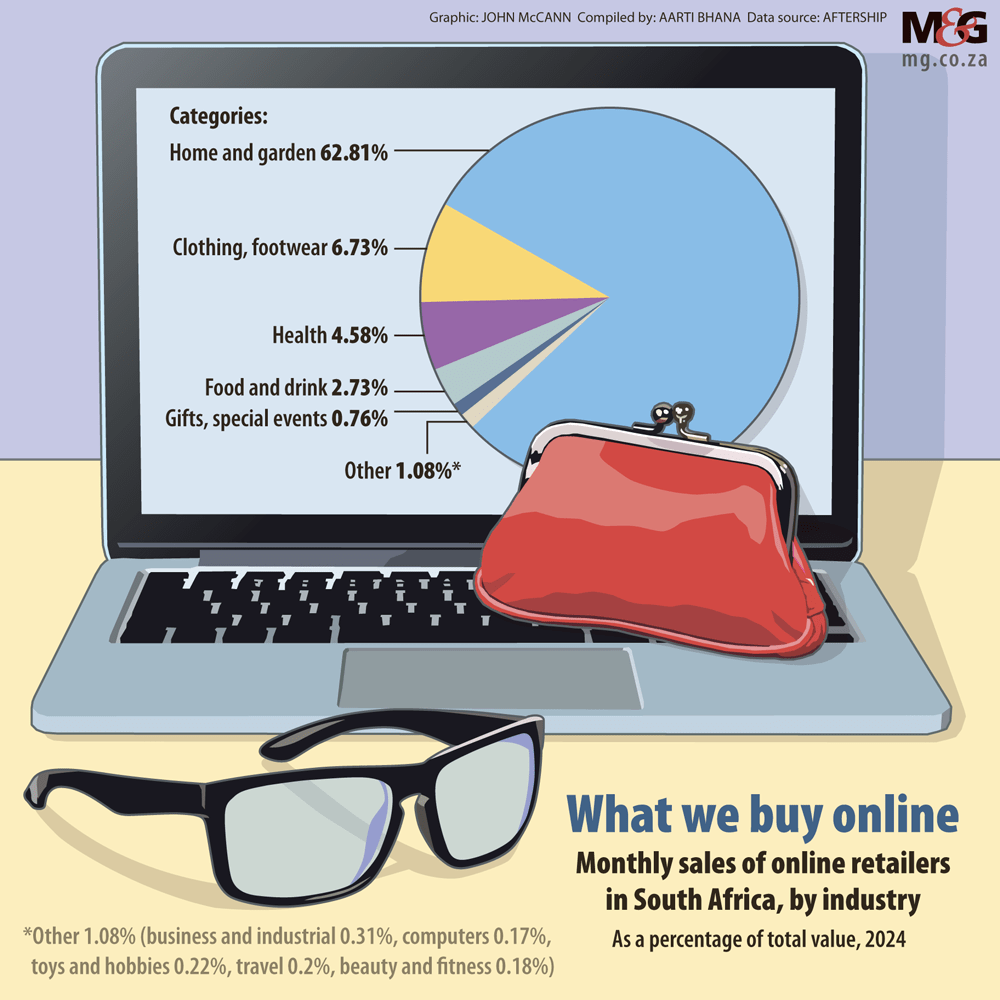 (Graphic: John McCann/M&G)
World Wide Worx chief executive Arthur Goldstuck said that overall, a new competitor is good for the online retail market.
“Competition is always good for consumers, especially when you see big players going neck and neck against each other. Then you realise the consumer has to benefit because, to compete for customers, they have to give customers two things: one is exceptional service and the other is exceptional value,” he said.
“So once you have major players like that competing on both service and value then the consumer benefits massively.”
Goldstuck said platforms such as Takealot.com, as well as traditional stores like Game and Makro, which have a similar offering, will need to up their online retail game.
“The companies that compete directly with Amazon like Take-a-lot are obviously going to find themselves seriously challenged, and not just for market share but also for customer share, because a lot of people want to consolidate their spending and they are going to look for where the best place is to consolidate that spending.”
Consumers can now decide whether they want to shop at the different e-commerce platforms and physical stores.
Aside from bringing international brands into the South African market, Amazon.co.za offers some local brands including Amanda-Jayne, King Kong Leather, Masodi and Tiger Lily.
“We’re enthusiastic about collaborating with South African retailers, independent sellers and brand owners to ensure customers enjoy a great shopping experience defined by competitive pricing, a wide variety of local and international product choice, and reliable delivery,” Koen said.
“For independent sellers, Amazon provides support and scalability, enabling them to concentrate on their products while we manage logistics and customer service.”
Abraham said a new player could also help create much needed jobs .
On Tuesday, Statistics South Africa reported that the unemployment rate increased to 32.9% in the first quarter of 2024 from 32.1% in the fourth quarter of 2023, as more people of working-age entered the labour market.
Goldstuck agreed, saying that with the growth in online retail, there will be opportunities for expansion of the logistics sector and the number of courier drivers and delivery drivers.
Koen pointed out that Amazon provides additional employment opportunities through its third-party business model, which enables independent sellers, small and large, to reach more customers, grow their businesses, and subsequently employ more people.
Goldstuck said: “In terms of their openness to suppliers from the small business environment, you’re going to see Amazon making it possible for a lot of new small businesses to emerge and that will also be a boost for employment.”
This is likely to force Takealot.com to tweak its model as well, he added, boosting both businesses, although Amazon.co.za is likely to gain the upper hand.
“Possibly within the next two to three years they will be one of the biggest online retailers in the country,” Goldstuck predicted. “But it takes time to reach that level.”