Way out: Gareth Ackerman will step down as Pick n Pay’s board chairperson and has already relinquished control over making executive appointments. Photo: Dwayne Senior/Getty Images
About 70% of family-owned businesses fail or are sold before they can be passed on to the next generation.
This is according to a 2012 Harvard Business Review article, which noted that the extended leadership tenures at family-run outfits make them slow to adapt.
Grocery retailer Pick n Pay was falling into this all-too-familiar trap, its founding family, the Ackermans, seemingly holding on to control with white-knuckled grip — until now.
Earlier this week the Ackermans announced their intent to forego their majority shareholding in the grocery retailer. The family has also relinquished its right to nominate Pick n Pay’s board chair, chief executive and chief financial officer.
Analysts say their decision to take a step back could be exactly what Pick n Pay needs to push on with its turnaround.
“The family had control over the chief executive and chairman and so there is no doubt that for as long as Pick n Pay had been in existence, there has been a perception that the family had been in control and had made all the major decisions. There’s no doubt about that,” said David Shapiro, deputy chairperson at Sasfin Securities.
The Ackerman family’s influence over executive appointments has not always worked in Pick n Pay’s favour — especially during Gareth Ackerman’s 14-year stint as board chair, a position he will soon be vacating as part of the ownership shake-up.
During Ackerman’s tenure, Pick n Pay brought in two outsiders — UK-born Richard Brasher and, a while later, Dutch national Pieter Boone — to get the retailer growing after it lost considerable ground to its competitors.
When they failed, the Ackermans anointed former Pick n Pay chief executive Sean Summers its new saviour. Summers, who served as chief executive from 1999 to 2006, took over from Boone shortly after the death last year of family patriarch Raymond Ackerman.
“I think they were the people who chose Pieter Boone. This is the outcome of very poor management decisions and a very poor strategy,” Shapiro said.
When Boone was shown the door, Pick n Pay cited the retailer’s poor performance under his leadership.
Reflecting on Pick n Pay’s current predicament under Summers, Shapiro said: “The state of the company is far worse than we thought. We knew that they were losing ground to Shoprite but not to the extent that we are seeing now. They are writing off whatever they can and they are positioning themselves for recovery.”
“But it will require massive execution, that is the risk of implementing this strategy,” he added.
“It’s one thing to have a plan, it’s another to make it work. They should not do it with family interference. They need a completely fresh approach.”
According to the retailer’s recent annual results, Pick n Pay swung into a loss, inflicted by a R2.8 billion impairment on underperforming stores.
To turn the business around and restore profitability, the group plans to shut 35 stores. Another 70 will become franchises or Boxer stores. In doing so, Pick n Pay will scrap its QualiSave stores, rolled out by Boone in 2022 in an effort to target middle-market consumers.
Shapiro said a lot of damage has been done to Pick n Pay through family interference — and Boone is taking the blame for it. “He is taking the fall and they have been quite open about it … QualiSave and all of his other decisions are viewed as bad decisions and they are reversing them. Pieter can’t even defend himself.”
On top of retiring as board chair, which he will do so after the release of Pick n Pay’s 2025 results, Gareth Ackerman has stepped down from the nominations with immediate effect.
According to Shapiro, Ackerman’s imminent retirement will allow Summers to turn the company around without him having to worry about the family.
“Sean is saying, hold on a sec, we have to do this without any ghosts and without any legacy issues. Without any ‘this is not how my father would have acted’,” he said.
“They need to get rid of the family and make a clean sweep.”
Makwe Masilela of Makwe Fund Managers said Pick n Pay shareholders had complained about the retailer’s ownership structure.
According to the Pick n Pay 2023 integrated annual report, the Ackerman family owns more than 54% of the shares in the company. After the new rights offer is implemented, the family’s voting rights will fall slightly below 50%.
“It took them some time to let go,” Masilela said.
“It started to dawn on them when they fired the CEO [Boone] that they needed to do something drastic. Shareholders also saw that the current structure was not working out because they were controlled. Meaning management could come up with ideas but if they did not suit the family then they would not be implemented.”
“To fully implement the turnaround strategy, the family had to go or else Summers would be seen just as a token,” Masilela added.
 (Graphic: John McCann/M&G)
The board has approved a three-year turnaround plan for Summers to implement, which includes improving customer service and separately listing Boxer to recapitalise the business.
Commenting on the plan, Summers said: “While we must learn from the past, there is little value living in it. We have a job to do — a significant one. Our plan is reasonable and can be achieved with our human and capital resources.”
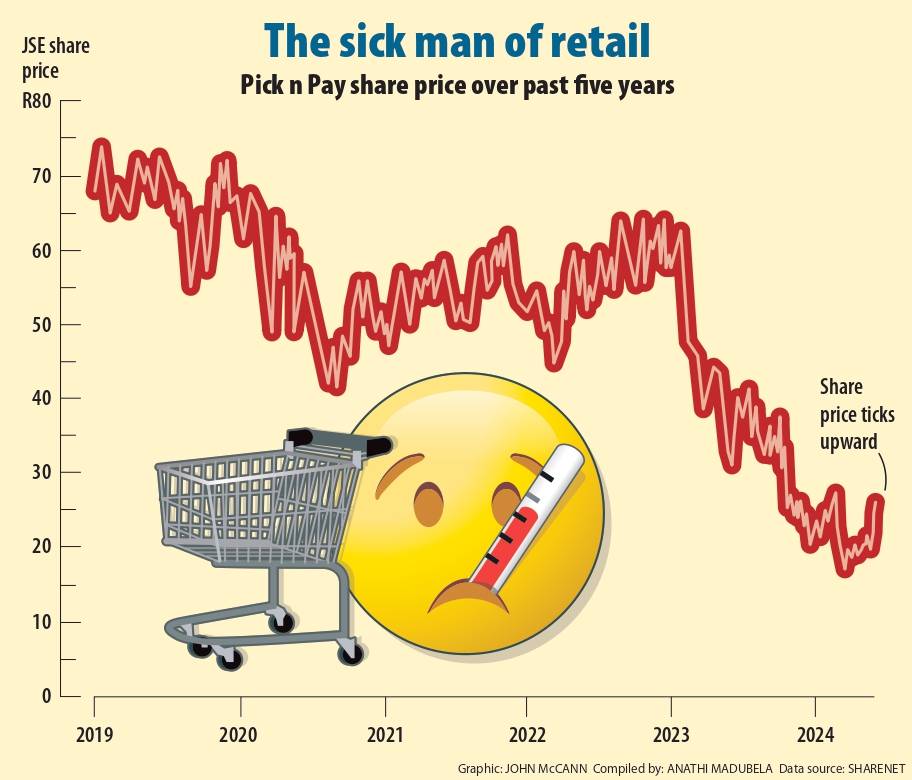
Masilela noted that the market reacted positively to the news and it welcomed the decision for the family to step back, even in the wake of another disappointing set of results. Pick n Pay’s share price increased by more than 6% in response to the news.
Summers’ closeness to the Ackermans is probably a comfort to the family as it relinquishes control. “They will probably be in his ear, but with trust that he will do what’s best for the company,” Masilela said.
According to Shapiro, businesses usually do better when their founding families are out of the picture, especially if it is a public company. “Look at Rembrandt and Remgro and how it lost its way. It was great; Anton Rupert appointed Johann Rupert and they led well for a bit but they overstayed,” he noted.
Anton Rupert founded the Rembrandt Group, which eventually split into Remgro (an investment company with financial, mining and industrial interests) and Richemont (a Swiss-based luxury goods group). Remgro is struggling in the wake of failing investments with its stock down 32% in the last five years. Johann Rupert is the presiding chairperson.
“Sometimes the family overstays its welcome. This is not the right thing to do, especially for a public company because it’s the public’s money, it’s not family money,” Shapiro said.