Adding a surcharge of R200 a month to 240 000 prepaid consumers, if all use more than 500kWh a month, would equate to an extra R576 million in revenue from households alone, each year.
City Power’s new R200 surcharge on prepaid meter users in Johannesburg could translate into additional revenue of just over half a billion rand a year for the metro, but the higher electricity prices will severely affect struggling households that are battling to put food on the table.
This is the view of analysts and civil activists following the city’s implementation of a R200 surcharge on residential properties that have a prepaid meter and use more than 500 units (500kWh) of electricity a month, and a R1 000 charge on businesses that use prepaid electricity, from 1 July.
According to City Power’s head of tariffs, Frank Hinda, the city has about 250 000 prepaid electricity consumers, of which fewer than 10 000 are business customers.
Adding a surcharge of R200 a month to 240 000 prepaid consumers, if all use more than 500kWh a month, would equate to an extra R576 million in revenue from households alone each year.
Analysts, the City of Johannesburg and other metros such as eThekwini — which has not implemented a surcharge but has higher electricity tariffs — have argued that the extra charge is necessary to cover the costs of maintaining the network because revenue is lost as more consumers switch to renewable energy supplies, yet still need to draw from the grid at times.
JoburgCAN, an Organisation Undoing Tax Abuse (Outa) initiative, described the move as “a poorly conceived strategy to address the city’s burgeoning customer debt”.
According to the city’s Section 71 report to the treasury, consumer debt rose R4.604 billion in six months to R49.650 billion as at 31 March 2024 and has nearly doubled over the past four years.
This includes R40.309 billion in bad debt (older than three months) that households owe for utilities such as water, rates, sanitation and electricity. Electricity debt alone is R7.654 billion, having increased by R709 million over six months.
The Outa executive manager for local government, Julius Kleynhans, said the prepaid surcharge “appears to be a lazy fundraising exercise by authorities who have no clear strategy for addressing the skyrocketing customer debt while placing the burden on paying residents and business to cover the city’s inefficiencies”.
“The city needs to provide transparency on how the revenue from this surcharge will be used, especially given the lack of its reflection in the current budget,” he said.
Outa said the public backlash against the surcharge underlined the metro’s failure to run a meaningful public participation programme about the budget, which left customers angry and resentful.
The city’s 12.7% average increase in electricity prices does not include the surcharge, resulting in a real increase of up to 31% for some users, according to JoburgCAN’s analysis of the effect of the surcharge on household electricity bills.
The organisation called for a comprehensive review of the prepaid surcharge and urged residents to voice their concerns.
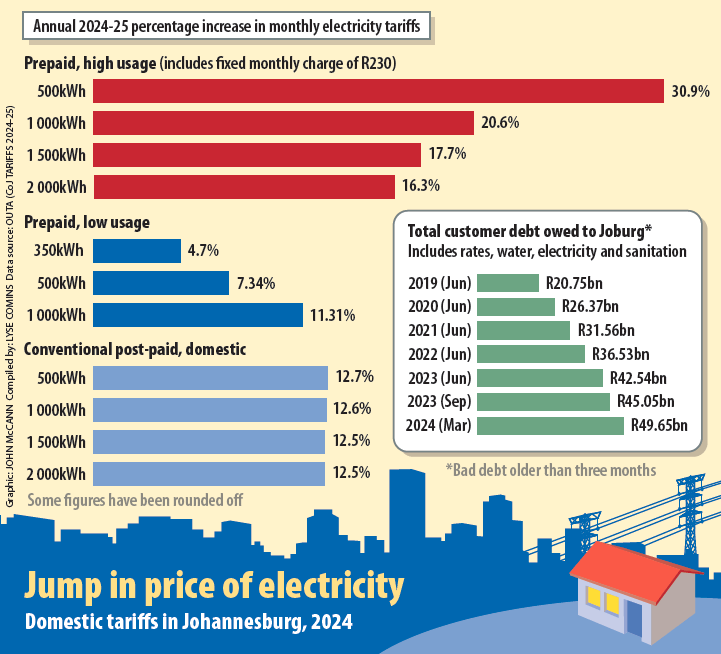
JoburgCAN’s manager, Julia Fish, said instead of penalising prepaid users with additional charges, the city should have incentives to encourage the shift to prepaid electricity to reduce its debt.
“The city must urgently re-evaluate its revenue streams and scrap the surcharge. Strategies to reduce customer debt such as expanding prepaid use, implementing high-profile disconnections and reducing dispute resolution turnaround times will strengthen the city’s financial position,” she said.
JoburgCAN has also initiated a Promotion of Access to Information Act request with the city, asking for the cost-of-supply study that City Power provided to the National Energy Regulator of South Africa (Nersa) to motivate the tariff increases.
Hinda maintained that the cost-of-supply study had justified the surcharge, which he said is “a tariff constituting a service charge and a capacity charge”.
“In terms of the cost-of-supply study, the expectation is that the tariff must be reflective of the costs incurred by the city to supply the prepaid customer,” he said.
“The prepaid residential tariff is still much lower than the conventional [post-paid] one, and it’s in an effort of trying to start the process of bringing them to be on par that we have implemented the basic charge of R200 from 1 July.”
Hinda said Joburg’s prepaid tariffs with the R200 surcharge made its electricity prices comparable to those of other major metros such as eThekwini.
He said the city had agreed to review the tariff following the public outcry but that the process would not be completed “overnight”.
eThekwini spokesperson Gugu Sisilana said the traditional electricity business model needs to “adapt to changing circumstances”.
“Previously, utilities like Eskom recovered network costs through energy tariffs. However, as more customers switch to alternative energy sources, it has become increasingly difficult for utilities to recover these costs,” she said.
The City of Johannesburg had implemented the R200 monthly surcharge “to help recoup a portion of the network costs”, Sisilana said.
“In contrast, eThekwini municipality has not yet proposed any plans for a surcharge, despite facing similar pressures to recover fixed network costs as more customers disconnect from the grid. This trend jeopardises our ability to cover network costs and subsidise poorer customers.”
City of Cape Town mayoral committee member for energy Xanthea Limberg said the city charges customers on its home user tariff, which applies to prepaid customers with a municipal property value of R1 million or more, and all credit metered residential customers a fixed monthly service charge of R281.78.
Institute for Economic Justice senior researcher Andrew Bennie said it appeared the state was trying to make citizens pay for its “inefficient or badly working” processes.
“Households across the board, let alone low-income ones, are already under significant financial strain with rising prices and the unemployment crisis, and so to try to squeeze more out of these households seems a low blow,” Bennie said.
“The city also needs to instead ensure that it has an efficient but also progressive electricity funding policy, so that low-income households are to some extent cross-subsidised by higher income ones.”
He said households would cut back on food spending to meet rising electricity prices.
“They cannot stop spending on transport to go to work, or on electricity to cook and heat the home, but they can cut on food by buying less of it, buying cheaper and less nutritious food types, cutting out on more expensive items like vegetables and fruits, and instead eating bulk, starchy, and cheaper foods like maize meal, bread and samp,” Bennie said.
“When the price of electricity goes up, this makes less money available for food consumption. As such, for poor households this surcharge could have food security and nutritional consequences.”
Vally Padayachee, a power and energy expert who was Eskom’s executive manager and City Power’s senior executive, said no customer would want to pay more for electricity if it was not justified.
“City Power Joburg has to defend how it arrived at the said quantum or amount of R200 per month for residential customers and R1 000 per month for business customers,” Padayachee said.
“However, what I can or will defend is City Power’s right to charge an amount for the upkeep of its electricity grid and the associated services it provides to end-use customers including prepaid customers,” he said.
“Unfortunately, in business, as we all know, there is no such thing as a ‘free lunch’. The power and energy sector is an asset-intensive and capital-intensive business, hence customers will need to also contribute to the upkeep costs, namely the R200 per month, which must be an approved and regulated tariff by Nersa,” he said.
Padayachee said the network upkeep costs for post-paid customers had already been factored into their tariffs.