Jennifer Fitchett sitting next to the excavation through the diatomite profile, adjacent to the core that was taken, April 2014. Photograph provided by Jennifer Fitchett
Two scientists have uncovered evidence of an ancient mountain lake that existed thousands of years ago in the Eastern Lesotho Highlands.
The discovery, which sheds light on a hidden chapter of Lesotho’s natural history, showing how climate and geography have shaped the region over millennia, was made by Jennifer Fitchett, a professor of physical geography at the University of the Witwatersrand, and Anson Mackay, an emeritus professor of geography at University College London (UCL).
Their study, published this month in the Journal of Quaternary Science, provides critical insights into past climate dynamics and helps predict future environmental changes in this sensitive high-altitude region.
Near Mafadi Summit, the highest point in South Africa, Fitchett decided to extract an extra core, on the last day of her PhD fieldwork, from what appeared to be a diatomite outcrop on the side of the mountain. Diatomite, a type of sedimentary rock rich in fossilised remains of diatoms (tiny aquatic plants), is a rich source of historical climate data.
The focus of her doctorate was on reconstructing the paleoclimate and paleoenvironment of eastern Lesotho.
Fitchett and Mackay had, in 2016, published what they thought was the main story about the bottom of the bowl-shaped depression. But their new analysis of the diatomite now showed that this high-altitude region once hosted a small but persistent shallow lake that teemed with life from 4 600 to 100 years ago.
“The Lesotho Highlands are considered the water tower of Southern Africa, and through the Lesotho Highlands Water Project, approximately 800 million cubic metres of water is transferred to South Africa a year, providing water security to Gauteng and surrounding regions.”
Despite its hydrological importance, “there is a lot that we don’t know about the hydroclimate of the Lesotho Highlands”, Fitchett points out. One big puzzle is why there are so few natural lakes in the region, despite the large total annual rainfall.
“It is a huge question because, if you compare the Lesotho Highlands to, for example, the Scottish Highlands, which also receive a very large amount of rainfall, the Scottish Highlands have so many natural lakes. And so we would expect the same kind of environment up in the Lesotho Highlands.”
But there are other forms of hydrological systems. In Sehlabathebe National Park, in the central eastern area of Lesotho, there are a huge number of rock bottom tarns (small ponds) and an extensive wetland network across the Eastern Lesotho Highlands.
“There’s a lot of surface moisture but the question is: why do we not have any lakes, and why did we have this lake there, that we have evidence was around from at least 4 000 years ago?”
The researchers’ best understanding is that it was probably a combination of post-industrial warming and the introduction of livestock that caused the lake to vanish.
Fitchett explains that post-industrial warming increased the evaporation rate, “potentially coupled with a reduction in rainfall that was just enough to outweigh that increase in the evaporation rate”.
And then, about a century ago, came the movement of livestock up into the Eastern Lesotho Highlands.
“Those livestock would be drinking water and it seems insignificant if you think about just one cow, but if you’re talking about loads of sheep, goats and cows, that can be quite a lot of water consumption, but also trampling the land. And if we’ve got a lake that only just sits within this topography, with a very tenuous border on the one side, you need very little erosion to take place for that to then just run out and to empty that lake,” says Fitchett.
To decode the history of the ancient lake, the researchers extracted sediment cores from the diatomite outcrop. Radiocarbon dating and microscopic examination of diatoms told a story of a lake teeming with life. Dominated by species such as Staurosirella construens and Aulacoseira ambigua, the diatom community suggested the lake had a continuous, relatively deep water presence for thousands of years.
Rainfall analysis using modern climate data showed that the area around Mafadi Summit receives significantly more rainfall than the region surrounding Lesotho’s only known natural lake, Letšeng-la Letsie. This, combined with topographic studies showing a bowl-shaped depression ideal for water accumulation, confirmed that the high rainfall and suitable terrain made the lake’s existence feasible.
The biggest challenge was reaching the remote site, located at an altitude of 3 400m above sea level, where the air is thin. The alternative was a hike of more than three days up through the Drakensberg, which was near impossible with all the equipment the team needed.
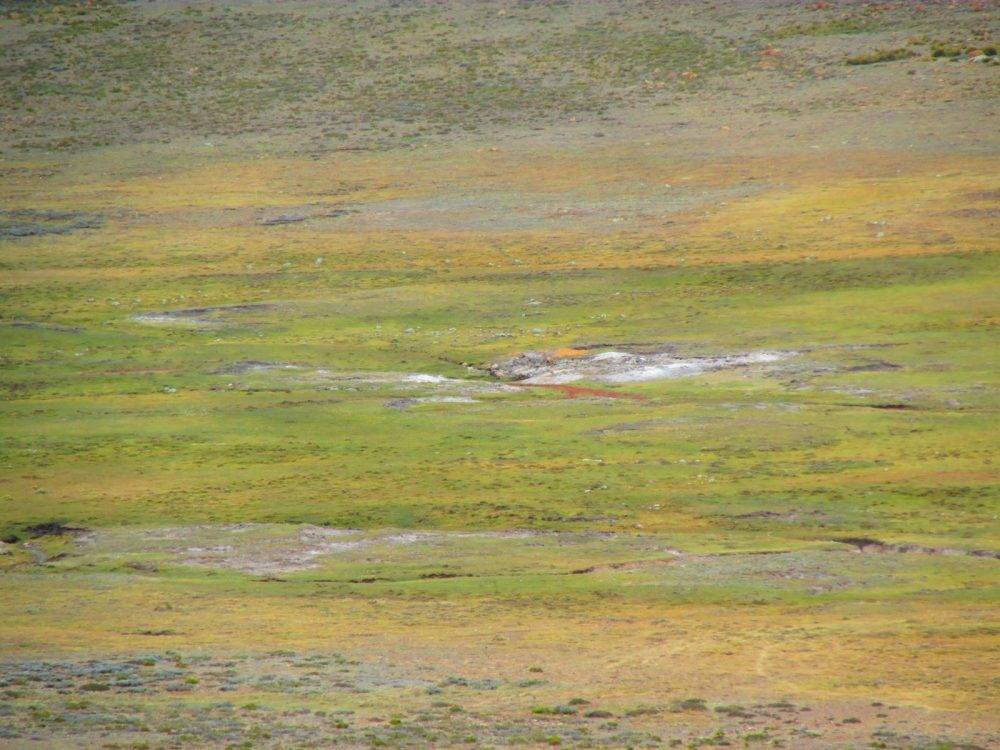 The white stripe on the landscape of the wetland environment at Mafadi is the diatomite outcrop from which the core was extracted. Photos: Jennifer Fitchett
“I flew in with my two local supervisors, professors Marion Bamford and Stefan Grab, by helicopter in 2014, when we collected the samples,” Fitchett said.
She recounted how she experienced a degree of altitude sickness, “which is one of the reasons I haven’t been back”, she said.
Her hands had swollen and she was short of breath.
“It’s really difficult to sleep when you’re struggling with altitude. When you’re in a tent and it’s minus goodness knows what outside but your brain just doesn’t want to go into a sleep state.”
When Fitchett and Mackay discovered how concentrated the diatoms were from the backup core, they knew they needed to explore this further.
“We originally applied for funding to take a helicopter back to Mafadi, but just as we got the funding, the world went into Covid-19 lockdown, and Anson was diagnosed with cancer.”
Fitchett also had health problems at the time and risking altitude sickness was not a good plan. The scientists re-strategised and took an approach to include remote sensing, gridded data, and further geochemical analysis on their samples.
Their dedication paid off, culminating in the paper’s publication a decade after the initial core extraction.
Theirs is a story of “slowing down science” in the academic world where there’s so much pressure to publish.
“It’s actually really refreshing to have a few projects like this, where you let them run their course,” she said, explaining that she took the extra core of the diatomites in 2014 and her PhD, which was published in 2016, barely referenced that extra core.
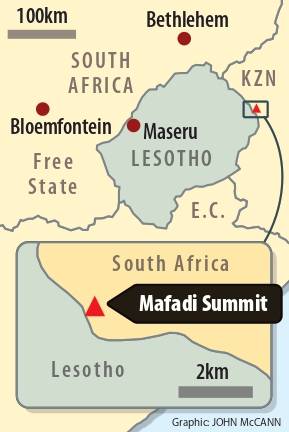 (Graphic: John McCann/M&G)
“But I took this extra core over to UCL where I was working with Anson and we decided to just do that extra bit of work to prepare and analyse those samples that weren’t part of my PhD,” Fitchett said. “Then gradually over the years, we started to look at what story it told and how we could support the story.”
This involved creativity and asking what other forms of evidence they could find despite their health setbacks and Covid-19.
“It was a very exciting process to be able to dive deep into a record and wait till we’re both really confident that what we found is a lake, because right the way through we were saying, ‘Well, it could it have been a spring, it could it have been a river’, and really chasing down all of these kind of alternate diagnosis for why we had that assemblage.”
Understanding how past climates and ecosystems interacted helps scientists predict future changes in these sensitive high-altitude environments.
“It’s really interesting to see that there was a lake and to know that it’s dried up and to understand that there are complex causes behind this,” Fitchett said.
She referred to the interplay between a changing climate, a changing environment and changing land use.
“The biggest message is that we need to carefully monitor the water bodies that are still around, whether it’s in Eastern Lesotho or the couple of natural lakes we have in South Africa and broader in Southern Africa,” said Fitchett, “because a lake that can be stable for a very long period of time can then dry up quite quickly.”
The other insight is in trying to better understand where the moisture experienced in the Eastern Lesotho Highlands originates from. “For example, if a lot of the moisture is related to our cold fronts, and we know that our cold fronts are progressively moving poleward, that is part of the reason for the Cape Town Day Zero drought, that we’re able to understand the climatology.”
This is to be able to monitor “and say if we’re very reliant on specific types of climate systems, and those climate systems are changing, again we may hit tipping points that occur much quicker than what long-term climate models may be projecting,” Fitchett said.