Missing in action: The Maersk Campton switched off its automatic identification system. Photo: Alamy
Danish shipping company Maersk has been accused of flouting global rules on trafficking hazardous waste after a container ship bound for Thailand, via Singapore, reportedly switched off its location transmission in South Africa’s waters.
The Maersk Campton was scheduled to dock in Cape Town on 1 August, according to international watchdog Basel Action Network (BAN), which said the vessel then “disappeared” after it had warned the South African government that it was suspected of illegally transporting hazardous waste.
Following its alert to South Africa, the ship’s automatic identification system (AIS) GPS beacon was switched off on 31 July, according to the BAN.
South Africa searched diligently for the missing ship, in vain.
“It skedaddled out of our waters,” said Bobby Peek, the director of nonprofit environmental justice organisations groundWork and Friends of the Earth South Africa, which is a member of the network.
“What happened when the ship came to South Africa was that it switched off its location beacon …
“Obviously, they picked up the warning [to the government] and the beacon was switched off. That’s our belief.”
Data from ship tracking intelligence service MarineTraffic suggests the beacon was switched back on, on 12 August, as it was approaching the Malacca Strait, which runs between the Malay Peninsula to the north-east and the Indonesian island of Sumatra to the south-west.
The department of forestry, fisheries and the environment (DFFE) had reached out to both Albania and Thailand to confirm the information communicated to it by BAN, spokesperson Peter Mbelengwa told the Mail & Guardian.
“The DFFE immediately set about tracking the vessels in question and put a plan in place together with the South African Police Service, the South African Maritime Safety Authority (Samsa), the SA Navy as well as the Port of Cape Town to do a full inspection when the ship docked.
“The DFFE also contacted Interpol to assist South Africa on this matter.
“The shipping company was contacted to request bills of lading to understand what cargo the ship was carrying and where these containers of electric arc furnace dust were in relation to other containers on the ship,” he said.
“The shipping company indicated to us that the ships were not scheduled to dock at Cape Town and that they would merely pass through our exclusive economic zone on its way east towards Thailand, with a stop in Singapore.”
The Maersk Campton is allegedly carrying an estimated 327 tonnes of what BAN believes to be toxic steel furnace dust collected from pollution-control filters, presumably from the steel industry in Albania.
If confirmed to be hazardous waste by the provisions of the Basel Convention, the UN treaty that controls the trans-boundary movements of hazardous waste and their disposal, the containers could be seized and repatriated to Albania, it said last week.
BAN also red-flagged a second ship, the Maersk Candor, carrying 61 containers, on a similar route as the Campton. The latter was due in Singapore on 13 August, while the Candor’s arrival was set for 23 August.
The Bangkok Post reported on Wednesday that the two Maersk ships have been banned from Thai ports and will be sent back to Europe.
The Maersk Campton was now displaying its location and sailing through the Malacca Strait, it said.
According to the International Maritime Organisation’s Solas Convention — the most important of international treaties concerning the safety of merchant ships — the AIS beacon should always be turned on when vessels are at sea or anchored.
Only in the case of imminent danger, when the captain of the ship is certain that the continuous signal broadcast compromises the safety and security of the ship, can it be switched off.
In response to questions, Maersk told the M&G that it was not uncommon for some vessel owners to turn off their AIS because of the security concerns in the waters around the Middle East.
Bloomberg reported on Wednesday that Maersk said the vessel had stopped broadcasting its location as it neared Cape Town “due to security concerns in the region [Cape Town]”.
“We can imagine no other reason for this behaviour other than an effort by Maersk to avoid arrest or delays due to the likelihood of their ship being involved in trafficking in hazardous waste,” Jim Puckett, BAN’s executive director, said in a joint statement issued by the organisation with groundWork, Friends of the Earth South Africa and Ecological Alert and Recovery —Thailand, last week.
Under international law, South Africa has jurisdiction over the exclusive economic zone, meaning that ships passing through would need a permit to get in. Ships would also be subject to inspection by South African authorities.
The situation is murky in that the ship straddled South African waters, but did not dock, before turning its locator off prior to disappearing.
In a letter sent on Tuesday to the competent authority of the Basel Convention in Singapore, Fu Yi Chen, Puckett said the Albanian government had confirmed that it had not been notified of the shipments by the exporter and “thus no notification was sent to transit or recipient countries as would have been expected for any type of hazardous or Basel-controlled waste”.
The Moroccan government confirmed these shipments had not been notified to it as a transit state — the Candor transited Tanger in Morocco on 26 July — while “the government of South Africa has not been properly notified either (the Campton was scheduled to dock in South Africa before it turned off AIS and the Candor is currently en route to South Africa)”
The DFFE confirmed that South Africa had not received a request for transit consent. Puckett said the government of Thailand also never received any notification of the pending imports, adding: “We don’t expect that the government of Singapore has been properly notified either.”
The two ships together are carrying an estimated 816 metric tonnes on 100 short containers of what is believed to be electric arc furnace dust, presumably from the steel industry in Albania “with waste codes corresponding to the EU code 10 0 207 and Basel Hazardous Waste Codes: A1020 and A1080”, he said.
Both ships were destined for Singapore.
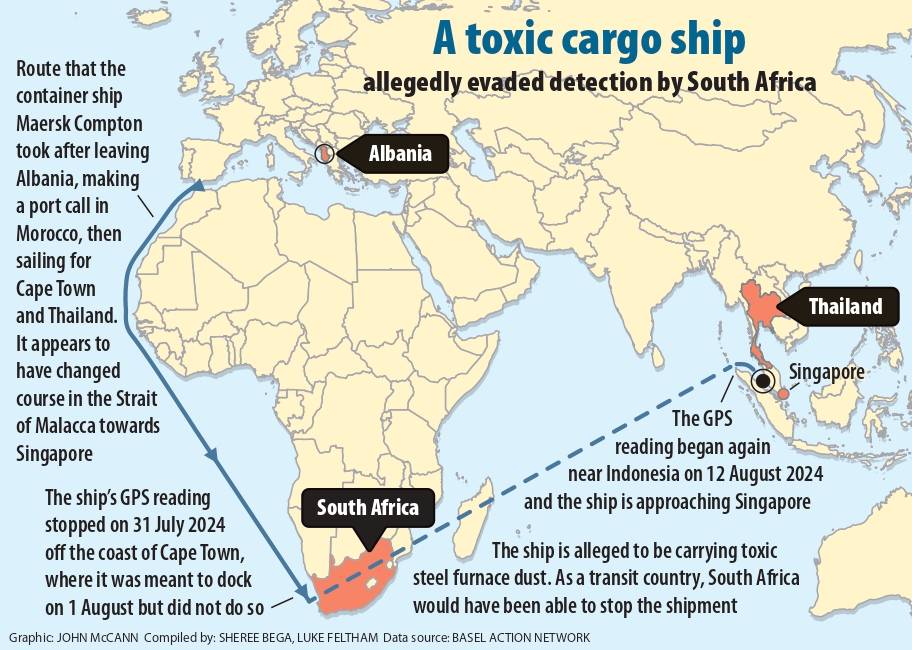 (Graphic: John McCann/M&G)
“There they will offload the short containers and then the containers are intended to be loaded onto another ship for destination Laem Chabang, Thailand …
“The Thai government has stated they will not allow the containers to be imported into Thailand …
“We are calling on the Singapore government with the assistance of the A.P. Moller-Maersk company to seize the containers and set them aside to be chemically analysed to determine whether the wastes are in fact hazardous wastes.”
Puckett noted that a similar shipment was seized by the Chinese government earlier this year and sampled. It was analysed as being waste containing high levels of lead (greater than 8%).
“Unfortunately, there has been false and incorrect information about the two Maersk-chartered vessels, Maersk Campton and Maersk Candor in the media,” Povl Rasmussen, a senior press officer at Maersk, told the M&G on Tuesday.
“For example, according to a press release from an NGO dated 5 August, the vessels were heading from Albania to Thailand carrying hazardous waste — with a call in South Africa in their schedules.
“All this is incorrect, he said. “The vessels have never called in Albania or South Africa, nor do they have any scheduled calls in Thailand.”
Additionally, Rasmussen said, the NGO had made speculations about why Maersk Campton’s AIS tracker was turned off.
“With the current security situation in the waters around the Middle East region, it is not uncommon that some vessel owners may turn off their AIS due to security concerns.
“Maersk Campton is currently en route to Singapore as per original schedule.”
“Maersk can confirm that the vessel Maersk Campton is — on behalf of another shipping line — carrying 41 containers that originate in Albania and should be discharged in Singapore,” Rasmussen told the M&G. “None of these containers have been declared to contain hazardous waste.”
Had they been declared to contain hazardous waste, Maersk would have declined to carry them, he said.
“Due to the speculation about the content of these containers, Maersk is currently cooperating with Singaporean authorities as well as the shipping line (which Maersk is carrying the containers on behalf of) to ensure that the containers will be repatriated to Albania in the best way possible.”
A similar procedure is expected to take place for Maersk Candor, which carries 61 containers, also originating in Albania, and is booked by the same shipping line, Rasmussen said.
According to Peek, BAN “informed everybody” on 30 July, specifically Mishelle Govender, the chief director of hazardous waste management and licensing at the DFFE, about the shipment that was possibly due to dock in Cape Town. “BAN had information that there’s toxic waste from a blast furnace in Albania on this ship [Campton].
“BAN, who has been following the Basel Convention since its inception, wrote to Mishelle as the competent authority in South Africa to take this issue up and follow it up.
“We have to acknowledge to some extent that some of the people that we’ve been dealing with [in South Africa] have been proactive,” added Rico Euripidou, the campaign coordinator at groundWork, singling out Govender in particular.
“She put out an alert to Interpol and alerted Samsa that the ship had turned off its beacon and that all of the marine compliance resources within the DFFE should look out for the first ship.”
Where local authorities fell short was in the interpretation and implementation of the Basel Convention, he said.
“What that interpretation should have been is that the ship was scheduled to dock at Cape Town, they should have alerted the shipping company and told them that when the ship docks, they want to do an inspection, and as part of that inspection they should have carried out the requirements of the convention.”
All countries, including South Africa which is a signatory to the Basel Convention, “could have taken a lot more action”, Euripidou said.
“What countries generally don’t do is they don’t follow the rules of what they agreed to themselves in the convention.
“In the event that all parties don’t do everything that they can to enforce the convention, it undermines the convention.
“We’re seeing a classic example of countries along the value chain of this ship’s journey … not implementing the convention.”
Article 4.4 of the Basel Convention is clear, he said.
“It says each party must take appropriate legal, administrative and other measures to implement and enforce the provisions of this convention, including measures to prevent and punish conduct in contravention of the convention.
“You can say that is open to interpretation, but if we were serious about doing something to prevent the trans-boundary movement of hazardous waste, and you know that there is hazardous waste in transit on a ship, in containers, then you can take legal and administrative and other measures to make the convention meaningful.”
Mbelengwa insisted that South Africa had not fallen short in the interpretation of the convention.
“The shipping company confirmed that the ship was not scheduled to dock in Cape Town … [The] DFFE had made arrangements to do the inspection. However, if the ship does not dock, and is outside our territorial waters, then DFFE’s powers outside the South African jurisdiction are limited.”
The country’s authorities, including the DFFE and Samsa, are fully mandated to stop a ship within the country’s jurisdiction, including its ports, to inspect it for illegal cargo or contraband, “if South African authorities have reasonable suspicion of such”, Mbelengwa added.
“If South African authorities find suspicious illegal waste, the challenge is that the cargo would have to be offloaded, tested to confirm the illegal hazardous waste constituents, [stored] and repatriated … to the country of origin.”
There are heavy financial implications linked to cargo offloading, testing and storing of suspected illegal waste, he said.
“This is an extremely expensive process and recouping the money for this is not guaranteed.
“The process is also a lengthy process and can [be] dragged out in the courts to delay the payment.”
Another challenge is that while South Africa can direct a vessel to dock when it is in the country’s territorial waters, it is difficult to stop a ship that is straddling South Africa’s waters transiting in the South African exclusive economic zone and is not affecting the country’s rights in this zone.
South Africa had planned to stop the Candor but this ship “never came close to South African territorial waters” in its journey to Thailand.
South Africa contacted the US Coast Guard, as well as the Maritime and Port Authority in Singapore to ask them to stop the vessel and inspect it when it docked there, he said.
“As far as the DFFE is aware, the exact time of arrival of Campton at Singapore was estimated to be 13 August 2024. The DFFE is waiting to hear if there are any positive results based on the notification that was sent to Singapore.”
Puckett said electric arc furnace dust contains high levels of hazardous heavy metals, such as lead; dioxins, chemically related compounds that are persistent environmental pollutants and polycyclic aromatic hydrocarbons, chemicals that occur naturally in coal, crude oil and gasoline.
They also are produced when coal, oil, gas, wood, garbage, and tobacco are burned.
They can only be recycled to recover zinc in very few operations around the world.
“It is a dangerous, potentially polluting and expensive recycling operation,” he said. “Thailand is not thought to be one of the places in the world where this type of recycling takes place. It is feared these toxic dusts will be spread on fields to the detriment of the people, the agriculture and environment of Thailand.”
Toxic waste, Peek added, should not be transported between the Global South or to the south because it opens it up to a whole lot of challenges.
“Toxic waste, ideally, should be dealt with in situ at the plant.”