Ringing true: Call centres have the potential to create many jobs in South Africa. Photo: Supplied
Siyathemba Nkosi travels two hours daily to and from her home in Daveyton, Soweto, and her job at a recently opened call centre in Sunninghill, Johannesburg, but is willing to make the draining daily commute after being unemployed for years.
The 33-year-old told the Mail & Guardian at the launch of the call centre that she felt lucky to get the job because she had started to lose any hope of employment.
The centre is an initiative by Vodacom and Unisa for the benefit of students and staff.
Nkosi was speaking about a week after the latest quarterly labour force survey from Statistics South Africa showed the unemployment rate increased to 33.5% in the three months from April to June, rising for the third consecutive quarter and reaching its highest rate in two years as several industries shed jobs.
The number of employed people decreased to 16.7 million in the second quarter, while that of jobless people increased by 158 000 to 8.4 million, Stats SA said.
The expanded unemployment rate, which includes those who have given up looking for jobs, was at 42.6%.
The percentage of young people, those aged 15 to 34 years, who were not in employment or in education or training increased by 0.8 percentage points to 44.2% in the second quarter of this year from 43.4% during the same period last year.
Increasingly, desperate young job seekers like Nkosi, who are most affected by unemployment, are looking to the call centre industry, although for many it ranks very low on their list of preferred careers.
Also known as business process outsourcing or global business services, the call centre industry employs 85 000 people in the Western Cape alone, according to data from CapeBPO, a strategic business partner for the city.
The industry employs over 270 000 people in six South African cities, 65 000 of whom serve international clients, according to a report by management consulting firm McKinsey.
In another report for the three months ended March 2023, call centre industry body Business Process Enabling South Africa said 4 569 new jobs were recorded for the period, with the most growth being in KwaZulu-Natal, which accounted for 46.96% of new hires. The Western Cape was second at 37.61%, followed by Gauteng with 15.43%.
But many people fall into the call centre industry out of desperation, rather than choice, after being unemployed for some time, said Peter Andrew, the chief executive at CCI South Africa, one of the country’s largest international call centres with clients throughout Africa and across the world.
“It is not an aspirational job like a doctor or a lawyer. So, it is a stopgap to a certain extent. A lot of people come into the industry because of a lack of opportunities in other work due to experience, which is a factor that a lot of other jobs require,” Andrew said.
“This really is the breakthrough industry for South Africa because it creates jobs for individuals which will solve, to a large extent, our unemployment crisis.”
About 65% to 70% of call centre employees are under the age of 35, noted Nathalie Schooling, a customer experience specialist at industry company Nlightencx.
“There’s a pool of well-educated people who need jobs … The government knows this and that is why it is supporting this sector,” she said.
The department of trade, industry and competition published a master plan in 2021 with the aim of growing the industry so it can help lower unemployment. The then trade minister Ebrahim Patel said at the time about 40 000 South Africans had been employed in call centres servicing the UK alone.
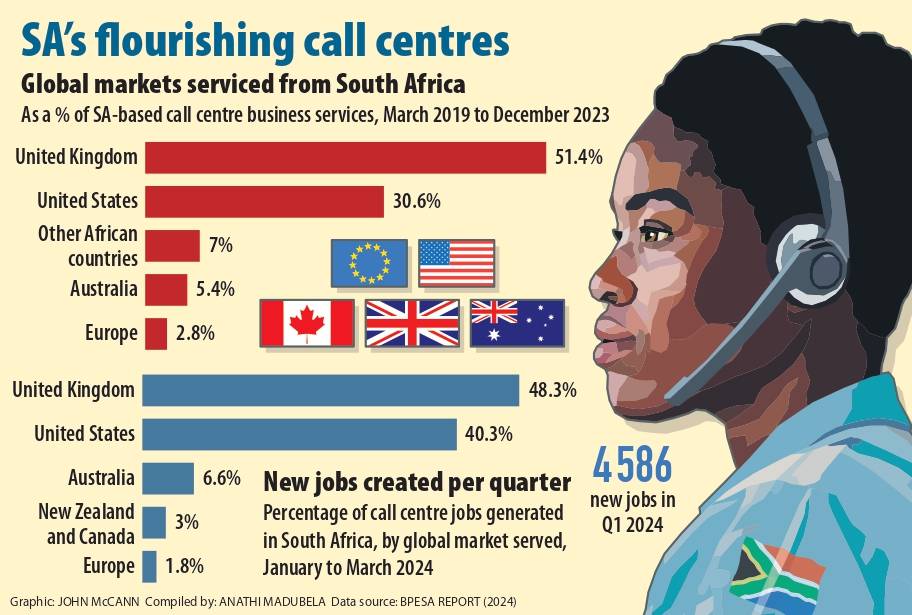 (Graphic: John McCann/M&G)
“There is an opportunity to scale current services up significantly, and to move up the value chain, by increasing the number of jobs that require more complex skills and problem-solving,” he said.
The government implemented a business process outsourcing and offshoring incentive programme in July 2007, which it says resulted in at least 6 000 new jobs and had attracted R303 million in direct investments by March 2010.
Last year, the government allocated R569 million to the call centre industry, towards a target of creating 500 000 new jobs by 2030.
Reaching this target would bring South Africa closer to outpacing the likes of India and the Philippines, the most and second-most favoured global call centre destinations, Andrew said. South Africa is third.
One factor that gives this country an advantage is having a similar culture to the UK and Australia, he said.
Another is robust infrastructure which ensures there is limited latency — the lag in speech over the phone — or loss of quality during calls.
“We have good stability within the workforce, government support and educated youth. So, certainly from the UK and US perspective, if they were to outsource, we would be the flavour of the month.
“Look at Amazon — why did they choose us?” Schooling asked.
Amazon‘s customer service unit has been operating in South Africa since 2010 and, in 2020, the global retail giant said it would be hiring 3 000 people in the country to support customers in North America and Europe. This would bring the total permanent workforce in South Africa to 7 000.
The initiative between Vodacom and Unisa has so far given employment to 18 people, who service the call centre 24 hours a day, working in shifts.
“It gets difficult sometimes when you have the later shifts, in terms of transport to work and home, but I feel well trained for the job,” said new hire Nkosi.
She underwent six months of training to be able to resolve queries from Unisa students and staff, ranging from billing to data provisioning and account disputes.
“The call centre aims at bridging the gap between the university and our students. Unisa students are scattered around the continent, and the only way to reach them is through this call centre initiative,” said Sibusiso Mthembu, director of supply-chain management at the long-distance university.