There are estimated to be fewer than 500 of the endangered mammals in South Africa’s waters
If there’s a “happy place” for Shanan Atkins, it’s being out on a small boat in Richards Bay, searching for endangered Indian Ocean humpback dolphins.
“To be on a boat out at sea early in the morning, where my mission in life is to find and follow these dolphins, document them and their behaviour and their lives is really a very rewarding job,” said Atkins, a postdoctoral researcher at the Whale Unit of the University of Pretoria’s Mammal Research Institute (MRI).
In the many hours she spent at sea, Atkins and her team have got to know Richards Bay’s humpback dolphin residents.
“We use their dorsal fins to identify individuals and we see some again and again and we watch the calves grow up; it’s very nice,” Atkins said.
Most people have probably never heard of the mammal, which is classified as South Africa’s most endangered dolphin. They are estimated to number fewer than 500 and inhabit a narrow strip of shallow, coastal waters.
Unlike their bottlenose dolphin cousins, they are shy, usually avoiding boats and people.
“They break the surface differently to how bottlenose dolphins do; they live in smaller groups; they don’t come and bow ride or interact with people the same way that bottlenose dolphins do,” Atkins pointed out. “They keep their distance and often are in and among the waves and are very close to the shore. You just don’t see them easily.”
For the scientist, there’s something special about her encounters with them. “You can’t see them and you don’t know where they are because they’re underwater and then suddenly one just breaks the surface and takes a breath of air, and you see the babies and they come up and you just see a little eye peeking out, as they surface.”
Atkins is coordinating the Indian Ocean Humpback Dolphin Conservation Network (HuDoNet), a new group of 77 scientists and conservationists from 17 countries along the western Indian Ocean and Arabian Seas, which is galvanising conservation action for the increasingly vulnerable humpback dolphin.
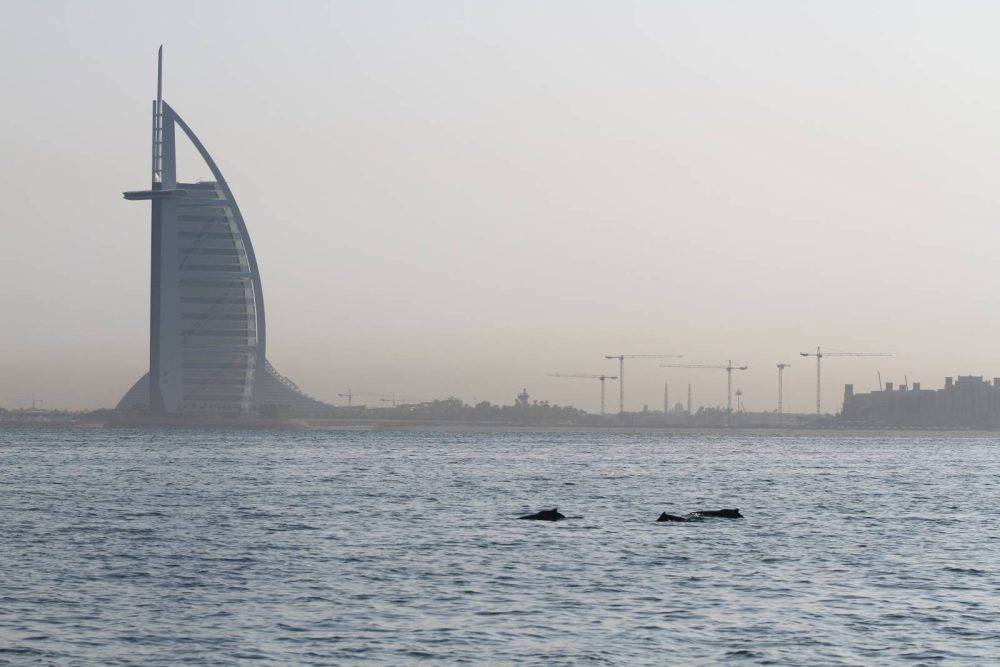 Humpback dolphins in Abu Dhabi.
The dolphin’s range extends from South Africa to other countries in Southern and Eastern Africa, the Middle East, western India and Sri Lanka, as well as islands such as Madagascar and Mayotte. Many of these 23 countries are low-income countries.
HuDoNet was launched this year to facilitate collaborative research and management efforts and sharing expertise to support conservation initiatives for the humpback dolphins across their geographical range. The University of Pretoria, through its MRI Whale Unit, along with the University of St Andrews in Scotland and Zayed University in the United Arab Emirates, were among the founding partners.
In most places, humpback dolphin populations are small and declining because of their proximity to highly populated coastlines. They are affected by human activities that occur on land, in fresh water and in the ocean, Atkins pointed out. “The dolphins die in fishing nets, their habitats are altered by port and harbour construction, coastal development, dredging and land reclamation. They are susceptible to pollution such as chemicals and loud underwater noise.”
Richards Bay is one of the few places where, if you see a dolphin, it’s more likely to be a humpback dolphin than a bottlenose dolphin, she said.
Along with the danger posed by shark nets, the harbour entrance is a core feeding area for the dolphins and the shipping lane, which is used by commercial ships and smaller ski-boats, cuts through the middle.
This exposes the dolphins to chemical and noise pollution, boat disturbance and food-web changes because of the introduction of exotic species. “We call it an ecological trap where it actually looks to be productive and a good place to be but then there are all of these things, which mean that the mortality rate is relatively high,” Atkins said.
Humpback dolphins also occur on the Thukela Bank between the mouth of the Thukela River and St Lucia on a wider-than-normal part of the narrow “Natal inshore” ecozone. “It’s quite shallow and the water is very brown and we think that humpback dolphins do okay there because the bottlenose dolphins tend to avoid that space because they don’t like the brown water.”
HuDoNet is not only a research project, according to Els Vermeulen, a senior lecturer and research manager at the MRI Whale Unit. “The ultimate goal is to collaborate and jointly create a conservation action plan for the species across its range; to collaborate, work with governments and share resources, knowledge and experience.”
The research will be used to inform precise conservation actions and to raise public awareness of the plight of this dolphin, she said.
The dolphin researchers face various problems. Ketki Jog, a PhD candidate from Australia’s James Cook University who is working in India, said a major issue is limited resources.
In South Africa, Vermeulen said that because of the elusive nature of the dolphins, data collection is difficult and also limited by resource shortages, which include limited data and technical support, little awareness of the species and its poor conservation status and inaction by the authorities.
“It is so difficult to get the authorities involved in conservation matters,” Yusuf Bohadi, a researcher at Kuwait University, said in a statement.
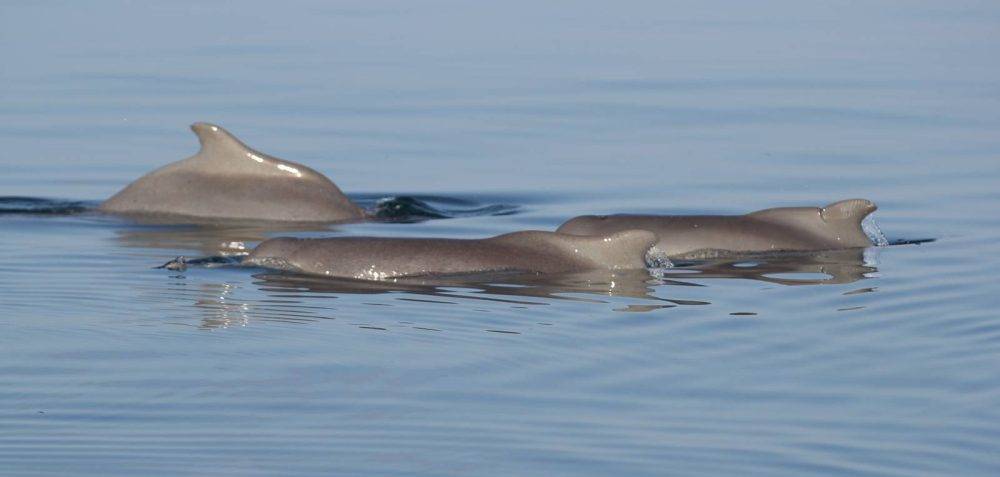 The humpback dolphin is classified as South Africa’s most endangered dolphin
The primary contribution from the University of Pretoria’s researchers to HuDoNet is centred on their work on SouSa, a national consortium working for the conservation of the species, which is also under Vermeulen’s lead. The group’s fieldwork predominantly entails small-boat work for photo-identification and biopsy sampling of humpback dolphins along the coast in Richards Bay and the Southern Cape coast.
Vermeulen said: “As part of our UP team, I have been working on the establishment of this network for more than two years, and I am proud that we are at a stage where we have launched and are actively working together across 77 members from very different cultural backgrounds, with the sole purpose of better conserving these endangered dolphins.”
Atkins added that a dolphin viewing platform in Richards Bay provides probably the “best chance” in the country of seeing humpback dolphins. Based in Johannesburg, she uses a hydrophone — an underwater microphone — in Richards Bay that records the seascape in the harbour entrance to detect and record the dolphins.
“I also have a webcam that you can see the coast and you see this spot where we do see humpback dolphins quite often, so I’m virtually connected on a daily basis. We do see dolphins on the webcam and we do have a bit of a citizen science programme where other people who might be watching see [the dolphins] sometimes and send us the information.”
Humpback dolphins deserve a fighting chance, she said. “They are animals out there, trying to exist and should be allowed to get on with it” without being affected by human activities.
“For humans too, it’s important to have biodiversity if we want healthy ecosystems; we need diversity in those ecosystems, or our future is going to be that much poorer and our health as a species is going to be that much poorer. We need resilient ecosystems and biodiversity is how we get that.”