Eskom is inadvertently helping drive the global sustainable energy movement by rapidly pricing South Africans out of the grid energy market. Photo: Waldo Swiegers/Getty Images
South Africa’s first youth-led climate change case got under way in the high court in Pretoria this week, challenging the government’s decision to procure 1 500 megawatts of new coal-fired electricity, for breaching the rights of current and future generations of children.
The Cancel Coal case was brought by the African Climate Alliance, the Vukani Environmental Justice Movement in Action and groundWork, Friends of the Earth SA, who are being represented by the Centre for Environmental Rights.
In October 2019, the then minister of mineral resources and energy, Gwede Mantashe, published the final revised Integrated Resource Plan (2019 IRP), which set out plans for 1 500MW of new coal-fired power capacity — equivalent to four large coal-fired power plants — to be added to the grid from 2023 to 2027.
The National Energy Regulator of South Africa (Nersa) agreed with the minister’s determination for new generation capacity, including the 1 500MW of coal power capacity. The IRP claimed that such coal generation would be cleaner because high-efficiency, low-emission Hele generation (regarded as clean technology coal) would be used, although it did not disclose which kind.
The applicants argued that the state’s plan threatens several constitutional rights, including the right to an environment not harmful to the health and well-being of present and future generations, as well as the rights to life, dignity, equality, and the best interests of the child.
This is because the carbon dioxide emissions and pollution from coal-fired power pose unjustifiable harms and risks of harm to human health, the environment, and the climate.
“Expert evidence supporting the case shows that we do not need this coal power to meet the country’s electricity needs, now or in the future, and it adds significant costs and emissions to South Africa’s electricity system,” they said.
The country’s electricity needs can be met by available and less harmful renewable energy alternatives, which are cheaper than the proposed new coal-fired power.
In their heads of argument, the applicants said they had brought their combined constitutional challenge and review on three primary grounds. The first is the failure to assess the effects on children’s rights. “The minister and Nersa failed to give adequate consideration to the impact of their decisions on the rights of current and future generations of children and thus failed to uphold the best interests of the child.”
The second centres on the failure to assess the feasibility of so-called clean coal technologies. “The minister and Nersa premised their decisions on the belief that ‘clean coal’ technologies would prevent all harms, but now admit that they made no attempt to assess whether these technologies can feasibly address the admitted dangers.”
The third was on the unjustified limitation of rights, with the applicants arguing that the minister and Nersa offered no adequate justification under section 36 of the Constitution for the limitations of the rights of children and vulnerable people, including section 24 environmental rights, the best interests of the child, the rights to life, dignity and equality, as well as socio-economic rights.
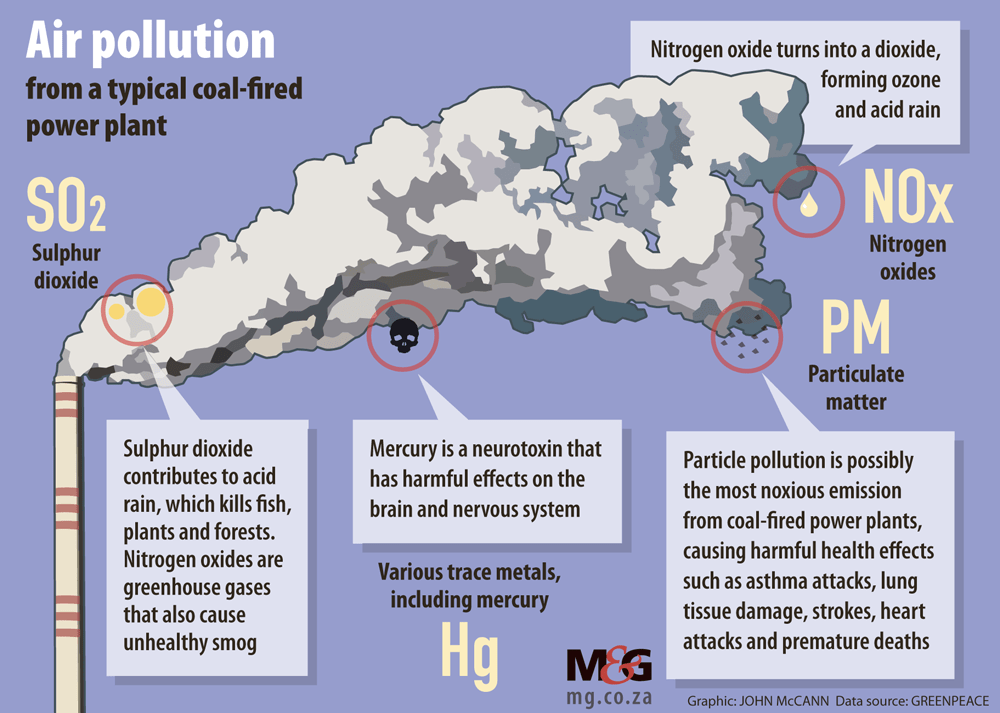 (Graphic: John McCann/M&G)
Accordingly, they seek a declaration of invalidity, declaring that the impugned decisions are unlawful and unconstitutional to the extent that they include provision for 1 500MW of new coal-fired power as well as an order setting aside these decisions and remitting them back to the minister and Nersa for fresh determination “in a manner that is consistent with their constitutional and statutory obligations”.
The primary question in this case, they charged, is whether the minister and Nersa complied with their constitutional and statutory obligations to respect and protect the rights of present and future generations of children. “The answer, we submit, is ‘no’.”
The dangers of coal-fired power stations are undisputed, they said. “Coal-fired power is the single largest contributor to climate change. The pollution emitted from these power stations also has severe and often deadly impacts on human health.”
It is, too, undisputed that present and future generations of children are disproportionately affected by these harms. “They are not only more vulnerable to environmental threats, but they will have to live with the consequences of climate change and environmental degradation over the course of their lives.”
Given the known dangers, any plan to introduce new coal-fired power stations required careful consideration of the effects on constitutional rights, based on proper information. “However, no such care was demonstrated here.”
Among the expert evidence submitted in support of the applicant’s case was a report by air pollution expert Ranajit Sahu, which confirmed that the proposed 1 500MW of new coal-powered electricity generation would cause significant air pollution and greenhouse gas emissions, even if the cleanest technology currently available was used.
“Large quantities of greenhouse gas emissions are unavoidable even from power plants that use Hele technologies,” his report said. “Pulverised coal units, even ultra-supercritical, will not be able to capture their emitted carbon dioxide due to extremely high costs. Circulating fluidised bed technology emits from two to 10 times more nitrous oxide than pulverised coal technologies.”
Nitrous oxide is a potent, long-lasting greenhouse gas with a global warming potential 300 times that of carbon dioxide.
Sahu said that even if Hele technologies are applied consistently and perfectly, a “practical impossibility” because the technologies do not work under all modes of operation, air emissions are considerable even just at the plant itself.
“Plus, there are non-air impacts such as wastewater and cooling water and waste generation at the plant. In addition to impacts from the plant, a coal plant will need to rely on an extensive supply chain starting at the coal mine and through disposal of the coal ash, with transportation in between – all of which not only have significant air impacts but also water and waste impacts. Thus, ‘clean coal’ is a myth.”
In his heads of argument, the minister said: “The applicants complain that the 2019 IRP and the September 2020 determination constitute a departure from government’s overall plan to decarbonise, in particular because the 2018 IRP recommended that on a ‘least cost’ model for future electricity generation, no new coal-fired power stations are required.”
But the applicants “deliberately left out the proviso in the referred statement, which stated that future electricity generation may not be required ‘unless affordable cleaner forms of coal power are available’”.
His determination that 1 500MW of electricity shall be generated from coal-fired power is based on the recommendations in the IRP, that high efficiency, low emission coal technologies be pursued.
“The opinions relied on by the applicants to argue that there is no such thing as clean coal and thus the basis for the alleged constitutional violations are not based on any conduct of the minister but postulations on the potential causes of climate change that may result from the implementation of the procurement of the 1 500MW of coal fired power.”
The procurement process itself has not commenced. “Therefore, there is no specification as to the types of technologies that may be deployed for the coal-fired power and the cost implications thereof from which to determine that the implementation of the determination will have the adverse consequences postulated in the expert reports.”
The applicants’ view seemed to be that any future use of coal in itself violates the Constitution. “In other words, had the minister made the considerations about possible adverse effects on human rights, he would not have included coal in the IRP and the determination at all … If the applicants were to have their way, the future use of coal to generate electricity capacity should be prohibited.”
According to the minister, there is no evidence that the IRP and the determination “have affected or have the potential to affect the rights of children”, nor does it have the potential to affect the rights to life and human dignity, as well as the right to water, healthcare and food.
In its heads, Nersa said among its reasons for concurring is that “there are CO2 emissions constraints that were built into the IRP model, which is applicable for the entire period of the plan and cannot be exceeded”.
“The extent of the coal contained in the IRP is within the imposed emissions reduction trajectory. In terms of this plan, South Africa’s greenhouse gas emissions are expected to increase and peak in the short term, before plateauing and declining over time.”
Environmental emissions were already considered in the IRP and in it a policy decision was taken that all new coal power projects must be based on Hele technologies to reduce emissions. It said that although the cost of coal would increase because of the deployment of Hele technologies and carbon tax, the cost was still comparable with other technologies.
“South Africa has vast coal resources that can still be used to benefit the country, provided that Hele technologies are employed to offset against harmful effects.”