Prasa, through the rolling stock recapitalisation programme, procured new rolling
stock for its Metro Rail operations as part of its long-term modernisation strategy.
(Delwyn Verasamy)
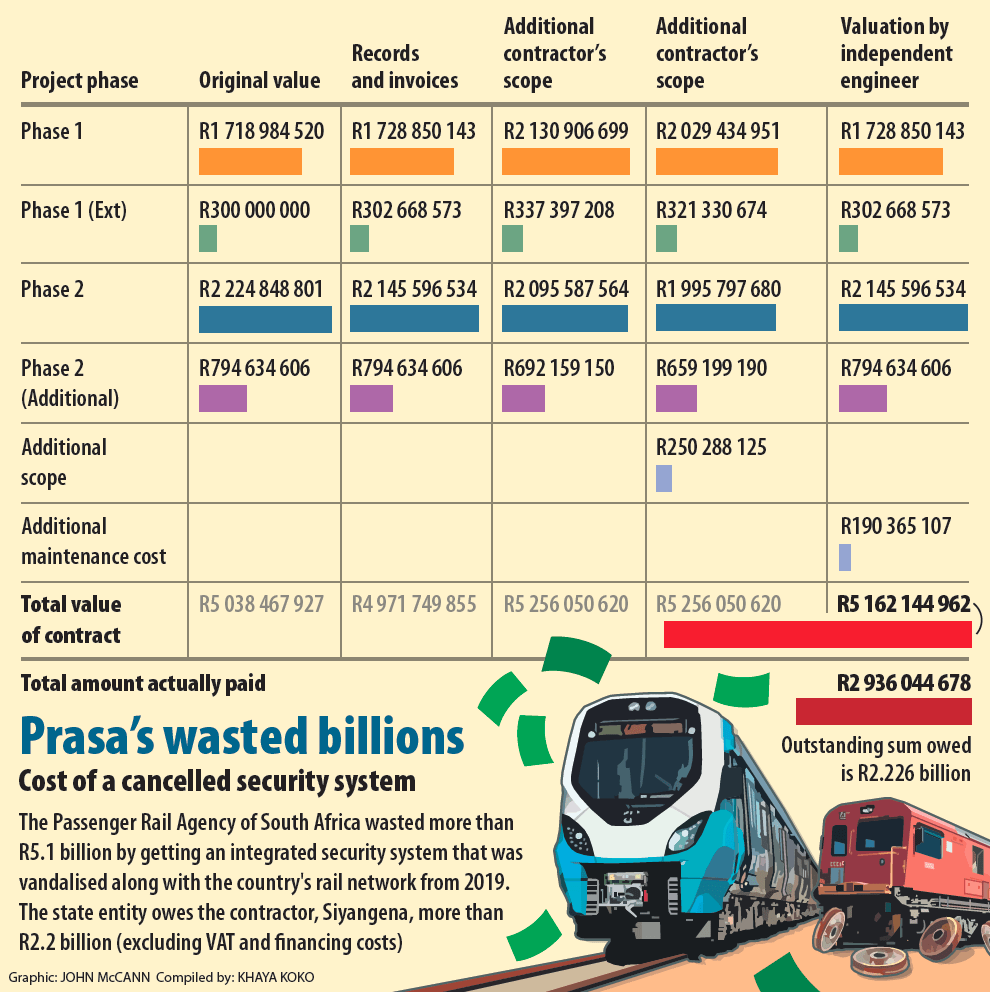
The Passenger Rail Agency of South Africa’s (Prasa) “reckless negligence” led to vandalism and theft at around 150 commuter stations, undoing the work done under a contract valued at R5.1 billion rand. This is according to an engineer report ordered by the Pretoria high court.
The report — which forms part of legal action involving the state-owned company — quantified the total cost of the destruction of the country’s commuter rail system after what it called Prasa’s “spectacularly unpragmatic decision” to cancel its security contracts in about June 2019 without new ones being put in place.
Politics was at play during the security contract cancellations after a public spat between ANC secretary general Fikile Mbalula, who was transport minister at the time, and former ANC spokesperson Carl Niehaus, who is now an MP for the Economic Freedom Fighters.
In 2020, as the vandalism of the rail network was in full swing, Mbalula accused Niehaus of being a “thug”, who — together with the late Kebby Maphatsoe, the former deputy minister of defence and military veterans — had orchestrated that those with links to the ANC’s military veterans association “irregularly” got Prasa security contracts.
“Prasa was your milking cow. I have closed the taps; that is my sin. You used to do as [you] wished with fake security companies,” Mbalula said.
In June 2019, Siyangena Technologies was eight years into its contract to refurbish more than 150 Prasa commuter stations with public address speakers, speed gates, fire-detection technology, electronic display boards, closed-circuit television cameras and access control fittings, among others.
In the same year, after the completion of what the court-ordered report said was a project displaying “high standards of technical professionalism by a responsible and competent contractor”, more than R5 billion worth of new infrastructure that Siyangena had installed was destroyed by looting and vandalism. This brought the country’s railway system to a halt.
These shocking details are contained in findings compiled by engineer Errol Braithwaite, who signed off the report in August after an appointment process the Pretoria high court began in October 2020 to find an expert to “value the works” performed by Siyangena.
Prasa’s negligence has resulted in a sharp decline in rail travel, with the agency’s national commuter numbers plummeting from a high of about 550 million passengers in the 2014-15 financial year to a projected paltry 186 million in 2026-27, according to its briefing to the transport parliamentary committee last month.
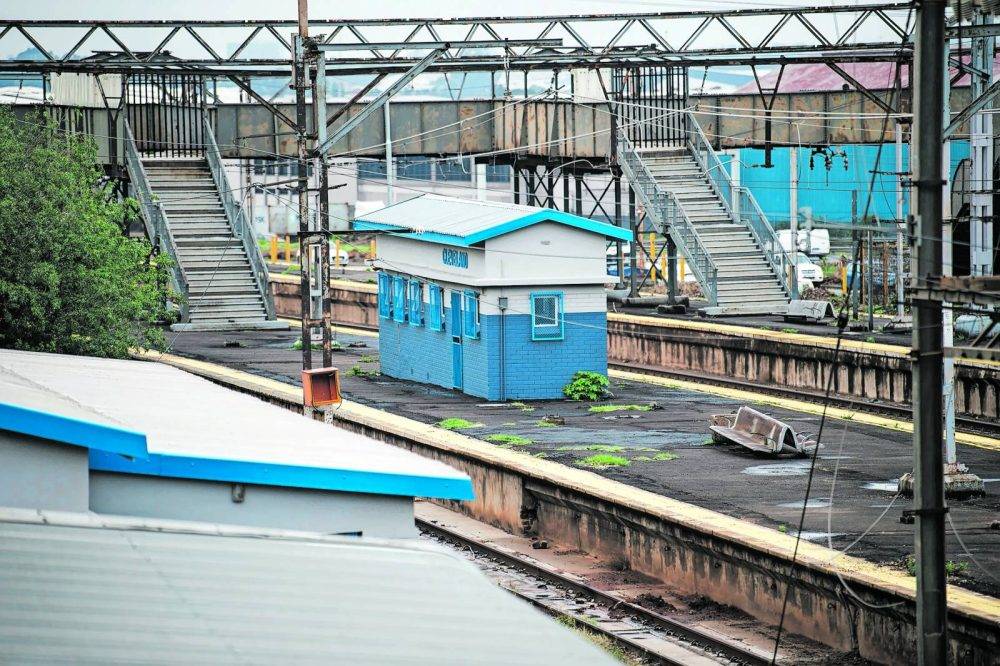 The public address system, electronic boards and cables at Cleveland station in Johannesburg have been looted. (Delwyn Verasamy)
In April 2011, Prasa awarded Siyangena the contract for its integrated security access management system to refurbish 150 stations ahead of the “blue” passenger trains with which the government eventually wanted to replace most of the grey-and-yellow coaches from the late apartheid era and South Africa’s early democratic years.
The system and stations revamp was an ambitious, “modern” project, the scale and complexity of which, according to engineer Braithwaite’s findings, had never been undertaken in the country.
“Even the Gautrain project (which included an analogous integrated system) comprised only 10 stations, all within 80km of each other. This Prasa project included well over 150 stations, in three different regions, several hundreds of kilometres apart,” the report read, highlighting the national outlook of the Prasa development, as opposed to the provincial focus of Gautrain.
Braithwaite added that the Prasa development, unlike the Gautrain, had to be “installed in fully operational stations, including retro-fitting new systems in a live railway environment”.
“The technical, safety and logistical complexity that this adds to a project is massively significant,” he stated.
However, in March 2018, Prasa began what became a successful legal application to set aside its contract with Siyangena as the parastatal believed the procurement process for the project had been irregular.
A year later, security contracts were also set aside by the high court for the same procurement irregularities found in the systems tender.
In October 2020, the high court ruled that the refurbishment tender had failed to act in a manner that was “fair, equitable, transparent, competitive and cost effective”, with the order that the contract was “invalid” and should be set aside.
But the court said the parties should agree to an independent engineer (eventually Braithwaite) to evaluate Siyangena’s installations and determine whether the company should reimburse Prasa for the nearly R3 billion paid to it, or whether the private firm was owed.
Prasa made the last payment to the contractor on 1 April 2015, four months before former public protector Thuli Madonsela released a derailed reportt after her investigation into fraud and corruption worth more than R2.8 billion.
The court process resulted in the August report — which the Mail & Guardian has established Prasa and Siyangena have received — detailing that, not only did the parastatal allow its assets to crumble, but had also not learnt from past mistakes.
Braithwaite, highlighting his site-visit observations, said he had “witnessed first-hand” how Prasa had allowed a “pervasive culture of poor maintenance, lack of due care, inadequate security and disregard of even the most basic housekeeping requirements, and there is an inevitable decline in functionality and service levels”.
“Thus, the challenges that Prasa faces are much deeper and broader than procurement irregularities and will require deep and committed (even ruthless) interventions by Prasa management on several fronts,” the engineer wrote.
Hishaam Emeran, Prasa’s group chief executive, said at the Africa Rail Conference in June that the agency had spent more than
R12 billion on revitalising its assets, and had brought back 31 of the 40 rail corridors nationwide, albeit operating at a fraction of their peak years.
When the M&G visited revamped stations around Gauteng this week, the security gates had already been ruined, with holes along the track lines, giving easy unauthorised access to railway lines.
Furthermore, benches for commuters had been damaged at Cleveland station, outside the Johannesburg CBD. The facility no longer had the public address system and electronic boards it boasted over five years ago.
Massive looting had occurred at Cleveland, according to Braithwaite’s findings, which saw the theft of 12 manhole covers as criminals sought to steal cables installed at the station and in its vicinity.
This included a 1 500m power cable, a 1 800m fire cable, a 1 000m speaker cable and a 1 500m fibre-optic cable, as well as two platform cameras and a dome camera.
However, the engineer’s report stressed that, despite the legal wrangling between the parties, at a working level, “the work progressed in a competent and professional manner”.
Braithwaite also assessed the cost model developed by Siyangena, finding that the original contract value and the generated invoices after work done were within 2% of each other, “lending credence to the valuation results”.
Siyangena director Roy Ferreira declined to comment this week, saying this was a legal matter, which he could not speak about.
This week, detailed questions were also sent to Prasa spokesperson Andiswa Makanda, who acknowledged receipt and said she would reply. Neither had responded at the time of going to print.
Meanwhile, the M&G spoke to several sources — independent of each other — with intimate knowledge of Prasa operations and contracts.
One well-placed insider highlighted what he called “the gross misappropriation of funds because around R5.1 billion was wasted without anything to show for it”.
“That whole R3 billion that they have paid Siyangena has gone to waste because only a few stations, including the one in Durban, are functioning optimally. So, this is a gross misappropriation of public funds — our money,” said the source, who asked to remain anonymous.
The M&G understands from another insider that the rail agency had been refusing to pay its former contractor.
Prasa, according to internal notes the M&G has seen, approached a well-known law firm to help it find another independent engineer to re-evaluate the work done by Siyangena, allegedly in an attempt to nullify the assessment Braithwaite had conducted.
Prasa was given the law firm’s name in the questions sent this week.
A senior official, who also asked to remain anonymous, said the entity was embroiled in a “waste of public funds” and could be held in contempt of court if it continued enlisting the services of another engineer, when the Pretoria high court had appointed Braithwaite.
“So, to approach another engineer, Prasa needs to return to the same court and file papers motivating why they want to appoint another engineer,” the source explained.
His views were supported by the October 2020 court ruling that ordered the use of an independent engineer, stating that, should the parties not agree on the evaluation, “the court could be approached on the same papers supplemented where necessary to determine the value of the works”.
Another state official added that Prasa by now should have informed Siyangena how much the rail agency would pay the former contractor. However, Prasa has yet to reveal its figures.
Meanwhile, the interest on the remaining payment is accumulating at 10% a year, meaning that, at R220 million annual accrual, Prasa could pay more than R1 billion extra on the remaining interest alone, having paid Siyangena’s last invoice in April 2015.
This would put even more pressure on the strained finances of the agency, the revenue of which has dwindled since reaching a high of more than R2 billion in the 2014-15 financial year. It came in at a paltry R119 million in 2022-23, as detailed during Prasa’s appearance before parliament’s standing committee on public accounts in September.
The auditor general also reported that Prasa had accumulated irregular expenditure of more than R3.8 billion during the 2022-23 financial year, the highest annual figure in the five-year period from 2018-19.
“All irregular expenditure related to contraventions of procurement-related laws and regulations,” the auditor general said in the report presented to parliament in September. Prasa’s fruitless and wasteful expenditure, however, dropped significantly from more than R302 million in 2021-22 to R179 million the following financial year.
Interestingly, the auditor general’s report detailed the same lack of consequences that the independent engineer highlighted in his findings, with the constitutionally mandated audit office asserting that Prasa had adopted a “culture of impunity towards transgressions of laws and regulations”.
Therefore, Prasa continued to incur unacceptable levels of irregular, fruitless and wasteful expenditure, said the auditor general.
“This, combined with Prasa’s need to simultaneously rebuild [railway] lines across all engineering disciplines at the same time and capacity constraints in the supply-chain management department, resulted in overloaded and protracted procurement processes, which, in a number of instances, did not comply with prevailing laws and regulations.”