Boning up: A group of scientists has scanned the fossilised bones of Jurassic-era crocodile found in South Africa. Photos: Supplied
A team of local and international scientists has used cutting-edge bone scans to uncover the secrets of a tiny Jurassic crocodile found in South Africa about 200 million years ago.
Orthosuchus stormbergi was an early ancestor of today’s crocodiles, according to the GENUS: DSI-NRF Centre of Excellence in Palaeosciences, and offers unique insight into their evolution.
Unlike its modern relatives, known for their large size, this crocodile was distinctive for its slow growth and being diminutive.
Orthosuchus “paints a fascinating picture of ancient ecosystems and crocodilian history”, the study said.
The team’s research, published in The Journal of Anatomy, was led by PhD student Bailey Weiss from the Evolutionary Studies Institute and School of Geosciences at the University of the Witwatersrand.
Orthosuchus grew relatively slowly, Weiss said.
“This research also confirms that it was a small-bodied adult — the smallest known archosaur [the group that contains birds and crocodiles] from the Early Jurassic in South Africa, about 200 million years ago. It took three to four years to reach maximum body size and the specimens we examined were eight and nine years old.”
To explore the inner workings of Orthosuchus’s bones, the scientists used synchrotron radiation microcomputed tomography, a powerful imaging technique that “acts like a supercharged CT scan”.
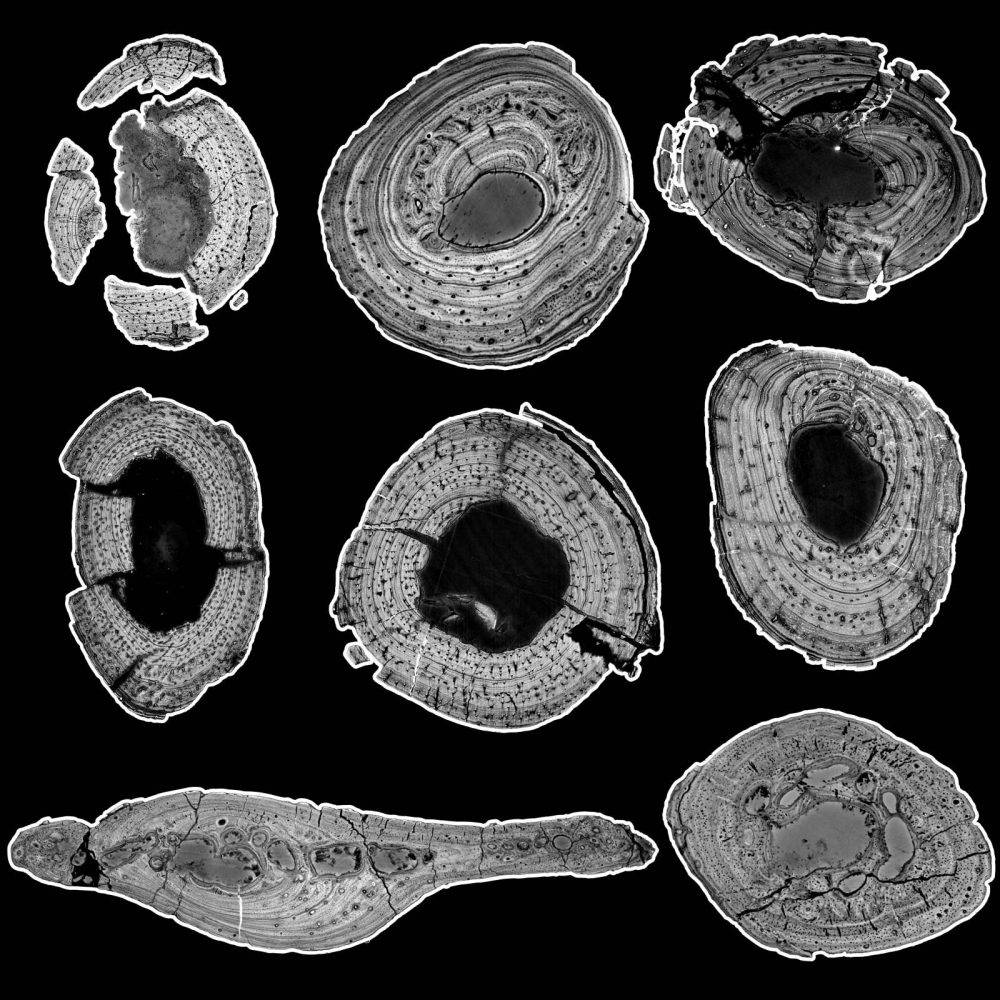 The fossilised bones of Jurassic-era crocodile found in South Africa.
This allowed them to examine the bone’s microscopic structures in extraordinary detail without damaging the rare fossils.
The experiment was conducted at the European Synchrotron Radiation Facility in Grenoble in France.
“This institution produces some of the most powerful X-rays in the world, allowing for high-quality imaging at high resolutions,” Weiss said.
“The method allowed us to study the inner bone structure without destroying the specimen, which is the classical osteo-histological method.”
South Africa is a scientific associate of the European Synchrotron Radiation Facility and the partnership enables local researchers and students to use this world-class technology at no cost to their institutions.
“Going through international security with priceless national heritage in a very conspicuous briefcase was a little nerve-wracking,” Weiss said. “However, seeing the specimen scanned on the airport security X-ray machine was exciting.”
On why it matters that Orthosuchus grew slowly, Weiss added: “Modern crocodiles are slow-growing reptiles, however, their ancestors were fast-growing.
“It’s important to understand why, how and when this transition from fast to slow growth occurred. This helps us learn what makes modern crocodiles the apex predators they are today and how they survived multiple mass extinctions.”
The team’s findings suggest that the evolutionary shift to slow growth may have begun earlier than previously thought, offering clues about how these ancient reptiles adapted to changing environments.
The scans show Orthosuchus’s bones were compact and thick-walled, traits typically seen in aquatic animals. But it lacked other features common to water-dwelling creatures, such as a flattened tail.
This suggests Orthosuchus might have had a semi-aquatic lifestyle, navigating between land and water.
Intriguingly, some of its bones bore characteristics often found in digging animals.
Today’s crocodiles dig burrows to escape extreme temperatures and it is possible that Orthosuchus did the same. However, without specialised adaptations, such as thick claws, the researchers stopped short of labelling it a true digger.
Weiss wants to continue investigating the growth patterns of early crocodilians. “This research will help us understand if growth strategies allowed specific groups of animals to survive mass extinctions, such as the End-Triassic Extinction.”