Analysts say that property owners will not be arbitrarily deprived of their rights under the new Expropriation Act
Jitters among property owners and investors of widespread or even blanket land grabs of private property without compensation under the Expropriation Act are unfounded, economists and political analysts say.
President Cyril Ramaphosa’s signing into law last week of the controversial legislation — which allows the state to expropriate land while paying “nil” compensation to private owners — has also probably already been factored into financial markets’ risk analysis for the country’s investment outlook.
Economists and political analysts also said this week that Ramaphosa took the strategic step to adopt the legislation to appease ANC leftists, knowing it is not easy to implement because the Constitution remains the vanguard of private property rights.
They added that he would possibly even welcome that it will be vehemently opposed by parties such as the Democratic Alliance (DA).
They were almost unanimous in their view that the law could not be abused in its current form although it could pave the way for future laws undermining property rights.
Economist Roelof Botha said most countries have similar laws to ensure the state can access land for development such as road infrastructure.
But the law still requires the state to negotiate a reasonable market-related price with landowners and only if they refuse to sell could it take steps to expropriate with nil compensation.
“They can’t just say this is in the public interest. We want to build a road, and now we’re going to expropriate, that’s not part of the law. It’s only in extraordinary circumstances that the ‘nil’ clause kicks in, and even then, there is still recourse to the Constitution. So quite frankly, it’s business as usual,” Botha said.
“No property developer in South Africa has anything to fear from this Act. This Act is merely an update of the 1975 Expropriation Act.”
Oscar van Heerden, a senior research fellow for African diplomacy and leadership at the University of Johannesburg, agreed that fears of blanket land grabs were a “red herring” as similar laws exist in most developed democracies including the United Kingdom, the United States, and France.
“There’s nothing extraordinary that South Africa has done in terms of this piece of legislation,” he said.
“It’s now been 30 years into our democracy and there have been no such attempts at all. In fact, there have been responsible interventions in terms of restitution of land. This is not the start of land grabs. There’s nothing to suggest that this government is going to act irresponsibly with regards to expropriation.”
Centre for Risk Analysis executive director Chris Hattingh said the new law provides for the expropriation of land at “nil” compensation dependent on “an open-ended list of conditions”.
Section 12 (3) of the Act states that “it may be just and equitable for nil compensation to be paid where land is expropriated in the public interest, having regard to all relevant circumstances, including but not limited to” the following conditions:
- Where land is not being used and the owner’s main purpose is not to develop the land or use it to generate income, but to benefit from appreciation of its market value;
- Where an organ of state holds land that it is not using and is not reasonably likely to require the land for its future activities and it acquired the land for no consideration;
- Where an owner has abandoned the land by failing to exercise control over it despite being reasonably capable of doing so; and
- Where the market value of the land is equivalent to, or less than, the present value of direct state investment or subsidy in the acquisition and beneficial capital improvement of the land.
How these conditions may be interpreted and what other considerations might apply is unclear, Hattingh said.
“Concerns remain about the Act’s constitutionality. In the event of a dispute relating to the amount of compensation payable, the Constitution requires that expropriation cannot proceed without a prior court order deciding the amount, timing, and manner of payment of compensation. As it stands, the Act would allow an expropriation to proceed without such an order,” he said.
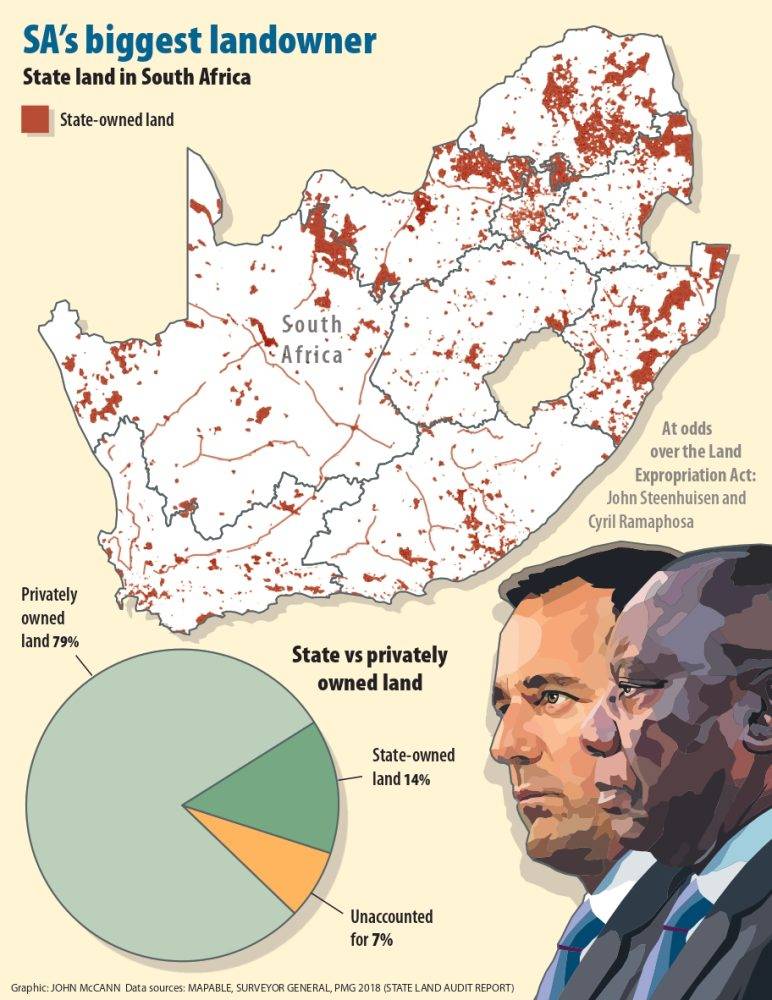 (Graphic: John McCann/M&G)
The law empowers state institutions — which are often corrupt and dysfunctional — to carry out expropriations, and this holds “significant risks” for business.
“The uncertainty that may arise from this is likely to exercise further dampening on South Africa’s investment attractiveness,” Hattingh warned.
He said the Act’s “unusually narrow” definition of expropriation had been drawn from a 2013 constitutional court judgment (Agri South Africa v Minister for Minerals and Energy), which — in a deviation from international norms — did not recognise expropriation as the mere deprivation of property but required that another party had to take ownership of it.
“Absent the latter condition, no expropriation had legally taken place. Applying this trick would allow a mass custodial taking of land — as in the case of mineral resources, in which case the state took control of them on behalf of South Africa’s people — to proceed with no obligation for compensation. The prospect of a custodial taking of all land without payment has been repeatedly raised, including by some in the government,” Hattingh said.
“The Expropriation Act does not itself attempt to vest the custodianship of all or certain land in the state. It does, however, prepare the way for this. With the new definition in place, the government could next pass another statute which expressly vests the custodianship of all or certain land in the state.”
He said the state could take away property for nil compensation under the law but it cannot do so in a “blanket” move.
“Each disputed case will trigger court action,” he said.
In addition, when a property subject to a mortgage is expropriated, the mortgage automatically comes to an end when ownership passes to the state. But the underlying loan is not extinguished and must be repaid.
“The compensation due to the owner is likely to be paid to the bank, to help pay off the loan. If the owner defaults on the outstanding amount, this could affect the sufficiency of land as collateral for bank loans. If large numbers of owners default on their underlying loans in these circumstances, this could trigger a banking crisis — as the Banking Association of South Africa has repeatedly warned the government,” Hattingh said.
The ANC has more to gain from public perception than reality, because the Act devotes more attention to how compensation can be paid than to “nil” compensation, said Ongama Mtimka, the acting director of the Raymond Mhlaba Centre for Governance and Leadership at Nelson Mandela University.
“The Act is located within the broader property regime in South Africa, with all the rights that are in the Constitution cut and pasted into this Act. It also states protections for people who do not have title deeds, but have rights of use.
“So, in a sense, the outrage about this Act is completely unfounded and misplaced, because the circumstances for expropriation without compensation are strictly defined.”
He added that the principles outlined in the Act make it “impossible for a government to act arbitrarily”.
But political analyst Ralph Mathekga said investors are “jittery” as they fear it could deteriorate the economic climate and suggested that Ramaphosa is treading the balance between mollifying ANC hardliners and maintaining control of the party.
“I don’t think he is signing those Bills wholeheartedly … he is hoping to be opposed and that there will be pushback and he will land somewhere, not exactly, where the hardliners expect him to land,” he said.
“Ramaphosa has got his way of doing things … he knows there are hardliners within the ANC who want this policy. He’s fighting an internal battle. If he is seen relenting and not signing these controversial Bills associated with the hardliners, that opens a gap for him to be attacked.
“The president is worried that if the ANC is not being seen at least to be doing lip service to populist policies to appeal to the masses, there’s the problem of MK (uMkhonto weSizwe party), there’s a problem of EFF (Economic Freedom Fighters) and there is also the problem internally.”
Despite all this, he said, investors still view South Africa as less risky than other unpredictable emerging markets.
“But they don’t say that out loud. It is almost like this thing is already written in the risk metrics of when you’re looking at South Africa. But how far are we going to push it, and how far can we really go in sending these mixed messages?”
DA leader John Steenhuisen last Saturday lambasted Ramaphosa’s decision to sign the new law, and suggested it may prompt his party to reconsider its position in the coalition government formed after the ANC lost its majority in general elections last May.
“If the DA actually gets so angry and they pull out of this thing, the ANC knows that they are going directly into a credibility crisis,” Mathekga said.