Afrikaner refugees from South Africa holding American flags arrive, Monday, May 12, 2025, at Dulles International Airport in Dulles, Va. (AP Photo/Julia Demaree Nikhinson)
The group of Afrikaners who arrived in the United States this week after being granted refugee status by the Trump administration for allegedly being victims of racial discrimination may be fish out of water in their new home.
The 49 people who arrived in the US on Monday might not have a full understanding of race and class relations in their host country, said Lisa Otto, an associate professor of African diplomacy and foreign policy at the University of Johannesburg.
“I honestly think that they’re going to get a little bit of a surprise when they get that side,” she said.
“I just don’t know what it is that they were expecting. Is it a case of us thinking that America is the land of milk and honey; a place we see on TV where it’s the land of opportunity and where, for argument’s sake, it’s still okay to be a white person there?
“I don’t know whether they have an appreciation of what the race and class dynamics are like in the US and whether they feel that their political ideology is going to be sufficient to enable them to assimilate.”
US media outlets have reported about a guidance memo purportedly handed to the new arrivals which stated, among others, that the South Africans are “expected to support yourself quickly in finding work”.
“Adults are expected to accept entry-level employment in fields like warehousing, manufacturing and customer service. You can work toward higher-level employment over time … Any credentials from your home country may not automatically transfer to the United States,” it said.
Otto recalled how her daughter was delivered by a Syrian refugee doctor in the United Kingdom, who had to retrain because his qualifications from home were not accepted there.
“You hear that kind of story over and over again and it’s not just a refugee story; it’s a migrant story.” A person may, for example, be “very proficient in something [but] you’re not going to necessarily get that job. You might be a factory worker; you might be a farm labourer.”
She wondered whether the Afrikaners had considered the possibility that the lives they might find themselves living in the US “might be a mismatch with how they identify themselves” in South Africa.
“There’s a linguistic barrier … I think the assumption is that if they go to Texas or somewhere in the South, that they’ll find a home. They are still migrants and they’re going to be identifiable as different immediately and do they have faith that American society is going to embrace them because they’re a white migrant rather than a brown one, for instance?”
Welcoming the new arrivals on Monday, US deputy secretary of state Chris Landau said they had detailed “harrowing” stories of violence in South Africa that were “not redressed by the authorities under the unjust application of the law”.
President Donald Trump has reiterated that there was a “genocide” of Afrikaner farmers taking place.
He said: “Farmers are being killed. They happen to be white. But whether they’re white or black makes no difference to me. But white farmers are being brutally killed and their land is being confiscated in South Africa.”
According to Kallie Kriel, of Afrikaner rights lobby group AfriForum, the “refugee situation” is a serious indictment of the ANC-led government. “It is this government that refused to condemn calls for violence against Afrikaners with slogans such as ‘Kill the Boer’. It’s this government that signed the Expropriation Act that allows for expropriation without compensation. It’s also this government that is implementing draconic race laws that are targeting minority communities.”
Within this context, Kriel said AfriForum and the Solidarity Movement would “continue to build a future for Afrikaners” in South Africa with self-reliant cultural infrastructure, but also escalating the pressure on the government and “that of course includes international pressure”.
Otto countered that the refugee argument has complete disregard for the proper meaning of the word “refugee” and the systems set up to help such people.
“It’s completely unheard of for people to go look for refugees and this is not really the spirit with which the system was created,” she said.
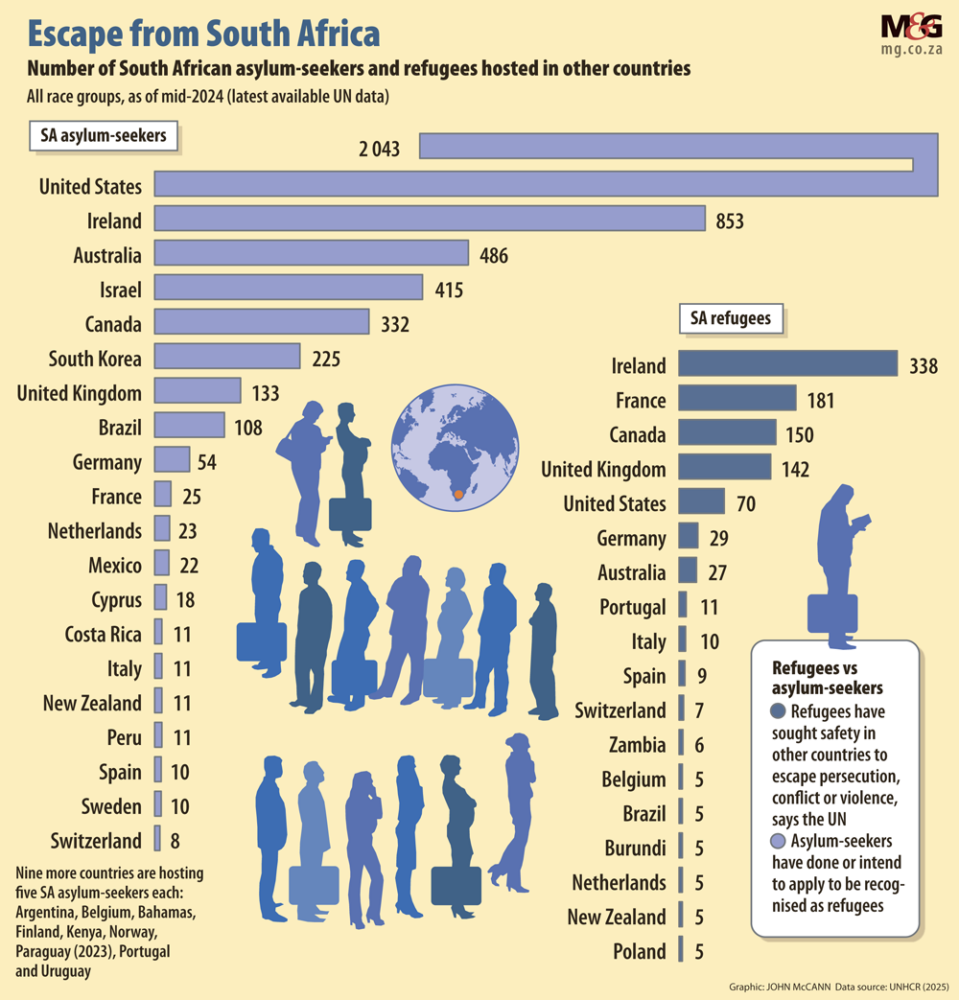
“The international legal framework … is really to protect select groups of people who fall victim to various different types of persecution, including political persecution. And I just don’t see that there is any basis in fact to argue that this group of people qualify as refugees. The way this process would usually work is you’ve got the UNHCR [United Nations Refugee Agency] that would usually assist with these processes.”
 (Graphic: John McCann/M&G)
For Otto, it underscores the notion that is been advanced that Trump is using the Afrikaners as pawns to serve a domestic political agenda, while there could be some credence to the US wanting to punish South Africa for some of its foreign policy decisions.
Trump’s move has exposed numerous contradictions, she added.
“The refugee programme is being halted [in the US] and yet we’re here now letting in a group of people, who as we’ve agreed, there’s no basis in fact to allow them into any refugee programme.”
Referencing Landau’s comments about the difficulties the Afrikaners faced in South Africa and how the Trump administration did not want lives to be lost, she asked: “What about Palestine? By which measure is what’s happening there not a genocide but what’s happening in South Africa is a genocide? That’s a massive contradiction in itself.”
Local crime statistics showed that all South Africans, regardless of race, are victims of crime. But predominantly, consistent with the demographics of the country, black people face more crime, Otto noted.
Solly Moeng, a brand reputation specialist, argued that the Afrikaner refugee controversy should allow for greater introspection among South Africans about national social cohesion.
“When you see a 10-year-old white child who hears groups of people singing ‘Kill the Boer, Kill the Farmer’ and the courts say it’s okay, it’s not,” he said.
The constitutional court in March dismissed an application by AfriForum for leave to appeal previous rulings that Economic Freedom Fighters leader Julius Malema’s public chanting of the anti-apartheid slogan did not amount to hate speech.
“During apartheid, the courts sent a lot of people to the gallows to be hanged who were innocent and the courts are doing the same thing today where they sanction the singing of killing people,” Moeng said.
“A child who is 10 years old who identifies as an Afrikaner and he hears people singing that song, what do we expect that child to think? People are singing that we are going to kill the people who look like you. It’s absolute nonsense.”
After the March court ruling, the ANC said it believed there is no longer a justification for chanting the slogan, but added that it would not advocate for watering it down to “kiss the boer” either.
This week, Moeng said the ANC — which solely governed South Africa from the end of apartheid in 1994 until it lost its outright parliament majority last year, forcing it to form a national coalition government — has not succeeded, and “has not even tried” to keep the nation together.
“You can’t lead South Africa if you don’t accept as a basic principle that it is a multicultural, multi-ethnic and multiracial country.
“Right now, because of this AfriForum, Solidarity thing, we are all being bludgeoned into misplaced emotional patriotism but we are actually defending the ANC,” he said.
In an interview with retired US Army officer Colonel Chris Wyatt, shortly before her departure to the US, Afrikaner “refugee” Thea van Straten said she was leaving South Africa after surviving four attacks on her farm in the Free State, one which occurred while she was applying for a spot in the asylum programme.
She added that 31 years after apartheid, the Afrikaner community continues to be blamed for the sins of the government of that time.
“We are facing backlash from society for the sins of our predecessors. I mean, [apartheid] ended 31 years ago, how long should we carry on like this?” Van Straten said.
She added that the signing of the Expropriation Act into law confirmed that the country had not moved on from apartheid, adding that the Afrikaner community had not been consulted.
Political analyst and sociologist Tessa Dooms laid the blame for the Afrikaners move at AfriForum’s feet.
“AfriForum and Solidarity must take responsibility for this. They must be proud of the implications this move has on the country. They are responsible for the racial divide this has caused. They must congratulate themselves while they watch [their] constituency leave,” she said.
Otto, meanwhile, cited Trump’s refugee resettlement plan for Afrikaners and South Africa potentially being removed from the trade agreement Agoa. “If it is trying to get us to comply more with what would be America’s preferences for our foreign policy positions, well, they’re not really giving us an example of what it’s like to be America’s friend.
“Look at the transatlantic relationship, [at] what’s happening with Europe. Trump gets on social media or says to the media about how Europe is ugly and nasty, all these really horrible things, and is threatening leaving Nato and obviously there’s the tariffs,” she said.
On Monday, the Episcopal Migration Ministries, which has historic ties with the Anglican Church of Southern Africa, announced it would no longer work with the US federal government on refugees after it was asked to help settle some of the Afrikaners. It cited its commitment to racial justice and reconciliation.
“It has been painful to watch one group of refugees, selected in a highly unusual manner, receive preferential treatment over many others who have been waiting in refugee camps or dangerous conditions for years,” Sean Rowe, the presiding Bishop of the Episcopal Church, wrote in a letter.
Senator Jeanne Shaheen, the most senior member of the Democratic Party on the US senate foreign relations committee, said it is “baffling” that the Trump administration is admitting Afrikaners for resettlement while continuing an indefinite suspension for thousands of legitimate asylum seekers who have fled persecution in their countries, with, their lives often at risk.
“Last year, the UN found no South Africans were eligible for refugee status. The decision by this administration to put one group at the front of the line is clearly politically motivated and an effort to rewrite history,” Shaheen said.
Neil Diamond, the chief executive of the South African Chamber of Commerce in the US, said it had handed over all information and correspondence “relating to individuals who approached us regarding the Afrikaner refugee issue” to the US embassy in Pretoria on 18 March.
“We have since exited this space entirely and, given the highly polarised nature of the subject, we have taken the decision not to provide further media commentary on this matter,” Diamond said.
“[Our] core mandate is economic diplomacy, and at a time of increasing global trade challenges, we are dedicating our full attention and capacity to strengthening bilateral economic relations between South Africa and the United States.”
Werner Human, the operational head of the Solidarity Movement, said the 49 Afrikaners had been an “asset” to the country.
“[It’s a] sad and tragic moment … They saw themselves in a position where their circumstances have necessitated them to look for refuge elsewhere.”
But Human said he was confident that only a small percentage of Afrikaners would go this route.
“Firstly, when the media reports broke about 70 000, 80 000 or so people, it was in a way conveyed as people who had applied to leave the country while it was more accurately people that had inquired about this new possibility,” he said.
“Secondly, it is not that everyone that follows that process succeeds. It’s not an open gate. There are very specific circumstances and situations that are considered.
“We see our task … to help create circumstances in this country for people to remain here. That is why we have built educational institutions from the side of technical education to higher education. We are also now seeing the possibility of building schools.
“People leave the country when they feel there’s no future anymore for their children but if our educational institutions can succeed, it means we can have a future for our children if there’s still quality education left.”
Otto conceded that South Africa has a lot of problems, particularly around race relations.
“But I think we’re also united in thinking that this way that they’ve [the Afrikaners] chosen to go is offensive, using this false concept of genocide as a platform for them to leave and presumably build a nice and shiny life in America. I think they’re going to struggle if they come back.”
Other South Africans emigrate, for “being gatvol” about poor service delivery and who find a job in Australia, for example. “I don’t think we would view it in the same way, as: ‘You know what, it’s genocide and I’m out.’”