The national carrier SAA emerged from three years under business rescue in April last year, thanks to a R10.4 billion bailout. However, it is still grappling with the effects of a turbulent history marked by financial distress, operational problems and allegations of mismanagement. (Delwyn Verasamy/M&G)
South Africa’s airlines are struggling to recover from the devastation wrought by the Covid-19 pandemic amid a weak economy, high fuel costs and capital shortages, putting the sector at risk of becoming “obsolete”.
The national carrier SAA emerged from three years under business rescue in April last year, thanks to a R10.4 billion bailout. However, it is still grappling with the effects of a turbulent history marked by financial distress, operational problems and allegations of mismanagement and corruption under the helm of the late former board chair, Dudu Myeni, who was declared a “delinquent director” in 2020.
A report from the auditor general last year showed that SAA’s irregular expenditure was at R22 billion in 2017-18 and had doubled by 2022 to R44.5 billion. Fruitless and wasteful expenditure increased from R24.78 million to R207.3 million over the four-year period of the audit.
Since coming out of business rescue, the carrier has tried to restore operational credibility while navigating uncertainty following the collapse of the Takatso consortium deal in March last year, SAA group chief executive John Lamola told the Mail & Guardian.
“These weren’t missteps, but rather strategic growing pains, as we repositioned SAA for long-term sustainability,” he said.
The deal, which was shrouded in secrecy, would have seen Takatso purchase a 51% stake in the airline for just R51, implying a R100 evaluation, with the condition that it would invest in its development.
SAA reported its first profit in more than a decade in the 2022-23 financial year. Net profit was at R252 million, while group revenue rose to R5.7 billion from R2 billion. This was the first time the group had achieved “a positive bottom line since 2012, which was achieved with only six to eight aircraft”.
During the 2023-24 financial year, the airline reported a total income of R7 billion, up 23% from the previous year. However, the group reported a net loss of R354 million, compared with a R210 million profit in the prior year.
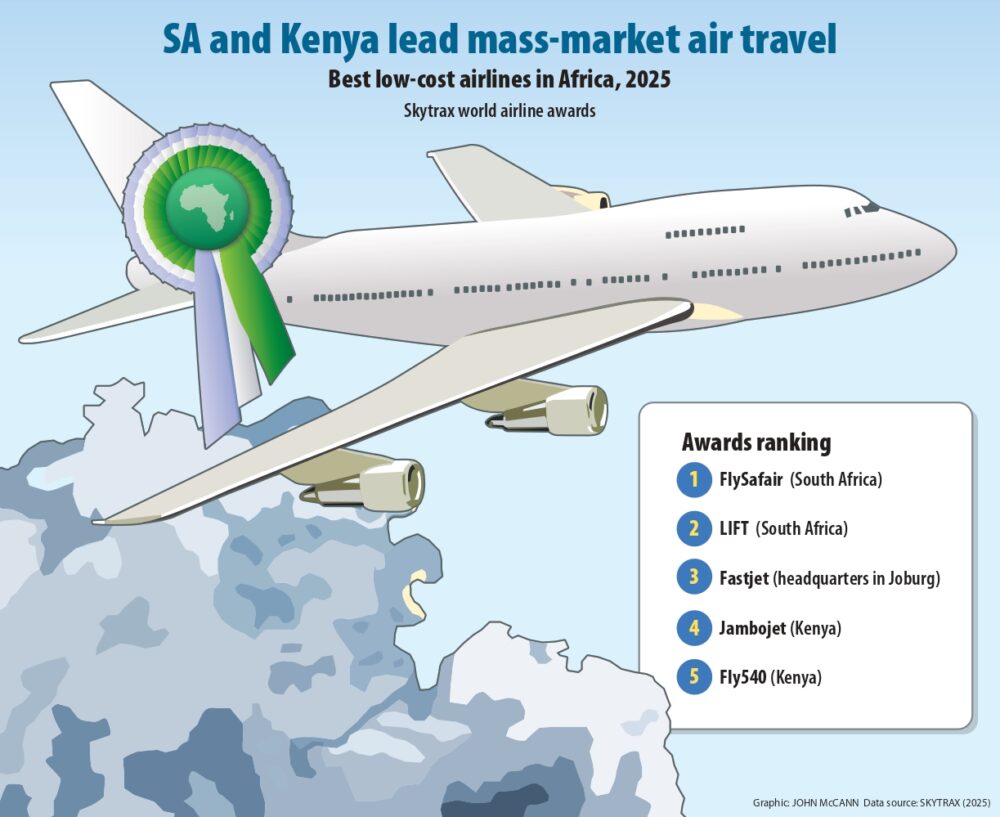 (Graphic: John McCann/M&G)
The airline said its losses could be attributed to “exogenous factors”.
These included the effects of the Ukraine-Russia conflict, which had pushed jet fuel costs from R1.3 billion to R1.9 billion over the year; a global shortage of aircraft, which drove leasing costs up by over 30% in 2023, and delays in the delivery of budgeted aircraft, which dragged down the revenue and earnings.
The latter declined from a positive R436 million in the prior year to a negative R90 million, the group said last month.
“What we have experienced is a modest decline in profits, primarily driven by global externalities such as elevated fuel prices, exchange rate pressures and delayed aircraft deliveries,” Lamola said.
“In a global aviation sector still in recovery, very little is entirely avoidable. What matters more is how we’ve responded — through tighter cost discipline, enhanced route-level profitability modelling and a laser focus on building a commercially resilient network.”
Lamola said he was confident about the carrier’s turnaround, saying it had expanded its fleet from six aircraft to 20, serving 17 destinations across 12 countries, including new intercontinental routes to São Paulo and Perth. SAA had also announced a new route from Cape Town to Mauritius this year.
But the aviation industry as a whole is vulnerable to a shortage of capital, making acquiring new aircraft unaffordable, experts said.
“Increasingly, the South Africa airline industry is slipping into obsolescence,” industry analyst Guy Leitch said, adding that South African regulators needed to intervene.
“SAA has its own problems … and that is recovering ground lost during the Covid-19 pandemic and the business rescue process. I am not confident that it will be able to ever again compete on the key routes, such as Johannesburg, London, New York and even Europe.
“One of the key problems SAA faces is that it feeds its routes from the south, and thus has a very limited market, whereas the European-based airlines feed their routes to South Africa from the north and have a much bigger natural feed into their routes.”
The airline needs access to capital to purchase competitive new aircraft with, for example, better fuel economy and in-flight entertainment, but it would take at least five years given the current backlog of new aircraft deliveries, Leitch said. “They are overpaying for old aircrafts. Further, I don’t believe they will be able to make up lost ground on traditional routes — such as Heathrow Airport [London] or John F Kennedy International Airport [New York] — without heavily discounting seats [which equates to] further losses.”
SAA also owns Mango Airlines, SAA Technical and Air Chefs. Mango was placed under business rescue in 2021 and has remained grounded ever since.
Mango was in the “final stages of concluding a sale and purchase of shares transaction with its selected investor, with the aim of relaunching the airline”, SAA said in June.
Analysts however remain doubtful.
“I don’t believe Mango will relaunch — I think this is funny accounting,” Leitch said.
More broadly, the challenges facing airlines stem from structural problems — including high fuel prices, limited infrastructure and a financially strained consumer base.
“While Comair and Mango did fold during this period, their departures are actually masks for the bigger issues behind the scenes, and it’s interesting to note that there are as many airline companies contesting the South African market as there were before,” said Kirby Gordon, the chief marketing officer at local carrier FlySafair.
“SAA (still in the market) operated both SAA and Mango and Comair (now replaced by new entrant Lift) operated both the British Airways and Kulula brands. What’s behind the market’s lack of recovery is two things: the cost to operate flights and the ability of people to afford flights,” Gordon told the M&G.
SAA has offered to assist FlySafair amid an ongoing strike by pilots represented by trade union Solidarity, which is now in its second week and has forced the airline to operate on a reduced schedule.
FlySafair rejected Solidarity’s demand for a 10.5% increase on base salaries, as well as additional flight pay and bonuses, saying the sum of all the demands would amount to more than a 20% increase in overall cost to the company — “an unsustainable escalation for any company”.
The airline said that it could only offer a 5.7% increase on base pay, which was 1.5% above inflation.
“This already substantial offer was made including other benefits — including a flight pay-based bonus — which brings the total increase to 11.29% on a cost to company basis,” it said in a statement.
“This offer was designed to balance the other 1 700 employees of the airline and the sustainability and resilience of the company with the demands of the pilots.”
At the centre of the dispute is the rostering system, which Solidarity says is to the detriment of the pilots’ well-being as it is unpredictable and does not allow them enough rest periods. They have demanded one weekend off a month.
The parties have been in negotiations under the guidance of the Commission for Conciliation, Mediation and Arbitration. The trade union said this week the airline needed to commit in writing to demands for better working hours for pilots.
“The company’s argument is that we are seeking operational control [on behalf of the pilots]. An agreement in which they have a say on shifts protects a basic right and is certainly not a takeover of operational control,” said Helgard Cronje, the general secretary of public industry at Solidarity.
“It rather serves as protection for an employee so that an employer’s powers are limited to its business interests and so that it does not control the employee’s life.”
By world standards FlySafair pilots are overworked and badly underpaid, Leitch said.
“There is an inherent conflict between pilots and management over pay and working conditions. I see this as a key battle which will determine the balance of power for the foreseeable future.
“I expect a compromise over the roster and pay from the airline – but they have been surprisingly unyielding,” he added.
“SAA has made a huge loss. It cannot afford to help FlySafair, yet it did, by flying A320s empty to Durban and then empty back so FlySafair could operate Durban and Cape Town. This would only be acceptable if FlySafair paid for those empty flights.”
Lamola responded that SAA’s intervention “has been limited in scope within a standard industry agreement between two airlines”.
While FlySafair says it is too early to quantify losses from the strike, it admits that it will leave a dent.
“The strike is an unfortunate stumbling block in our path now. It’s not something we would ever have planned for, and obviously would seek to avoid, but it is what it is and ultimately will form part of our story in the long run,” Gordon said.