Danger: Sanitation in South Africa, such as that found in Govan Mbeki is not adequate for people’s needs. At schools, children are exposed to the possibility of falling into an unsafe latrine or septic tank. Photo: Delwyn Verasamy
Last month, Avethandwa Kunene, 6, a Grade R learner at Umzila Primary School in Dannhauser, KwaZulu-Natal, drowned after falling into an underground septic tank at his school.
For Ferrial Adam, the executive director of WaterCAN, a water and sanitation civic activism nonprofit, the child’s death was yet another preventable tragedy caused by unsafe sanitation infrastructure.
“It makes no difference if a child dies in a pit latrine or a septic tank at school,” she said. “Both show the same truth: South Africa still does not have safe sanitation. An open septic tank is as deadly as a pit toilet — both are the result of neglect.”
She noted that the septic tank had not been properly cordoned off or secured. “These deaths are preventable, yet they keep happening. The government must act now to make sanitation safe and dignified for every child.”
KwaZulu-Natal basic education department spokesperson Muzi Mahlambi confirmed that Umzila Primary does not have pit toilets but rather septic tank ones.
“The child fell into the septic tank while playing with a tyre. The teacher, security and a community member tried to rescue him, but when paramedics arrived, he was declared deceased,” he said.
“No one sends the child to school to perish but everyone, when preparing the little soul in the morning, always expects him or her to come back. Our prayers are still with the family as we understand the pain that they are enduring.”
WaterCAN has long warned that inadequate sanitation in schools is a national crisis, with pit latrines, collapsing infrastructure and unsafe wastewater systems posing deadly risks.
“No child should lose their life because a school cannot provide safe sanitation,” Adam said. “Water is a human right and access to safe sanitation is dignity. How many more children must die before the government treats this with the urgency it deserves?”
The nonprofit has urged the basic education department to launch a new, independent national audit of water and sanitation in schools and to eradicate all unsafe toilets, not only those counted in outdated audits.
“Without accurate data, children’s lives will remain at risk,” she warned. “The tragic death of the young learner in Dannhauser is not the first. Unless urgent action is taken, it will not be the last.”
In April, Basic Education Minister Siviwe Gwarube conceded she had failed to meet her 31 March 2025 deadline to eradicate pit toilets identified under the government’s Sanitation Appropriate for Education (Safe) Initiative, which was launched in 2018 after a series of child deaths in pit latrines.
“The Safe Initiative was born out of tragedy,” Gwarube said. “We remember five-year-old Michael Komape, who drowned in a pit latrine in Limpopo, and Lumka Mkhethwa and Langalam Viki from the Eastern Cape. These were not just accidents — they were failures of the state.”
At its launch, the Safe Initiative identified 3 372 schools with dangerous pit toilets. “Our goal was clear: to ensure 100% eradication of the identified pit toilets backlog identified under the Safe Initiative,” the minister said at the time.
“We came very close, but we came 4% short. While we have come incredibly far, the fact remains that 141 of the schools identified under the Safe Initiative still have unsafe toilets.”
Yet in a parliamentary reply in March, Gwarube reported 590 schools still relied on pit latrines — 340 in the Eastern Cape, 170 in KwaZulu-Natal, 77 in Limpopo and three in Mpumalanga.
She said in 2018, the department had conducted an audit to determine how many pit toilets needed to be eradicated. “We must go further and deepen our efforts … We are working towards a new audit to ensure that any schools missed in the initial count are identified and included.”
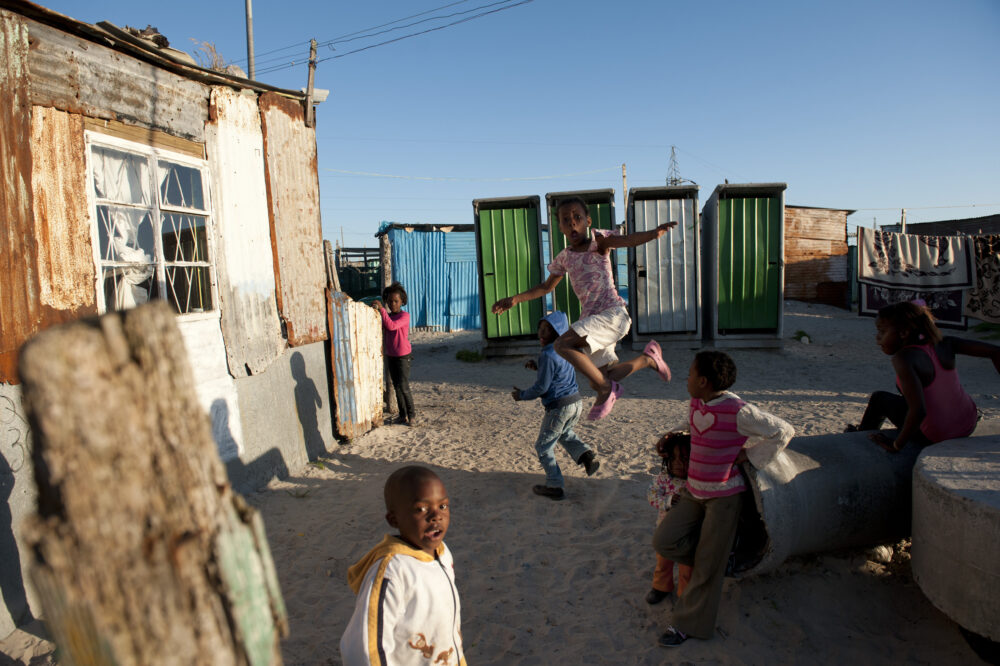 Failure: Communal toilets in Khayelitsha (above). Children are exposed to the potential danger of drowning in unsafe toilets at schools and where they live. Photo: David Harrison
Plain pit toilets were banned from schools by the Minimum Uniform Norms and Standards for Public School Infrastructure in 2013 and should have been removed and replaced by 2016, noted Shenilla Mohamed, the executive director of Amnesty International South Africa.
“The department of basic education has been promising since 2016 that it would eradicate all plain pit toilets from schools but each year it has broken this promise and shifted the goal posts, violating the human rights of thousands of learners,” Mohamed said.
She pointed out that the department’s target was not based on all schools but on those schools which formed part of its Safe Initiative, adding: “However, there are many schools still using pit toilets which have not been accounted for and lives have been lost.”
Amnesty has been calling on the department to provide clarity and be transparent about the actual number of schools still using pit toilets, including those not part of the Safe Initiative, and how it plans to eradicate those that are not part of this initiative with clear timelines.
Mohamed said Gwarube, while announcing that the government had again missed its own deadline to eradicate all pit toilets which were part of the Safe Initiative, had confirmed that the initiative did not include all schools with pit toilets. Her department was working towards a new audit to ensure that any schools missed in the initial count were identified.
“Had the true extent of pit toilets still in use been made transparent, children’s deaths in them might have been avoided.”
The use of plain pit toilets in schools violates a learner’s right to health, sanitation, education, dignity and, in some cases, life. She noted that the department last did an audit of pit toilets in 2018, and these schools formed part of the Safe Initiative.
The department has also recently taken on the responsibility for early childhood development (ECD) centres and needs to include these in its new audit.
“There needs to be a new audit, which the minister has said will be done. We now need to hold the minister accountable to that promise so that we ensure that not a single school or ECD centre is left with a pit toilet.”
She said Amnesty International SA has been basing its campaign on the numbers, information and promises made by the department.
Every year the department publishes an education facilities management report.
On 8 August, it published an updated education facilities management report, which gives updates on infrastructure in schools, including pit toilets.
“In this new report, the department is saying there are 448 schools with pit toilets remaining. This number is different from the 141 schools Minister Gwarube announced in April. The department of basic education needs to answer as to why this is. Has a new audit of schools been done already?”
“The right to quality education includes having a school where learners are safe to learn and have the adequate infrastructure and facilities to do so, but as our research has shown this is not the reality for many learners in the country.
“Many schools and the communities they serve continue to live with the consequences of the political and economic decisions made during the apartheid era, where people were segregated according to their skin colour, with schools serving white communities properly resourced.”
The result is that a child’s experience of education still very much depends on where they are born, how wealthy they are and the colour of their skin.
For Amnesty International SA, eradication means the complete removal and demolition of all pit toilets in all schools and ECD centres.
“Progress is not replacing the pit toilets with other unsafe structures.”
In February, the South African Human Rights Commission released a report exposing systemic failures in school sanitation in the Eastern Cape.
It focused on rural, under-resourced schools serving young children, after three preventable deaths since 2018: one child drowned in a traditional pit toilet at Luna Primary School in Bizana and two others in ventilated improved pit (VIP) latrines at Mcwangule Primary School and Little Champions Daycare.
The commission found that although VIP latrines are considered safer, they often fail to meet the needs of younger children. Many lacked essential safety features such as smaller pedestals, protective handles and reinforced structures, making them nearly as dangerous as pit toilets.
Despite government programmes such as Safe, 427 schools in the Eastern Cape still rely on traditional pit toilets, while thousands more have substandard VIP latrines. “This dual failure continues to put the lives and dignity of South Africa’s youngest learners at risk,” the report said.
School sanitation has long been acknowledged as a critical concern. “The legislative framework is clear, and the constitutional principles are trite: no child should be subjected to unsafe, undignified or inadequate sanitation facilities in their place of learning. Despite this clarity, children continue to die, and many more are exposed to daily risks due to unsafe sanitation.”
Ministerial spokesperson Lukhanyo Vangqa said that of the 3 372 schools identified in the Safe backlog, problems at 3 308 have now been eradicated. “We can therefore confirm that as of today 98% of the Safe Initiative backlog has been eradicated.”
He said Gwarube has publicly stated that the 2018 data for the Safe Initiative may not be complete and may not account for pit toilets that may still exist in some schools.
These are pit toilets that may have been dug after the 2018 audit or where some schools, which are not able to use newly-built toilets because of a lack of water reticulation by water authorities, revert to reopening old pit toilets.
“While we have made extraordinary progress in replacing pit toilets with appropriate sanitation facilities, we must acknowledge that the job is not done.
“The minister has indicated that a new audit may be necessary to ensure that any schools with pit toilets but which for some reason are not on the Safe Initiative are identified and included.”
This requires funding that is not readily available through the public fiscus. Vangqa said the department had to be resourceful, drawing on contributions of civil society and corporate and social partners.
This is “to ensure that we build an accurate database that is complete and that will enable us to ensure that every learner in this country can access safe and dignified sanitation facilities while they are at school”.
Building safe and hygienic toilets is only half the battle, he noted. “If we do not maintain them, we will return to square one in a few years. We have seen too many cases where new infrastructure deteriorates because of a lack of maintenance.”
As part of the department’s 2024 guidelines on infrastructure maintenance, schools must prioritise toilet upkeep. Maintenance budgets must be ring-fenced, in line with the 80/20 principle. This requires provincial education departments to spend 20% of their budgets on non-personnel items, such as school infrastructure development and maintenance.
District officials, school principals and school governing bodies need to be held accountable for ensuring that school facilities, including school sanitation facilities, are well-maintained and functional so that these facilities can remain safe and dignified spaces for learners, he added.