Good examples: In Midvaal, the library was teeming with locals who had access to free wifi and computers provided by the municipality. Photo: Delwyn Verasamy
ANC president Cyril Ramaphosa caused ructions within the party and in local government when he told councillors that the Democratic Alliance governs better, urging them to learn from the opposition.
Although he faced a backlash over his admission, which affirmed claims that the DA itself frequently makes, Ramaphosa might have had places such as Midvaal, south of Johannesburg, in mind when he addressed ANC councillors last month.
To test the truth of the assertion that where the DA governs, things work, the Mail & Guardian visited Midvaal and found a place pregnant with pockets of excellence — a far cry from everyday life in the ANC-run Emfuleni just next door.
Driving in Midvaal, long touted as one of the DA’s examples of good governance, was sheer pleasure. The small town clearly punches above its weight: clean, quiet, with roads properly marked and road signs clearly painted.
The R2.3 billion stolen from Tembisa Hospital during the Covid-19 pandemic is slightly more than the R2 billion Midvaal Municipality gets for the year to run its affairs. And it is money well-spent.
We saw people relaxing in a pristine park and enjoying free wifi under the trees with birds singing above them.
Walking around the municipal offices, everything looked clean, with grass being cut and no broken windows in sight. In the library, located metres from the offices, a big touch screen is mounted on the wall for users to search and locate the books they want, instead of having to walk from aisle to aisle.
The library was teeming with locals who had access to free wifi and computers provided by the municipality. Others were locked in a computer lab, being upskilled to make them more employable in the job market.
A few steps from the library is a public pool so well kept you would swear it was in a private resort. Around the corner is a fire station so well-maintained that even the trucks bought in the 80s are still in good condition.
Located at the station is a camera room with screens plugged into over 100 cameras placed all over the town, allowing the municipality to monitor who comes in and out of their town, making it easier to apprehend wrongdoers.
In the town centre we found newly built stalls for hawkers near the taxi ranks. According to municipality officials, the stalls will open in two weeks after water pipes are installed. The stalls have water sinks, sensor lights in the bathrooms, wifi and electricity, and will cost only R70 per month to rent.
A first-time visitor may think the first impression of Midvaal is too good to be true, and officials are hiding the ugly side of the town. But this is not the case — the story of Midvaal writes itself and needs no special effects.
We drove to a nearby township, Sicelo, where we saw no visual potholes and sewerage running in the streets, while the roads were well marked and maintained.
The public library or community centre here was even better than the one we saw in town.
It had the same screen to search for books, there were computers for the community and the same computer lab. There was also a studio where aspiring artists can book time to record music, free of charge. During our visit, four teenagers were recording their music.
A well maintained stadium field lies at the back of the community centre. The centre has a vegetable garden for pensioners, a gym for older residents and a playground for little children.
Still not 100% convinced that Midvaal was as good as we had been made to believe before our visit, we went to the local informal settlement, Kuvukiland, where we found that each shack had its own chemical toilet, its own water tap and electricity. To mitigate against power cuts, the municipality built its own R65 million power station to provide electricity to the township and the informal settlement.
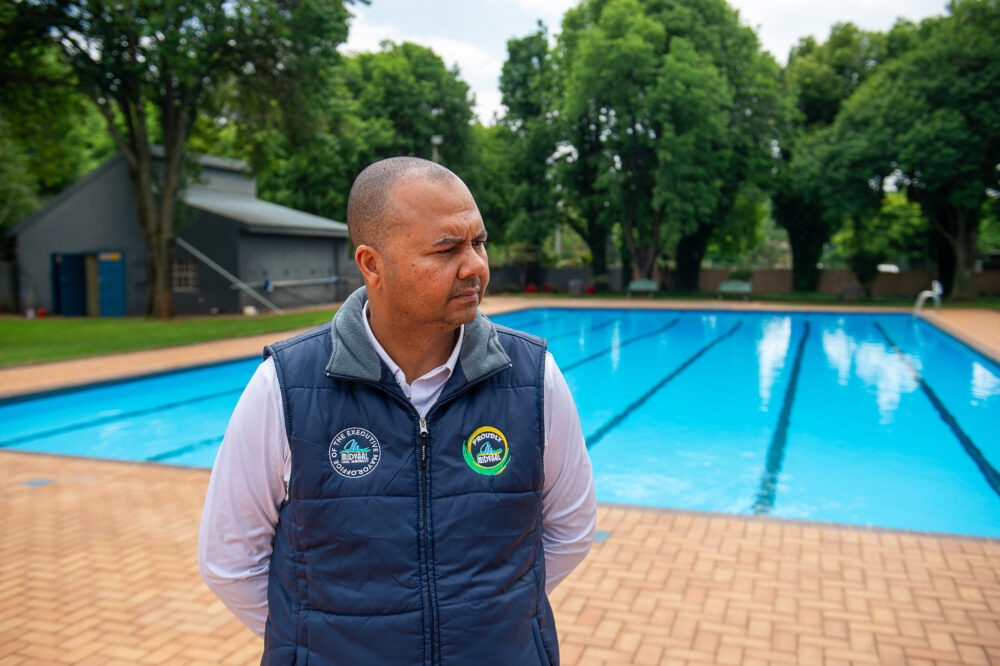 A few steps from the library is a public pool so well kept you would swear it was in a private resort. Photo: Delwyn Verasamy
Kuvikiland resident Tetiwe Mtjale told the M&G that there will always be problems in informal settlements, but she had no complaints of bad service delivery.
As she tackled her laundry, Mthale spoke about how the street lights worked, rubbish was collected on time and the chemical toilets were also emptied timeously.]
“Apart from jobs that we are always looking for, I can not fault the municipality for anything because they take care of us,” she said.
We found illegal dumping sites, but surprisingly this was in the township rather than the informal settlement. To deal with this, the municipality budgets between R2 million – R3 million. It also allocates a budget every year to replace at least 25 kilometres of water pipes and prevent leaks.
In the 2023/2024 financial year, Ratings Afrika graded Midvaal municipality as one of the most financially sustainable municipalities in South Africa. In February, the municipality said it had received a clean audit for 2023/2024, its 11th consecutive one. The Auditor General of South Africa found that the municipality spends enough to maintain the infrastructure to ensure sustainable and continuous service delivery. In April, Midvaal was was rated the most financially sustainable municipality for the third consecutive year by Ratings Afrika, tied with Mossel Bay which is only run by the DA. Only a handful of municipalities achieved a score card of 70 and Midvaal was the only municipality to do this in Gauteng.
According to Midvaal mayor Peter Teixaira, the reason the municipality is well run is political will and a culture of good governance installed over the 20 years the DA has been in power. Getting majority votes in Midvaal has enabled the DA to put together a 10-year masterplan.
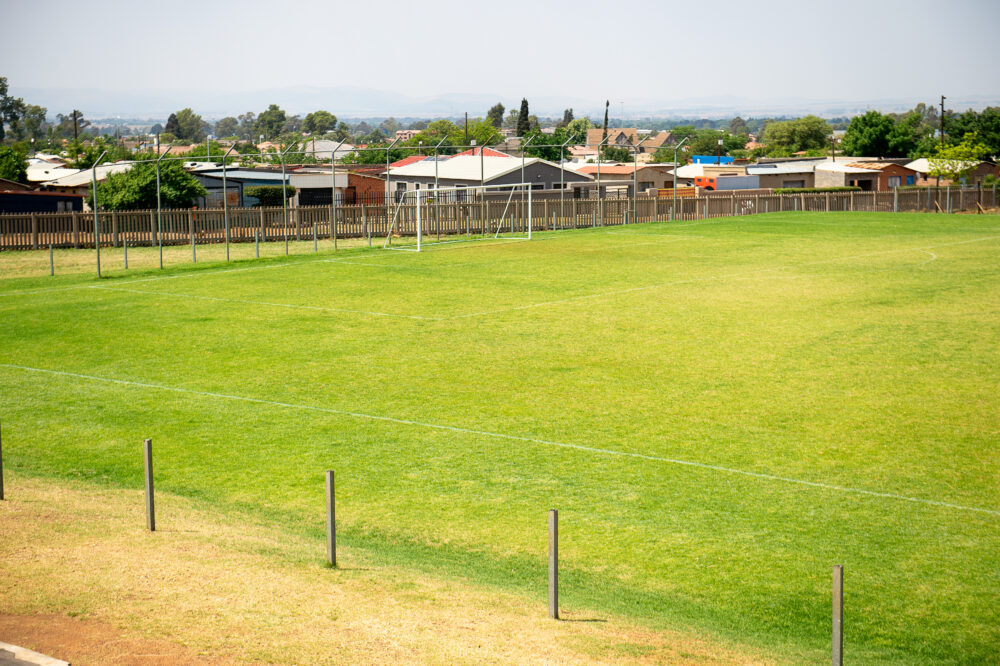 The soccer field in Midvaal is also well kept. Photo: Delwyn Verasamy
“Not only that, but it’s the commitment and dedication by the municipal employees. Midvaal employs only competent, suitably qualified individuals. We do not compromise on that,” Teixaira said.
“There are two administration legs — the political office as well as the administration office under the municipal manager — and there is a clear distinction between the two. We are very clear on legislation and the law; there’s also consequence management and zero tolerance to corruption.
“We have got a service charter which is part of our integrated development plan (and) has got strict turnaround times on service delivery matters or complaints. For example, if a resident reports a pothole at 3pm on Wednesday, there’s a certain turnaround time on the service charter, which will tell you within 24 hours that the pothole must have been repaired. For as long as it is not repaired, that complaint remains open.
“On a monthly basis, we receive full reports from the call centre, telling us which places are open and obviously, there are consequences and oversight for those that are open and we, the mayoral committee, hold the official responsible for unattended matters.”
“We also hold our service providers to account. For now, there’s a contract we are going to terminate because of poor performance as they are failing to provide the service. Even our irregular and wasteful expenditure — if you look at the municipalities, Midvaal is one of the lowest in the country because there’s accountability.”
Providing housing and sanitation is the responsibility of the provincial government but the municipality has partly intervened when the Gauteng government did not have funds to clean the chemical toilets, Texeira said. The municipality invests R5 million towards public safety given that the South African Police Service is under-resourced.
“Throughout Midvaal we have CCTV cameras which are monitored 24hrs but we also work with the community policing forum where we empower them with certain resources and we work well with the security companies in the area. The investments have really paid off,” Texeira said.
Comparisons are often drawn between Midvaal and the badly run Emfuleni municipality next door, but South African Local Government Association (Salga) president Bheke Stofile said this was unfair because the latter has a larger indigent population.
“The number of people who are able to pay is much lower than in the other municipality … You can’t compare Midvaal and Emfuleni because Midvaal, in terms of its income through households paying, will be more advantageous and better than Emfuleni,” Stofile said.
Political analyst Ntsikelelo Breakfast argued that in most of the areas where the DA touts its good governance, particularly in the Western Cape, it has done little to reduce the divide between rich and poor. “For example, in Cape Town you have a divide between the haves and have nots, there is always a side of the rich and always the side of the poor. In the IDP, the budget is channeled to suburbs, which then tells me that these people are not interested in transforming townships because there’s a small amount of money given to those people,” Breakfast said.